Tag: Graz

  • Writing about writing about heavy metal, part four: how do you explain (Styrian) heavy metal?

    Since my last blog post on the “Mexican experience” of writing about metal, quite some time has passed. Also in writing my book about the history of the Styrian heavy metal scene. At the moment, the focus of the writing is on the phase of the 1990s with its pluralisation tendencies and the 2000s with the beginning digitalisation of the scene.

    What is formative for this phase and therefore now also characterises the reflection on writing are both continuities and processes of change in the Styrian metalness identity in those years compared to the 1980s as the founding period. The scene consolidated and pluralised in the 1990s, finally becoming digital around 2000.

    In writing, this touches on a theoretical core question of metal studies, namely how heavy metal (in Styria) can be theoretically explained. For these decades, the history of the Styrian metal scene is about determining the interplay of law, morality and sound for the construction of the local metalness identity. There is the “pure” historiographical, the “pure” musicological and the “pure” legal view – or the possibility, which seems wiser to me, of thinking all three integrally and together.

    It therefore seems most appropriate to me at this stage of writing to see the history of metal in Styria since 1990 as a “hybrid” of musical, moral and legal aspects. All together make up the specific “soundness” of this scene. Metal can therefore perhaps be explained as the “trinity” of law, morality and sound – at least in this specific scene at this specific time.

  • Writing about writing about heavy metal, part three: the Mexican experience

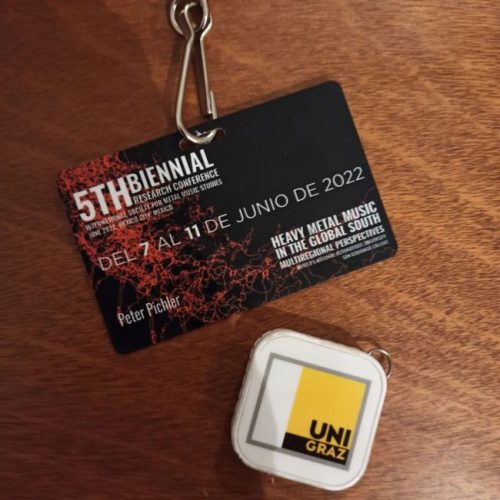
    Over a month ago now, I had the great pleasure of attending the fifth conference of the “International Society for Metal Music Studies” in Mexico City. This central event of Metal Studies usually takes place every two years, but in this case was held this year instead of last year due to the Corona pandemic. In this blogpost, I want to reflect on how this event – possibly – changed my own writing about metal, especially about the history of the Styrian metal scene, which I have been researching intensively for two and a half years now.

    The conference in Mexico City, which was attended by about seventy of the leading researchers in Metal Studies, was dedicated to the topic of “Heavy Metal in the Global South: Multiregional Perspectives”. I gave a presentation on my research project on the Styrian metal scene. My central thesis was that the theoretical worlds of “Global South Studies” could potentially help to better explain cultural transfers between metal scenes across the “Iron Curtain” before 1989/90. My talk can be seen online here.

    With the temporal distance of about a month that exists today for me to this conference, it becomes more and more clear to me that in a certain sense it has had an influence on my thinking and writing about metal. One could speak of a “Mexican experience” that has had an impact – possibly not only on me – on personal and individual Metal Studies discourse. How can this be and what kind of change is it? What is this “Mexican experience” supposed to be?

    Basically, there are two points to be made in the reflection. The first is a sociological one of scholarship, the second a thematic one in the choice of the research object. On the first level of this conference as a collective academic experience of the participating researchers, it is hardly surprising that such a major event has an influence on the personal metal paradigm. At this conference, the latest findings in the field were presented and discussed, renegotiating the way scholarship writes and talks about metal. It is compellingly logical at this level  that paradigmatic shifts manifested here individually and collectively.

    The second point is then particularly interesting – and I think also particularly transformatively effective. In Mexico City, the “southern” perspective on metal and Metal Studies was in the foreground. For me, as a scholar from the “global north,” the themes and the values and notions of norms that were linked to the study of metal at this event made a crucial thematic aspect much clearer. It is always dangerous to speak of historical tendencies, as they invite stereotyping and essentialization of complex historical processes.

    If one nevertheless attempts such a historiographical trend survey, it can be summed up as follows: in the “global north” metal has already become much more commodified, an expression of northern affluence saturation. Here, metal is only “dangerous” or profoundly socially transformative in exceptional cases. In the “south,” on the other hand – and this was the “Mexican experience” that for me still burned itself in much more strongly than before – metal and Metal Studies are still inextricably linked to the struggle for social equality, decolonization, and protest against injustice. Here metal is even more socially transformative.

    For my own writing about metal, this Mexican experience is extremely enriching and important. For the remaining stages of my book on the Styrian metal scene since 1980, which I am currently working on, it follows that I should look in particular at those historical times and spaces where metal had a liberalizing and socially transformative effect in this sense. For example, in the confrontation with still existing catholic-conservative traditions in Graz in the early 1980s, when the scene was founded, or in the fight against right-wing extremist and neo-Nazi tendencies in the 1990s. The Mexican experience is a call to write about metal again more strongly also as scientific-cultural empowerment, enlightenment in the most original sense.

  • Writing about writing about heavy metal, part two: theories and methods

    In the weeks since my last blog post, the central work in my project on the history of the Styrian metal scene has continued to be writing down the book resulting from the project research. During this period, a first draft of the chapter on the “foundations” of the narrative that will be unfolded in this book has been written down.

    These “foundations” concern the theories and methods used to construct the narrative, as well as the type of data from historical sources that were evaluated. Writing on this has been both instructive and challenging. In this blog post, I want to share some reflections on writing about theories and methods in metal studies.

    Theories and methods

    As is customary in scholarly books, my narrative opens with an overview of the state of research as well as the theories and methods incorporated into the presentation. In metal studies, there is (still) no consensus on how to write a history of a scene. There are very different scene, genre, and music concepts, as well as a wide range of methods that researchers can use.

    For writers in the field, this is both a curse and a blessing. On the one hand, it allows for innovative and original work. On the other hand, as a writer you are automatically caught between all the theoretical and methodological fronts. Plus, as far as genuinely historiographical work in the field is concerned, there are only a few points of reference.

    Relying on the familiar…

    Reflecting on the writing phase to date on these theoretical and methodological foundations, two aspects seem crucial to me. First, it seems to have proved successful for me, as far as the selection of theories and methods is concerned, to rely on historiographic approaches that are established and have been successfully applied many times. As specifically historiographical methods, oral history and cultural-historical discourse analysis also proved to be profitable perspectives for researching the Styrian scene since 1980.

    …and going new ways

    Secondly, however, there was then the necessity – I am dealing with metal, a musical culture – to also include the musical language itself. This meant including in the writing, in addition to theories and methods that were familiar to me, musicological approaches that were new to me. The experienced musicologist Charalampos Efthymiou had undertaken the analyses of relevant pieces of music for my project.

    For this stage of writing, it turned out to be fundamental to consciously take a “naive” perspective on the subject again. In particular, the theoretical and methodological approaches, which were unfamiliar to me, brought new and exciting insights. The new ways paid off!

    To summarize the writing experiences of the past few weeks on the topics of theories and methods: a balanced mix of conservative-familiar and innovative-bold personal writing paths seems promising to me in metal studies.

  • Writing about writing about heavy metal

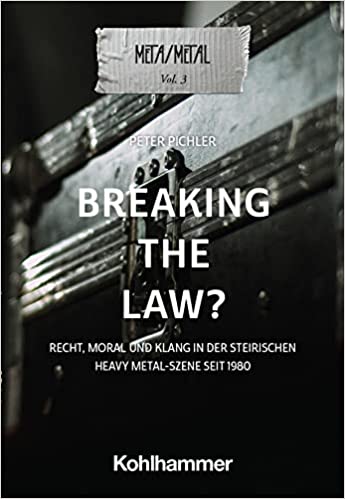
    The past year in my project on the history of the law myth in the Styrian metal scene was dedicated to empirical research. Discourse-analytical, oral-history and musicological data on the history of this scene was collected.This phase is now over and the third and last year of the project, which just started, is dedicated to writing up the results in a book.

    I have just started writing this book. This also changes the function of the posts in my blog. Whereas previously they had the function of documenting the project, its genesis, and then the empirical research, now they are about reflexively accompanying the writing process. It is about writing about writing; more precisely, it is about writing about writing about heavy metal.

    Such a reflection of one’s own academic writing activity on the meta-level is nothing new. Pierre Bourdieu already held a famous leçon sur la leçon, and history as an academic discipline in particular is increasingly engaged in research on such writing. ((See Pierre Bourdieu, Leçon sur la leçon, Paris: Les Éditions de Minuit, 1982; Wolfgang Schmale, Schreib-Guide Geschichte, Vienna et al.: Böhlau, 2006.)) The new book series Meta/Metal: Exploring the Complexities of Metal Cultures will also make a contribution in this regard of the meta-level of Metal Studies.

    I don’t yet know exactly where this writing journey will lead. But it’s clear to me that I don’t think much of the famous quote “writing about music is like dancing to architecture”. I am much more interested in looking for discursive points of contact for reflecting on the radiations of this subculture – also the radiations into the universities of Austria and the world.

  • “The end complete?”: finishing the empirical phase

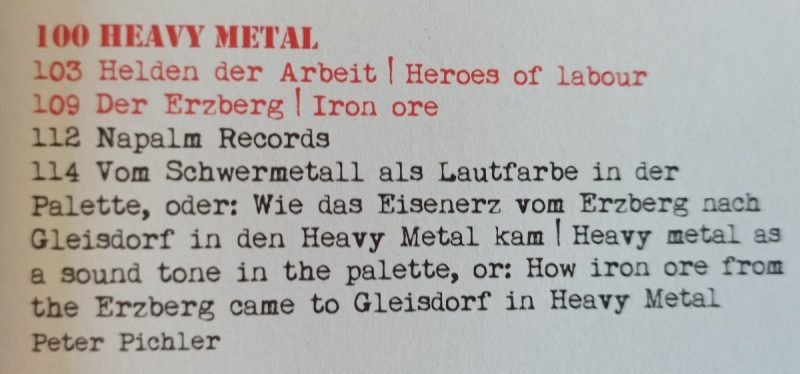
    The picture above shows part of the table of contents of the catalogue for the exposition “Palette” by the Austrian artists Helmut and Johanna Kandl. I contributed an article to the catalogue. ((Peter Pichler, Vom Schwermetall als Lautfarbe in der Palette, oder: Wie das Eisenerz vom Erzberg nach Gleisdorf in den Heavy Metal kam, in: Kunsthaus Graz/Landesgalerie Niederösterreich, eds., Helmut und Johanna Kandl: Material + Archive, Wien: Verlag für moderne Kunst,  2021, 114-120.)) The publication of this article and the opening of the exhibition with a section on heavy metal mark in a way the end of the empirical phase in my research project.

    I spent the last year empirically researching the local heavy metal scene in Graz and Styria. Two research methods were the focus: oral history and semiotic discourse analysis. The Covid19 pandemic did not make conducting the research any easier, but I think the “hunt for data” was successful. I have a rich body of oral history data and cultural artifacts from all four decades of the scene’s history. Those artefacts will be analyzed as historical sources. Musicological research from the first year of the project is an important component of the scholarly examination of this scene. A first article about our results can be read online.

    In these weeks of completing the empirical phase, it finally struck me the fundamental extent to which the specific values, individual rules and local music of this scene form one integral cultural fabric. In order to understand this cultural history, it is necessary to analyze it at the intersection of morals, attitudes towards law and the musical language of metal, that is, to explore what I call the local norm-related sonic knowledge. This perspective on the junctures of texts, images, practices and sounds will be the focus of the book I will begin writing in early 2022.

  • “Aren’t you the guy doing this metal studies interview stuff?”: On distance and self-reflection

    In my recent post, I wrote about oral history as a the method of choice to decode the Styrian metal scene’s emerging collective memory. This scene memory depends on the the scene’s shared attitude towards law. Since then, my research has progressed. Another series of interviews was conducted, the discourse analysis has been continued.

    Still, I have the feeling the empirical research is progressing well. The last third of the field research period has begun. In this post, I do not want to go into details about the data collected (this will happen in later posts). Rather, I want to focus on one issue, which – once more – has proven to be crucial: the question of closeness and distance in metal studies.

    Prior to my research, I was a member of this local heavy metal community. I knew scene members and attended concerts. It was – more or less – a silent leisure pleasure. After 21 months of local scene research and consequently many intense contacts with the scene members, I am the ‘metal studies dude’ now. “Aren’t you the guy doing this metal studies interview stuff?”, is a question I am approached with regurlarly at scene events.

    This means that my position in the community seems to have changed. The knowledge about the project circulating, there comes even more support from the scene. I am eternally to the scene members for their neverending patience with my questions. This patience is metal.

    However, with the growing visibility the key issue of the position of the researcher in the community investigated has become vital once more. As now my position has turned from a silent academic watcher to a more visible role, I have to re-reflect upon the question of distance and closeness.

    I would suggest that, in metal studies, each step of data collection in the scene should be reflected upon by the researcher carefully and thoroughly right after having taken the step. Hence, I do not want to be only the guy doing the metal studies interviews stuff but as well the guy thinking about the interview stuff.

  • The Styrian metal scene in 2021: ‘Pandemism’ and localism

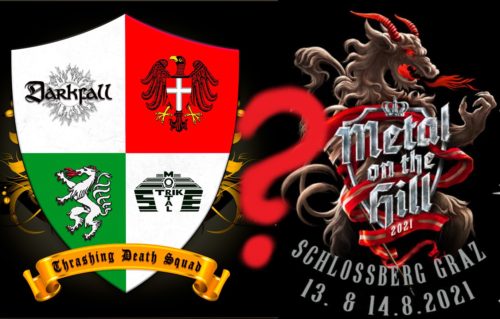
    Copyright of the elements of the title image: cover artwork ‘Thrashing Death Squad’ EP © MDD/Black Sunset Records 2021; branding artwork ‘Metal on the Hill 2021’ © Napalm Records 2020.

    In my project on the Styrian metal scene since 1980, I am currently conducting oral history interviews in this local metal community. I have already talked with several stakeholders, musicians, studio owners, record producers, and other community members. I am very grateful to them for beeing so cooperative and open during the interview sessions. While some of my initial assumptions about the scene have proven to be right, others have been corrected or modified. Steadily, the evaluation of the interview recordings opens up new insights. This phase of research will last about a year until early 2022.

    Of course, the Covid19 pandemic has been one of the crucial topics in most of these interviews. Scene members experience the pandemic in different ways, depending on many individual and social factors. However, some shared patterns of experiencing the pandemic seem to be recognizable. Most of the local metalheads share a very understandable frustration about the lack of concerts and scene events. Also, most of them feel an uncertainty or are worrying about the scene community’s future.

    On balance, the pandemic crisis seems to catalyze the trend of digitalization that was already transforming the scene before 2020. Digital concert streams and many other forms of digital scene life are gaining momentum. Because of the present lack of opportunities to play gigs, the scene moreover witnesses a productivity boost. Bands focus on studio recordings – as far as this is possible under the current conditions.

    Fascinatingly, in this phase of a new productitivity in the Styrian metal scene, a new localism is gaining momentum. A number of new Styrian records  – for example, the new split EP by Darkfall and Mortal Strike shown in the title image – thematize local semiotics. They rework cultural themes from Styria and Graz – for instance, the traditional Styrian blazon. Another example is the branding of the ‘Metal on the Hill’ festival scheduled for August 2021, also shown in the title image.

    Intriguingly, the new productivity in the scene promotes feelings of local Styrian beloging, identity, and history. The new music is more ‘Styrian’ than ever before. This recent phenomenon, which I am tempted to call the scene’s ‘pandemism’ (in a sense of trying to culturally cope with the pandemic crisis in form of musical self-empowerment), is crystalizing currently. Hence, from 2021 onwards, the ‘glocal’ character of the scene seems to be even more important than before. We should keep an eye on both the ‘pandemism’ and the localism.

  • Metal scenes: Multi-role agents and scene ethics

    In the last few days, I had quite some intense exchanges with crucial agents in the Styrian metal scene, which I am researching in my project. When reflecting upon how these members of the local scene have constructed their community over now more than fourty years, I realized how diverse their multiple scene roles have been throughout their scene biographies. Many of them have acted as ‘multi-role agents’ in the scene.

    In a single person, they have combined and integrated meaningfully their scene roles as – for instance – musicians, journalists, fans, concert organizers, peers, and so on; usually various scene identites in a single person. Looking at the already dense discourse on scene research, most of all on the early periods and founding scenarios of scene, this finding comes as no suprise. ((Just to mention a few important titles, see the case studies in: Jeremy Wallach e.a. (eds.): Metal Rules the Globe: Heavy Metal Music arount the World, Durham, NC: Duke University Press, 2011; Anna-Katharina Höpflinger/Florian Heesch (eds.), Methoden der Heavy Metal-Forschung: Interdisziplinäre Zugänge, Münster and New York, Waxmann: 2014; Andy R, Brown e.a. (eds.), Gobal Metal Music and Culture: Current Directions in Metal Studies, London e.a.: Routledge, 2016.)) From this research we know very well that metal scenes usually grow out of a DIY ethos but strive intensively for professionalization (whatever it might mean to be a professional metalhead).

    From this finding follow crucial conceptual and emprical implications for the oral history research I am doing on the history of the Styrian metal scene since 1980 (most of all I deal with matters of the scene’s ethics, its values and scene laws, and then how these norm-related aspects depend on global metal’s attitude to law). If  one assumes that the crucial agents of the scene – for example in the founding period in the 1980s – have been such ‘multi-role agents’ then they also must have been equally multifaceted in respect of developing their scene community ethics. The values they attached to their ermerging community were the values of musicians, fans, organizes, entrepreneurs – in many cases all in a single actor. This is key to keep in mind when leading oral history interviews.

  • Covid19, metal studies, and oral history research: A methodological rant

    In my last blog post, I attempted to describe the thoroughly digitalized research environment I discovered in our project on the history of the Styrian metal scene. Our research is progressing very well. My colleague Charris Efthimiou already provided no less less than thirteen very detailled analyses of law-themed metal songs and albums. Besides the crucial referential frame of globally famous classics (such as Judas Priest’s ‘Breaking the Law’) Charris focused on Styrian music. Hence, we now have a good data set on the musical production in the Styrian scene.

    As  the project leader, I spent the last few weeks gathering data on the cultural production in the scene since the early 1980s. I am constructing a permanently growing corpus of cultural artefacts from the scene. I am collecting T-shirts (as crucial pieces of clothing), album covers (as pictorial historical sources that ‘cover’ the music on records), concert flyers, posters, and other forms of sources. This body of sources currently comprises dozens of artefacts, images, and texts. It will grow steadily. Still, I am very thankful to receive information on further source materials.

    Thus, at this point, the project team is in midst of the process of researching our empirical data. Thanks to Charris’ brilliant work the musicological stream is advancing very well. The same holds true for the semiotic discourse analysis of the scene. Most texts and images, in many cases also of T-shirts, are available from the web. As well, many pieces of clothes can be ordererd to really hold them in hands. In this respect, digitalization makes things possible that would not have been possible five or ten years ago.

    Yet, I do face a highly ambivalent situation in respect of the oral history stream of my project. For almost a year now, face-to-face interviews have been difficult, often even impossible to conduct. Currently, we are experiencing (again) a quite strict form of a ‘lockdown’ here in Austria – with an open ending point. Of course, in many other places around the globe the situation is the same or – sadly – even worse. Of course, this is frustrating. Yet, I also think this is a very good occasion to globally rethink using oral history methodologies in metal studies. From my point of view, two aspects are crucial to reflect upon.

    First, there already is a rather dense discourse on experiences and practical information on how to conduct interviews online. For instance, the British Oral History Society gives good advice on this. Also, metal studies scholars have started to discuss this problem in their field. Hence, perhaps relieving the frustration a bit, no oral history researcher is alone with this problem! Nonetheless, we need a broader discussion on this issue in metal studies!

    Second, as a historian it is fascinating to think of the fact that, now in 2020/21, digitalization as the crucial historical ‘mega trend’ of the last two decades has not only transformed the scene I am researching but also the ways I am researching it. Doubtless, both aspects depend on each other. Yet, in the pandemic period, digitalization is more relevant than ever before. Metal studies is almost fully digital – at least for the moment.

    Hence, we should not only see this as a frustrating attack on our used ways of research. Much more it is the historically logical catalysis of a development which already was transforming metal studies before the pandemic. The pandemic did not start the process, it only catalysed it. Hence, for my project, I try to see it as a valuable opportunity to experiment with new forms of conducting interviews remotely. I would expect that after the pandemic we will have gained a big deal of important experiences in this changed world of research.

  • Oral history as a method in research on local metal scenes

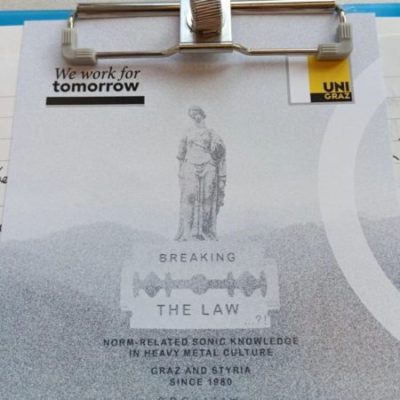
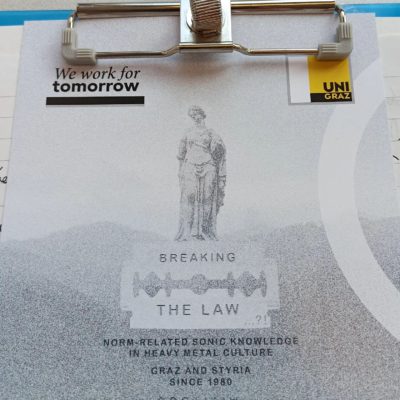
    This week, I started working in the research project ‘Norm-Related Sonic Knowledge in Heavy Metal Culture: A Case Study of the Heavy Metal Scene in Graz and Styria‘ at the University of Graz. I have thematized it in a post some months ago. In this project, we want to find out how law-related phenomena (for instance, the topos of ‘Breaking the Law’ as a cultural narrative in metal since the early 1980s; the local scene ethics as ‘scene-laws’; the thematization of law and justice in local metal music; attitudes to law in the scene) affected the distinct cultural history of the local heavy metal scene in Styria, a ‘Bundesland‘ in the Southeast of Austria.

    Asking for the ‘longue durée’ dimension of a scene history

    In our research, oral history is one of the methods, that will be applied in the second, empirical phase of field work in 2021. With scene-members and stakeholders but also with professionals from the legal field (for instance lawyers and other professionals in the judicial system) from outside the scene, we will conduct interviews on their narratives of law (in metal). Already at this early stage, at the point of re-reading the crucial literatures in the field, it is necessary to reflect upon the question how exactly oral history can be applied fruifully in our research. ((See L. Abrams, Oral History Theory, London and New York: Routledge: 2010; R. Perks and A. Thomson, The Oral History Reader,  Routledge: London and New York, 2000; D. Ritchie, Doing Oral History, 3rd ed., Oxford: Oxford University Press, 2015.))

    For us, one of the critical aspects of present scene research is the sometimes rather ahistorical conceptualization of the histories of  local metal communities. From the point of view of trained historians, current scene theories tend to rather oddly isolate scenes from the broader historical flux of culture and their surrounding contexts. ((See. E. Baulch, Making Scenes: Reggae, Punk, and Death Metal in 1990s Bali, Durham, NC: Duke University Press, 2007; A Bennett, and R. A. Peterson (eds.), Music Scenes: Local, Translocal, and Virtual. Nashville, TN: Vanderbilt University Press, 2004; K. Kahn-Harris, Extreme Metal: Music and Culture on the Edge, New York: Berg, 2007;  J. Wallach and A. Levine,‘“I Want You to Support Local Metal!”: A Theory of Metal Scene Transformation’, in Popular Music History 6, 1/2, 2011, 116-34.)) In a nutshell, metal music studies needs ‘more history’. In this respect, we see our expertise as a chance to better grasp the longue durée dimension characteristic of history.

    For this purpose, oral history – a methodological and theoretical discourse developed mostly in English-speaking academia since the 20th century – makes a ‘weapon of choice’. Qualitative interviewing is broadly used in many branches of cultural research nowadays. What we aim at is unwrapping the long-lasting narratives of scene ethics and ‘scene-laws’ in the Styrian metal community, as they seem to have continuties since the early 1980s. Today, they are deeply routed in this community.

    Does metal have a long-lasting history in Styria?

    Thus, the pivotal matter in applying oral history in this case is not only about the selection of interviewees; above all, it matters to develop a set of questions that makes scene-members and stakeholders remember their versions of these narratives since the early 1980s. Summarized in a short formula we have to ask our interviews right at the start: “Does metal have a long-lasting history in Styria?” This is the opening question for our oral history inquiries.