Blog

  • Beavis & Butthead and the law, or: How norm-related sonic knowledge works

    In an earlier post, I wrote about heuristics in our project. The aim was to describe a conceptual framework, which (provisionally) maps the field we want to explore. I labelled this field as the one the history of ‘norm-related sonic knowledge’, i.e. the cultural history of law-related phenomena in heavy metal culture. Thus, currently, we have a concept of how to approach the field heuristically; this concept will be honed in the course of the exploration.

    What we do not have at this point, is an accurate idea how such norm-related sonic knowledge ‘works’ in mundane everyday contexts. A good way to start thinking of this aspect is looking at the mass-medial representations of norm-related sonic knowledge; especially at cases that represent the flux between metal culture and the ‘mainstream’.

    Beavis & Butthead as a case study of norm-related sonic knowledge

    The case I want to analyze in this post is the well-known cartoon series ‘Beavis and Butthead’. Originally, it was aired on MTV between 1993 and 1997. At its core, it is a parody and satire. In their grotesque adventures, the notoriosly dumb and stereotyped teenage metalheads Beavis and Butthead  face a stereotypedly conservative American society. Hence, the series can be interpreted as a satirical portrait of both the U.S. in the 1990s ((See B. Klypchak, ‘How you gonna see me now’: Recontextualizing metal artists and moral panics. Popular Music History, 6(1/2), 2011, pp. 36-49)) and metal culture. ((See P. Pichler, Metal Music, Sonic Knowledge, and the Cultural Ear in Europe since 1970: A Historiographic Exploration, Stuttgart: Franz Steiner, in press.))

    What is not researched at all in metal studies is the fact that law and law-related phenomena always haved play a crucial role in the main protagonists’ adventures. On several occasions, Beavis and Butthead have to do with the police, are locked up in jail, face lawyers or other people and institutions that represent the law and/or the American legal system. As the series was a massive mainstream success and was created by people that know metal culture well, it is a rich case study of flux between both fields. Below, I will discuss and analyze two key situations, where one can unpack how norm-related sonic knowledge ‘worked’ in the series.

    Beavis & Butthead face the law

    On YouTube, one can find a good deal of clips in which Beavis & Butthead have been arrested. Being arrested is a legal procedure. Prisoners face the law in the personae of the police forces that arrested them, the lawyers that work with them, etc. Here, the broken laws are portrayed to form a seemingly threatening, perhaps conservative body of rules that control and govern our two heroes. This clip is paradigmatic:

    Beavis and Butthead are locked into in a cell with some other inmates. The funny climax of the narrative is that all of the inmates in this cell are Iron Maiden fans. When the policeman opens the door to ‘check on those two kids’, all people in the cell are singing the Maiden song ‘The Prisoner’. Under arrest, the ‘two kids’ are not scared at all but even founded a little metal ‘scene’ in the cell.

    The situation is full of paradigmatic details. Law-related phenomena play a crucial role in the narrative. In the cell, all the other inmates (who seem to be stereotyped ‘rednecks’) are metalheads. When discovering their shared metalness and singing ‘The Prisoner’ (also a reference to a law-related phenomenon) they form an ‘instant metal community’. Doing so, they constitute a group of ‘outlaws’. Their position outside the legal order depends on their shared metal identity. Law is the field that makes emerge metal culture and the mainstream – and the differences between both.

    Beavis & Butthead ‘break’ the law

    Whereas in the first situation the two protagonists face the law and have to surrender to it factually, in the following clips they seem to transgress the law and ‘break’ it:

    In a perfectly absurd scene, Beavis uses a chainsaw to injure his friend Butthead. In the course of the short scene, they start to sing the Judas Priest classic ‘Breaking the Law’. Finally, Butthead comments upon what they just did with his usual “That was cool!” We should see this clip in its close relation to the following:

    Here, the two teenage metalheads put a poodle dog into a washing machine and see what happens when switching it on. The punchline is that they comment upon this singing, once more, the Priest classic; but this time they substitute the hookline ‘breaking the law’ with ‘washing the dog’. Hence, the narrative of the outlaw at the core of the song’s lyrics (it is about a jobless character, who uses law-breaking as a means of social empowerment) becomes fully absurd and ridiculed, a parody of both: metal and the ‘mainstream’.

    Law as the thin line between metal and the ‘mainstream’

    Only seemingly these are just the hilarious tales of two not really smart teenage metalheads in the America of the 1990s. There is much more to it. In both settings – in the situation in the prison and when referencing ‘Breaking the Law’ – law-related phenomena were crucial. When facing the law, Beavis and Butthead (and their fellow prisoners) constitute an ‘instant metal community’ around their shared vision of law-breaking. In the second case, metal’s own vision of ‘breaking the law’ as empowerment (in opposition to the mainstream) is attacked in a parody.

    In a nutshell, law-related phenomena were the territory on which metal and the ‘mainstream’ touched upon each other. In the series, law drew the thin line between the ‘greater society’ and the metal subculture. Norm-related sonic knowledge worked here in a paradigmatic way: The metal scenes’s vision of law allowed the scene to constitute its own community, perfectly illustrated in the first clip. The mainstream’s supposed ‘law and order’ approach allowed to mark the metalheads as the ‘outsiders’; illustrated in the second example. This mass-medial case is one point of departure to develop a more detailed idea of how norm-related sonic could also have worked in the history of Styrian metal community since 1980.
  • Introduction clip research project “norm-related sonic knowledge”

    Corona is locking me in at home…I am messing around a bit with what YouTube can do for me and my new research project “Breaking the Law…?! Norm-Related Sonic Knowledge in Heavy Metal Culture. Graz and Styria since 1980.”….In the following, I post sort of an introduction video to the project. Under these circumstances, locked into home office, it was shot with a very ordinary mobile phone.  This is a test run. I am interested in how YouTube works for metal music studies. Feel free to throw digital stones at me or say something nice 😉

  • Wittgenstein, Davidson and Halford: the heuristics of studying norm-related sonic knowledge

    This is the first post, which ‘officially’ discusses my research in the new project ‘Norm-related sonic knowledge in Heavy Metal culture’. We started on 1 February and are currently working on the project website, which will go online in a few days. There, blog posts from the project will be featured in a special section and appear in the newsfeed too.

    In this first post, I want to address a topic which is crucial in our research: the heuristics of what I called ‘norm-related sonic knowledge’. The main question here is how we plan to map this realm of knowledge.  This sphere is constituted by law-related phenomema in metal culture, metal practices, metal music and metal networks. We need a good heuristical strategy to map the field.

    Here, the result of a fruitful conversation I had recently with my colleague Christian Hiebaum (a legal philosopher and legal sociologist at the University of Graz) is key. In our discussion, Christian raised the point that, philosophically and analytically, all the terms involved (e.g. justice, law, legal system, crime, moral, ethics, law-breaking, rule-breaking etc.) form something like a ‘family’ or a ‘Sprachspiel’ of terms.

    Taking up the thoughts of analytical philosophers like Donald Davidson ((See D. Davidson, The Essential Davidson. Oxford: Oxford University Press. 2006; D. Davidson, Truth, Language, and History: Philosophical Essays, Oxford: Oxford University Press. 2005; D. Davidson, Truth and Predication. Cambridge, Mass.: Harvard University Press. 2005.)) and Ludwig Wittgenstein ((See C. Bezzel: Wittgenstein zur Einführung. Junius, Hamburg 2000, L. Wittgenstein, Philosophische Untersuchungen. Frankfurt: WBG, 2001.)), it is quite easy to recognize that all the categories of norm-related sonic knowledge form a ‘pool’ or a ‘family’ of notions and meanings. Heuristically, the crucial point is how the meaning of each individual term is constituted within this family.

    Herein, each of the terms – in its individual meaning – depends on the other ones. Let us think of some examples. To be understood and fulfill its function in culture,  the notion ‘law’ relies on its links to related notions like ‘justice’, ‘ruling’, ‘order’ ‘legality’ or ‘law-breaking’. The notion ‘breaking the law’ needs a presupposed and in the metal scene shared understanding of terms like ‘law’, ‘morality’ or ‘crime’.

    If we take Judas Priest’s classic ‘Breaking The Law’ once more as a paradigmatic example, this approach makes us look at the lyrics in a new way:

    There I was completely wasted, out of work and down
    All inside it’s so frustrating as I drift from town to town
    Feel as though nobody cares if I live or die
    So I might as well begin to put some action in my life

    Breaking the law, breaking the law
    Breaking the law, breaking the law
    Breaking the law, breaking the law
    Breaking the law, breaking the law

    So much for the golden future I can’t even start
    I’ve had every promise broken, there’s anger in my heart
    You don’t know what it’s like, you don’t have a clue
    If you did you’d find yourselves doing the same thing too

    Breaking the law, breaking the law
    Breaking the law, breaking the law
    Breaking the law, breaking the law
    Breaking the law, breaking the law… ((Lyrics to Judas Priest, ‘Breaking The Law’, on British Steel, 1980.))

    In red and bold, I marked the notions that are relevant for these heuristics. Analytically and philosophically, it might be very risky, even problematic to integrate not only individual notions (e.g. ‘law’ or ‘anger’) but entire word groups or clauses (e.g. ‘breaking the law’, ‘every promise broken’, ‘out of work’) into such a family of terms. This needs more and accurate thinking.

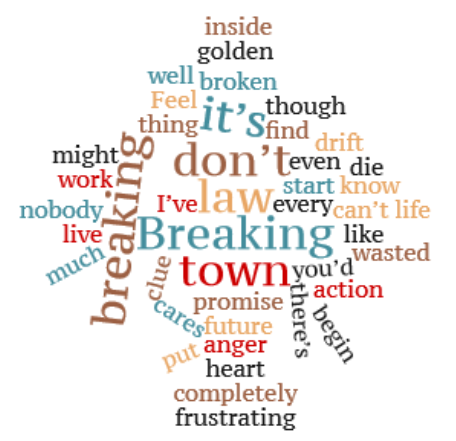
    Yet what we gain from this is heuristically highly useful. We see very clearly that the categories of norm-related sonic knowledge in the lyrics (e.g. ‘law’, ‘breaking the law’) – in the constitution of their meanings – are closely linked to key aspects of metal culture like anger, frustration, or freedom. And further, these notions are linked to the sounds and music of heavy metal. ((R. Walser, Running with the Devil. Power, Gender, and Madness in Heavy Metal Music. Middletown, CT: Wesleyan University Press, 2014.)) A word cloud would arrange the lyrics in this way:

    In a nutshell, these heuristics should make us able to identify the semantic and analytical links between the different categories of norm-related sonic knowledge. Moreover and equally important, they make visible the linkages to the mental, sonic, visual, and emotional ‘moods’ and dynamics of metal culture.

  • Oral history as a method in research on local metal scenes

    This week, I started working in the research project ‘Norm-Related Sonic Knowledge in Heavy Metal Culture: A Case Study of the Heavy Metal Scene in Graz and Styria‘ at the University of Graz. I have thematized it in a post some months ago. In this project, we want to find out how law-related phenomena (for instance, the topos of ‘Breaking the Law’ as a cultural narrative in metal since the early 1980s; the local scene ethics as ‘scene-laws’; the thematization of law and justice in local metal music; attitudes to law in the scene) affected the distinct cultural history of the local heavy metal scene in Styria, a ‘Bundesland‘ in the Southeast of Austria.

    Asking for the ‘longue durée’ dimension of a scene history

    In our research, oral history is one of the methods, that will be applied in the second, empirical phase of field work in 2021. With scene-members and stakeholders but also with professionals from the legal field (for instance lawyers and other professionals in the judicial system) from outside the scene, we will conduct interviews on their narratives of law (in metal). Already at this early stage, at the point of re-reading the crucial literatures in the field, it is necessary to reflect upon the question how exactly oral history can be applied fruifully in our research. ((See L. Abrams, Oral History Theory, London and New York: Routledge: 2010; R. Perks and A. Thomson, The Oral History Reader,  Routledge: London and New York, 2000; D. Ritchie, Doing Oral History, 3rd ed., Oxford: Oxford University Press, 2015.))

    For us, one of the critical aspects of present scene research is the sometimes rather ahistorical conceptualization of the histories of  local metal communities. From the point of view of trained historians, current scene theories tend to rather oddly isolate scenes from the broader historical flux of culture and their surrounding contexts. ((See. E. Baulch, Making Scenes: Reggae, Punk, and Death Metal in 1990s Bali, Durham, NC: Duke University Press, 2007; A Bennett, and R. A. Peterson (eds.), Music Scenes: Local, Translocal, and Virtual. Nashville, TN: Vanderbilt University Press, 2004; K. Kahn-Harris, Extreme Metal: Music and Culture on the Edge, New York: Berg, 2007;  J. Wallach and A. Levine,‘“I Want You to Support Local Metal!”: A Theory of Metal Scene Transformation’, in Popular Music History 6, 1/2, 2011, 116-34.)) In a nutshell, metal music studies needs ‘more history’. In this respect, we see our expertise as a chance to better grasp the longue durée dimension characteristic of history.

    For this purpose, oral history – a methodological and theoretical discourse developed mostly in English-speaking academia since the 20th century – makes a ‘weapon of choice’. Qualitative interviewing is broadly used in many branches of cultural research nowadays. What we aim at is unwrapping the long-lasting narratives of scene ethics and ‘scene-laws’ in the Styrian metal community, as they seem to have continuties since the early 1980s. Today, they are deeply routed in this community.

    Does metal have a long-lasting history in Styria?

    Thus, the pivotal matter in applying oral history in this case is not only about the selection of interviewees; above all, it matters to develop a set of questions that makes scene-members and stakeholders remember their versions of these narratives since the early 1980s. Summarized in a short formula we have to ask our interviews right at the start: “Does metal have a long-lasting history in Styria?” This is the opening question for our oral history inquiries.

  • “Too late, too late…?” On the norm-related sonic knowledge of female aggression

    Female emancipation in metal – too late?

    In 1979, Motörhead released the song ‘Too Late Too Late’ as a b-side to the ‘Overkill’ single. If we take the song title as a question, it seems to fit the history of female emancipation in heavy metal culture. As already Deena Weinstein stated in her pivotal cultural sociology of metal, ((D. Weinstein, Heavy Metal: The Music and its Culture, Boulder, CO: Da Capo Press, 2000.)) metal culture has been imbued with conservative gender stereotypes right from the start. Nonetheless, metal itself as well as metal studies have diversified in terms of gender roles since. ((A. Digioia & L. Helfrich, ‘”I’m sorry, but it’s true, you’re bringin’ on the heartache”: The antiquated methodology of Deena Weinstein’, in Metal Music Studies Volume 4, Number 2, 1 June 2018, pp. 365-374; also, see more globally: H. Savigny & J. Schaap, ‘Putting the “studies” back into metal music studiesPutting the ‘studies’ back into metal music studies’, in Metal Music Studies Volume 4, Number 3, 1 September 2018, pp. 549-557.))

    In this blog post, I want to take up these reflections on female gender roles in metal and discuss them under the auspices of the theoretical notion of ‘norm-related sonic knowledge’. This notion is at the heart of the research project on law-related phenomena in metal cultural history I am leading in the three coming years. In this project, we want to research how law and law-related phenonema contributed to the specific scene-building process in Graz and Styria from the 1980s to the present.

    In one of the two peer-reviews of the research proposal, the reviewer mentioned critically that gender roles are an important matter in this project and should be researched more prominently. Undoubtedly, the reviewer was insofar right as law is intrinsically connected to the normative spheres of metalness and thus touches upon gender normativities. However, since this is the first research on this topic at all, we cannot deliver a ‘full’ history of all facets. Perhaps, systematically, it would make sense thinking of such more specifical research after the basic research on this scene is done. In this post, I will raise some points that could lead into this direction.

    Jinjer in Zagreb

    Last Friday, I had the opportunity to see the Ukrainian band Jinjer live in the venue of Tvornica Kulture in Zagreb, Croatia. The experience of a Jinjer concert is a great occasion to discuss this topic, because the band in highly interestingly ways breaks up usual gender standards in their music. Their music can be described as a mixture of death metal, djent and groove metal. Their musical language is characterized by ‘bouncing’ guitar riffs (that reminded me of Rage Against The Machine’s Tom Morello) and, most of all, the versatile vocals by singer Tatiana Shmailyuk .

    It is this vocal style and the singer’s on stage performance that is worth taking a closer look. Being such a versatile vocalist, Shmailyuk performs both harsh guttural parts and clean melodic singing parts. The result is a combination of very aggressive parts and mellow melodic parts, usually within one individual song. Hence, reminding of black metal artisy Myrkur, the singer can play both roles of the 'tender' woman and of the aggressive female. These two short clips I recorded at the concert illustrate the band's musical language:

    What I witnessed at the venue in Zagreb in front of an highly energetic, sometimes almost rowdily mosh-pitting crowd also was a musical perfomance of gender roles in metal. In her vocals, the singer delivered both aggression and softness. In this specific historical event of a concert, repeated during a tour cycle on an almost daily base, Jinjer broke up the normativities of metal gender roles and created something new. I do not know whether it was this sheer overwhelming experience of an emotional rollercoaster that dynamized the crowd's behaviours in such dramatic ways.

    The norm-related sonic knowledge of gender in metal

    In our project, we will use the mentioned concept of norm-related sonic knowledge as an analytical description of the longue durée dimension of sense-making in metal by law-related phenomena and topics. The notion describes how such phenomena were used in metal culture to constitute the normative sphere of the regional scene in Graz and Styria.

    Already applied to the event of Jinjer’s performance in Zagreb, the notion leads to so far not asked questions on gender roles. If we see the history of female metalness as a long, diversifying and ambiguous development of normative ‘gender laws’ over almost fifty years since Black Sabbath took the stage, then this concert in late 2019 was a play in this history and with this history.

    Jinjer took some of the key norms (conservative female gender roles), broke them into pieces and re-assembled them into a new set of rules that probably could contribute to new, more progressive ‘scene laws’ in the future. If we think of this recomposition as a deeply cultural-historical act refering to five decades of women in metal, this seems to come late but not too late – but only so if the culture itself and also metal studies seriously keep up engaging with ‘difficult’ topics such as racism, misogyny or nazism.

  • ‘Fandom’ and ‘scholarship’: Comparing two cultural-historical institutions

    I ended my last post on the paradox at the heart of metal studies with the suggestion that cultural history, as one individual discipline in the transdisciplinary field of metal studies, could become an exciting enrichment. It gives us the promise of a structurally exploration of the the intertwined histories of fandom, scholarship and ‘fan scholarship’ in the field. In this (admittedly rather short) blog post, I take up this thought and attempt a first comparative analysis of ‘fandom’ and ‘scholarship’ as historically constructed cultural institutions. Once more, I take and stress the point of view of a historian.

    There seems to be a consensus in metal research that the nexus between metal fandom and metal scholarship is a crucial one. In Salzburg, Keith Kahn-Harris and Rosemary Lucy Hill encouraged us to proactively embrace the arising tension between both by self-reflexively asking diffictult questions on racism, sexism, bigotry, misogyny, nazism and other critical phenomena in the scenes. In this, history with its focus on developments over periods of decades (for metal studies this means to study the whole period since the inception of metal culture around 1970) can provide a helpfully orientating narrative. ((Peter Pichler, Metal Music and Sonic Knowledge in Europe: A Cultural History Since 1970, Bingley: Emerald, forthcoming.))

    Seen historically, both fandom and scholarship are not essentialist roles or identities but social formations, that both have long histories. The habitus, rituals and practices of that structure them can be traced back deep in history. If we view them as such complexes of historically constituted roles, the hybrid zone formed by them together in metal studies receives sharper contours. I start with fandom.

    Fandom

    Usually, metalheads are stereotyped as male, long-haired (semi-)adults wearing band t-shirts and battle vests. ((Once more, refer to Weinstein’s classic work: Deena Weinstein, Heavy Metal: The Music and its Culture, Boulder, CO: Da Capo Press, 2000; also, see Bettina Roccor, Heavy Metal. Die Bands, die Fans, die Gegner, Munich: Beck: 1998.)) Practices such as the formation of moshpits or showing the ‘metal horns’ at concerts complete the stereotypical imagery. They are expressions of scene members’ feelings of belonging to their communities, performed in public and addressing audiences within the scence as well as outside the scene.

    If we take the point of view of cultural history things appear in another light. Popular culture – and fandom as a crucial functional position of people in it – have a history that in some of its forms can be traced back to early modern periods; at least to the 19th century, when mass media established new forms of public spheres for mass audiences. The masses became literate. ((For introductory texts, see LeRoy Ashby, With Amusement for All: A History of American Popular Culture since 1830, Lexington, KY: University Press of Kentucky, 2009;  John Storey, Cultural Theory and Popular Culture: An Introduction, Harlow: Person, 2009; Kaspar Maase, Populärkulturforschung: Eine Einführung, Bielefeld, 2019.)) Thus, fandom is a cultural construction that, today, takes varying forms in different pop cultures (e.g. literature, music, film, gaming, sports etc.) but all of them stem from one root of comparable processes over decades, sometimes even centuries (as in the case of soccer culture or the passion for classical music).

    Taking this view very much relativizes the allegedly absolute newness of metal fan culture since the 1970s. Yes, the practices installed over almost five decades in the global metal scene produced some innovative patterns; however, only being constructed after 1970, the new rituals, practices and scene rules built there heavily relied on what has been learnt, experienced and practiced in other fan cultures before Black Sabbath took the stage. So, metal fandom is a cultural institution that can best be studied in comparison to other forms of fandom in history. And even more crucial, it has to be compared to other cultural institutions.

    Scholarship

    Let us come to scholarship. At first glance, scholarship seems to be something completely different. Scholars usually are seen as rational, well-educated and distinguished personalities. Once more, the stereotype is a male one. Scholars wear glasses, speak of almost non-understandable things and live in the ivory towers of their universities. Yet, also scholarship – and the modern intellectual as a role in it – are historically constructed phenomena. The role of both cannot be separated from the history of the university in Europe and the world since the Middle Ages. ((For introductory texts, see Hilde de Ridder-Symoens et al., eds., A History of the University in Europe, 3 vols., Cambridge: Cambridge University Press, 1992-2004; Thomas Sowell, Intellectuals and Society, New York, NY: Basic Books, 2010; Dietz Bering, Die Epoche der Intellektuellen 1898–2001. Geburt – Begriff – Grabmal, Berlin: Berlin University Press.)) Since the Middle Ages, philosophers, scientists, theologians and intellectuals – scholars in a most broad sense – tell us how to make sense of the world.

    As said before, this role appears to be very different from fandom. Nonetheless its realities work – basically and structurally – in ways comparable to any other spheres of community-building. Academia knows rituals, do’s and dont’s, forms of identity-building and othering. ((See Anthony Becher and Paul R. Trowler, Academic Tribes and Territories, 2nd edn., Buckingham: Open University Press, 2001.)) The essential question here is what sets this cultural institution, grown out of the tree of a history of almost thousand years, apart from other cultural institutions such as fandom.

    Seen from this angle, what separates them and what makes them comparable at once belongs to the same sphere: their historical backgrounds. How, on the one hand, scholars use the centuries-old narratives of scientific wisdom in their lives and how, on the other hand, metal fans use their  decades-old narratives of metalness can be compared, but only historically so. Both have come together in the history of the field of metal studies.

    Metal studies as a transgressive laboratory of cultural institutions

    What can we learn from this? If we take the point of view of history, metal music studies is they structural point where both histories come together. Seen this way, metal studies is nothing else than a cultural discourse, in which the insitutions of metal fandom and scholarship – with all their heritage – build a ‘match’. Thus, we should see the field as a transgressive laboratory, in which we work on these cultural institutions in the long term and, arguably, shape the new ‘sub-institution’ of the ‘metal scholar’. It is not about playing off one against each other but much more about thinking this new institution in visionary yet critical ways.

  • The paradox at the heart of metal studies

    Over the last two days, I had the wonderful opportunity of taking part in the inspiring Hardwired VII conference at the University of Salzburg. Already the seventh conference in this series, it was an event of intense discussions on topics of transdisciplinarity and transgression in metal studies. As such a stimulating event, it was an oportunity of further developing the scientific community in the field.

    In this post, I want to reflect upon what – probably – can be called the ‘heart of metal studies’. Intentionally, I use this notion of the ‘heart’, because as a metaphor it evokes associations of vitality, life, energy and of the identity of the metal studies community. Worth remembering, German metal veterans Accept released a classic album called Metal Heart in 1985. ((Accept, Metal Heart, Portrait Records, 1985.))

    Now what is at the heart of our field? From my point of view, taken together the two keynote lectures of the conference, by Rosemary Lucy Hill and Keith Kahn-Harris, summed up the crucial challenges scholars have to master in the coming years. Of course, I cannot deliver a full solution to the central problems of metal research in this blog post. From the perspective of a cultural historian, I want to comment upon the paradox at the heart of metal research.

    In her lecture ‘”You’re asking the Wrong Question!” Methodology, Standpoint and Fandon in Metal Research’, Hill delivered an excellent analysis of the main problem of the field in its ‘teenage years’. Metal research is dominantly conducted by scholars, who also take part in the culture as metalheads. With this comes an obvious, structural conflict between the obligation of the scholars in us to keep a distant and critical view on metal and the metal fans in us, who love the music. Hill encouraged scholars to keep asking hard questions on the difficult aspects of metal, e.g. sexual violence, fascim, racism and misogyny.

    In his keynote ‘Too much Transgression – Metal in an Age of Explicit Knowledge’, Kahn-Harris took up his work on metal culture and the concept of ‘reflexive anti-reflexivety’. For Kahn-Harris, today’s metal culture is to be seen as a culture in an age of abundant knowledge. Transgression takes new forms. He called these forms ‘transgressive literalism’, ‘transgressive unintellegibility’ and ‘transgressive inversion’. Also in his view, conflicts between stances to problematic aspects of metal have to be reconsidered.

    For a cultural historian, both lectures thematize a paradox, which seems to form something like the heart, perhaps the dark heart of the field. This heart pumps into the field (and its community) its vitality and is its key problem at the same time. The core issue  seems to be to develop theories, strategies and a communal habitus or ‘thought style’, which enable us of coping with the tensions between our identities as scholars and identites as fans in a productive way.

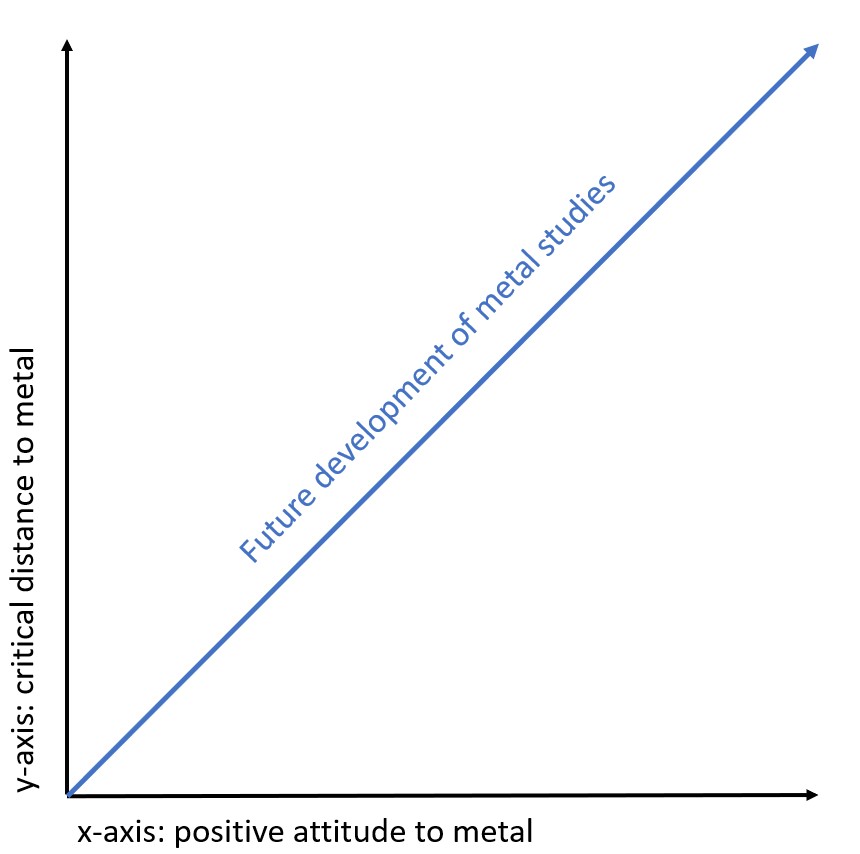
    Logically, this is a classic paradox. The point here is, cultural-historical experience teaches us that usually paradoxes cannot be solved. ((For instance, for the paradoxical structure of the identity of the European Union between nation-state and ‘super-state’, see Peter Pichler, ‘European Union cultural history: introducing the theory of ‘paradoxical coherence’ to start mapping a field of research’, Journal of European Integration 1 (2018), pp. 1-16.)) In the long term, the identitary tensions that arise from such conflicts are solved only contigently by creating new spaces of knowledge, in that scholarship goes as far as possible in both directions: in the direction of critique and the direction of keeping a positive attitude to the culture. In a perfect metal studies world, which never will become reality, this could look a bit like this figure:

    Thus, metal studies should not aim at defining a methodology or theory of metal that resolves the paradox. It should aim at constituting a new sphere of knowledge, in that we can go as far as possible into both directions. What Kahn-Harris called ‘engaged scholarship’ comes pretty close to this. With Hill, we should keep asking difficult questions. In this, history with its focus on longue durée developments over decades since 1970 could become an exciting enrichment. ((Peter Pichler, Metal Music and Sonic Knowledge in Europe: A Cultural History Since 1970, Bingley: Emerald, forthcoming.))


  • On the history of the ‘metal ear’ and methodological ‘distant listening’

    Currently, I am in a phase of revising some older texts on metal cultural history. During these revisions I realized that over the last five years since I started this blog, my approach to heavy metal records, as sonic sources of history, has changed quite a bit. In 2014, when I set out to write first pieces on albums like Behemoth’s The Satanist or Temple of Oblivion’s Traum und Trauma, I listened to those records like I did in the 20 years before – as a metalhead who happens to also be a historian.

    When reading an older piece on Panopticon’s Revisions of the Past, I acknowledged that my identity as a metal listener developed into a new direction. There are times when I listen to Panopticon (or Behemoth or Temple of Oblivion) as a metalhead but there are also times when I listen to them intentionally as a metal scholar. Over the past few years, I developed a second, more ‘methodical’ mode of listening to records, as sonic historical sources. Herein, I do receive the music as ‘data’ and ‘process’ it in my texts.

    I do not mention this career of my personal ‘metal ear’ ((I would like to thank all the participants at the ‘History’ panel at the ISMMS conference in Nantes on 19th June 2019 for sharing their thoughts on this matter.)) in order to celebrate it. I do so because, arguably, there is a significant methodological aspect hidden within such kind of self-reflection. Sound history, as a recent discourse of the new cultural history ((Burke, P. (2004). What is cultural history? Cambridge: Polity Press; Langenbruch, A. (2018). Klang als Geschichtsmedium. Perspektiven für eine auditive Geschichtsschreibung. Bielefeld: Transcript; Schrage, D. (2011). Erleben, Verstehen, Vergleichen. Eine soziologische Perspektive auf die auditive Wahrnehmung im 20. Jahrhundert. Studies in Contemporary History 8(2), 269-276.)) showed instructively that our ways of listening have changed significantly over the course of history. For instance, the sound of the motorization of modern cities in the early 20th century with car engines and car traffic changed how the inhabitants of the cities experienced urban worlds.

    Analogically, in metal sound history, the structural situation of the metal ear in 2019 is very different from that of the early 1970s, i.e. when metal was ‘invented’. In 1970, fans listened to Black Sabbath’s debut on vinyl albums, at live concerts or on the radio. Today, we can listen to the debut and to their last LP 13 (and all of other recordings in their back catalogue) on one of the digital, globally available music platforms that are available via our smartphones. If we grow tired of Sabbath, it takes just a moment to jump to Rihanna, to Miley Cyrus or even to spoken content like comedy or audiobooks. Thus, our medial and structural situation of listening to metal and hearing metal today involves overwhelmingly more cross-genre and cross-media jumps, and hence there is also much more fluidness and transgression. Arguably, this affects the cultural metal ear.

    On balance, this leads me to suggest to not only think of historical agents as ‘learning listeners’ or ‘conditioned listeners’ but also of ourselves as researchers in metal studies as potentially self-reflexive listeners. On myself, I can observe a kind of ‘distant listening’ when intentionally listening to metal records as a scholar. Having a certain potential of methodological meta-reflexivitiy, this kind of ‘distant listening’ could become an aspect of historical theorizing in metal. Strategically treating metal records as sonic historical sources, one could think of a sort of ‘training program’, in which this kind of listening would be consciously nurtured. This also implicates to claim a deeper interdisciplinary exchange between cultural and musicological research in metal studies.

  • On interdisciplinary and transdisciplinary cooperations in metal music studies

    Currently, I am putting final touches on the manuscript of my book on European metal cultural history. ((P. Pichler, Metal Music and Sonic Knowledge in Europe: A Cultural History, Bingley: Emerald, Forthcoming.)) In this stage of revision, I have been thinking a lot about the forms interdisciplinary and transdisciplinary cooperations take in metal studies. In the following, I elaborate upon my view of these in our field crucial processes and invite my peers to discussion.

    In each of the currently existing introductory books to our field (and also in more specialized studies), the character of metal research is described as interdisciplinary and transdisciplinary. It is a discourse, in that since its inception around 1990 scholars from musicology, sociology, philosophy, linguistics, the study of religion etc. cooperate and discuss a shared subject: metal.

    However, often we approach the shared subject from very different angles and speak different disciplinary languages. For each of us, the epistemic and theoretical vocabularies we use are informed by our various disciplinary trainings. In my case, I live in the world of an Austrian historian, educated in this small country in central Europe. Thus metal studies, beneath the surface, is not only an interdisciplinary and transdisciplinary enterprise but also an ‘inter-identitary’ and ‘trans-identitary’ one, transgressing the boundaries between our sociological, musicological, historiographical, philosophical etc. identities.

    This has serious consequences. In metal studies, at conferences, in book projects, in collaborations and cooperations, we regularly face situations of conflict, of nonunderstanding and of misunderstanding caused by our various disciplinary traditions. From my point of view, there can be only one solution to this crucial issue: more theoretical self-reflection and and a clearly and explicitly defined theoretical language.

    In the sense of Savigny and Schaap’s recent essay on ‘putting the studies back into metal music studies’, ((H. Savigny and J. Schaap, ‘Putting the ‘studies’ back into metal music studies’, Metal Music Studies 4, 3 pp. 549-557)) we should lead an open discussion on key terms like ‘metal’ itself, but also on ‘scene’, ‘time’, ‘space’, ‘sound,’ ‘history’, ‘identity’, ‘culture’…obviously, the list ist opend-ended. The point here is to put more emphasis on explicit work on terminologies – in order to perhaps give birth to an independent language of metal studies.

  • Putting metal in its time!? Theoretical, methodological and empirical observations on ‘locating metal’ by a historian.

    In the recent stage of gaining clearer contours as an independent field, metals studies scholars have demanded more theoretical self-reflection and rigor. On balance, they said we ought to more carefully reflect upon our theoretical and methodological approaches. ((Online version of my talk at ISMMS 2019 conference, Nantes 19 June 2019.)) Or as Savigny and Schaap put it, we had to ‘put the “studies” back into metal studies’. ((ThSee H. Savigny and J. Schaap, ‘Putting the “studies” back into metal music studies’, Metal Music Studies 4, 3 (2018) 549-557.)) I want to address this claim from the point of view of a trained historian.

    That said, I hope to make clear how the careful introduction of history as a discipline into the multi-disciplinary realm of metal studies could enrich the field in the years to come. From my point of view, locating metal means locating metal in history. But also, in turn, it means locating history in metal. Putting metal into its time, more accurately putting metal into history, requires us to become more aware of some crucial epistemological points, we should adhere to when researching metal and history. I want to elaborate upon these points.

    I go three steps. First, I give a very short description of the position of history as a discipline in metal studies, from my point of view. Second, at the base of an empirical example, I try to illuminate the consequences from my first section. Finally, as my conclusion, I attempt formulating four points we should be aware of when putting metal into history in this sense.

    1. Metal studies and sound history: the longue durée

    We already do have an eclectic range of reflections on metal and history. ((See D. Weinstein Heavy metal: A cultural sociology. New York, NY: Lexington Books, 1991; R. Walser, Running with the devil: Power, gender, and madness in heavy metal music. Hanover, NH: Wesleyan University Press, 1993; A.R. Brown et. al. (eds.), Global metal music and culture: Current directions in metal studies. Milton Park and New York: Routledge, 2016; B. Hickam, Amalgamated anecdotes: Perspectives on the history of metal music and culture studies. Metal Music Studie 1, 1 (2015), 5-23.)) However, so far, those reflections have come from cultural studies, sociology, musicology or other disciplines. Now, the questions that historians ask are not better than those questions; but they differ from them in theoretical and empirical terms. Thus, the current relationship between metal studies as a field and history as a discipline is characterized by the fact that history, as a discipline, is not satisfyingly represented in the field – again from the point of view of a historian.

    Thus, I think the specific perspective of ‘the new cultural history’, that was developed by Lynn Hunt and other scholars in history since around 1990, could be an enrichment to already existing research on history and metal. Above all, the innovative theories from the recent discourse of ‘sound history’, a fruit of the new cultural history, have the potential of bringing in more historical awareness.

    Sound history, a research strand developed by scholars such as Dominik Schrage, David Hendy, Gerhard Paul, Ralph Schock, Anna Langenbruch and others, ((See D. Schrage, Erleben, Verstehen, Vergleichen. Eine soziologische Perspektive auf die auditive Wahrnehmung im 20. Jahrhundert. Zeithistorische Forschungen/Studies in Contemporary History, 2, 8 (2011), 268-276; D. Hendy, Noise: A human history of sound and listening. London: Profile Books, 2013; G. Paul and R. Schock, Sound der Zeit. Geräusche, Töne, Stimmen – 1889 bis heute. Göttingen: Wallstein, 2013; A. Langenbruch (ed.), Klang als Geschichtsmedium. Perspektiven für eine auditive Geschichtsschreibung, Bielefeld: Transcript, 2013. )) examines the ways how sonic sense-making changed over longer periods during the 20th century. Sound historians ask how hearing and listening developed over periods of decades during that century. They suppose that our cultural framing and habitus of hearing and listening prefigure the ways we make sense of the world we live.

    Crucially, in the second half of the 20th century, musical pop cultures and their sounds became a structural framework, that conditioned our ways of hearing and listening. On a global scale, we cannot think of the sound of the second half of that century without referring to the sound of the electric guitar – however stereotypical and flat this observation may be today. Sound historians analyze the patterns of the diachronic longue durée of those more than seventy years since the Second World War. A German-language article by Dominik Schrage explains this perspective:

    The musical mode of hearing enables us as subjects to experience comprehensibly the effects of sounds and rhythms, be it contemplatively or expressively – plunging into music or dancing to it. Like images, sounds cannot be transferred to linguistic meaning without fractures; but both are experienced as being in harmony with each other, correspond with moods, affections, and emotions in the experiencing subject. Sounds, melodies, chords, and rhythms share a fundament across cultures, but in different musical cultures they are encoded, systematized and linked to harmony theories in different ways. ((Schrage, Verstehen, 269-276. Author’s translation.))

    Thinking of metal’s history of almost half a century, we can assume that also metal has its own sound history since 1970; its specific frame of auditive and cultural sense-making. We can suppose that the historically varying settings, in that people have heard metal and listened to metal, influenced crucially how metalness identities have been constructed. Likely, this sound history prefigured heavy metal’s cultural frame, the construction of scenes.

    For instance, the frame of hearing and listening in the early 1970s, when Black Sabbath’s (1970) self-titled debut was released, differed eminently from the frame in 2013, when their last LP 13 was issued. The frame differed in terms of media, of networks, of listening conditions in the broadest thinkable way. Today we listen to both records on Spotify, inform us on them on the Encyclopaedia Metallum website, and jump from them to Rihanna if we have a bad taste. Researching this frame requires the diachronic perspective of sound history.

    Thus, this main question for the changes or stabilizations of the forms of cultural sense-making in the sound history of heavy metal, interpreted as a history of now almost fifty years, is the fresh aspect that could be introduced by history as a discipline. Historians using their expertise and knowledge of historical processes, also their expertise in interpreting and reading historical sources, could bring in new aspects to metal studies. On balance, the currently lacking expertise from historians promises more historical awareness and self-reflexivity.

    2. An empirical example: Heathen Foray’s ‘Mei laund’

    To this point, I have dealt with history on merely a theoretical level. Theory is there to be applied on empirical realities. Thus, in this second step of my thoughts, I turn to an empirical example, aiming at illustrating what I just said about sound history.

    Some weeks ago, with a colleague from musicology, I have submitted a proposal for a three-years research project to the Austrian Science Funds. Herein, we plan to examine the sound history of the metal scene in my hometown of Graz, Styria, located in Southern Austria, close to the Slovenian border, since about 1980. We want to research the local scene’s sound history.

    We specifically ask for the role of law-related phenomena in this case study. Since Judas Priest’s classic anthem ‘Breaking the Law’ (1980), topoi of law-breaking and other norm-related imaginations of law and justice are important in metal around the world. They seem to have played a role in scene-construction in Graz, Styria an Austria.

    For the proposal, we conducted first research and had first oral history contacts with scene stakeholders. I want to show you an example of a song by a local band. I hope, on the base of this song one can see the potential of the approach I just described.

    Our example artists, Heathen Foray, are a pagan metal/ melodic death metal group from Graz. They are well-known in the local scene and had some international success since 2004. On their album Inner Force (2013), we find the track ‘Mei Laund’ (Engl., ‘My land’) with lyrics written in Styrian dialect:

    These are the quintessential parts of the lyrics with an approximative translation to English language:

    ((Lyrics to Heathen Foray, ‘Mei laund’, on Inner Force, Independent, 2013. Author’s translation.))

    At a first glance, this track seems to be a ‘usual’ song of the pagan metal and folk metal sub-genres. But there is more to it. The narrative of the song presents the story of a local man. His father died and, now, the man inherits the family’s land. So, he becomes the landlord. This is a clearly patriarchic narrative, taking place in a rural, early modern setting or a medieval setting, perhaps also a fantasy setting. The male landlord has to defend his land. The protagonist tells us his story and that he will teach his son exactly what he learned from his late father.

    Looking at the track as a product of 21st century heavy metal sound history, we find a quite unique way of acoustic and cultural sense-making. At the heart of the song is a distinct concept of law and legal norms. Only the son can inherit the land from his father. Those are very strict and archaic, deeply conservative and patriarchic ideas of law and the private property of land. Put into extreme metal sound, those ideas formed the cultural protocol that structures the entire story. It characterizes the song from the beginning to the end.

    In order to really historically understand the song, to put it into history, in our project we plan to perform quite a broad spectrum of sound-historical close readings.

    First, we will have to read Heathen Foray’s ideas of law and heritage before the backdrop of disciplinary historical research results on medieval and early modern law systems.

    Secondly, in a musicological analysis, my colleague Charris Efthymiou will answer the question whether this specific idea of law is represented by distinct musical and formal patterns.

    Thirdly, we plan to put those results into the longer history of the local scene since 1980 and of ‘glocal’ developments.
    So, sound-historical expertise, in this case, intends to performs a broad contextualization in the disciplinary knowledge of history and seeks permanent interdisciplinary contact with musicology

    3. Conclusion

    I come to my conclusion. I tried to show that history, most of all the recent discourse of sound history, has the potential of probably enriching recent metal studies discourse. Its expertise of researching the longue durée dimensions of auditive cultural sense-making could support our search for more theoretical rigor. On balance, the result of my reflections can be summarized in four points. When we put metal into history, we should

    • make full use of history’s disciplinary expertise in reading and interpreting historical sources,
    • always read metal history before the backdrop of broader research results in global cultural history,
    • pay crucial attention to the analysis of the longue durée dimensions of sound-historical sense-making,
    • and permanently keep the dialogue with other disciplines in metal studies.