In my project on the Styrian metal scene since 1980, I am currently conducting oral history interviews in this local metal community. I have already talked with several stakeholders, musicians, studio owners, record producers, and other community members. I am very grateful to them for beeing so cooperative and open during the interview sessions. While some of my initial assumptions about the scene have proven to be right, others have been corrected or modified. Steadily, the evaluation of the interview recordings opens up new insights. This phase of research will last about a year until early 2022.
Of course, the Covid19 pandemic has been one of the crucial topics in most of these interviews. Scene members experience the pandemic in different ways, depending on many individual and social factors. However, some shared patterns of experiencing the pandemic seem to be recognizable. Most of the local metalheads share a very understandable frustration about the lack of concerts and scene events. Also, most of them feel an uncertainty or are worrying about the scene community’s future.
On balance, the pandemic crisis seems to catalyze the trend of digitalization that was already transforming the scene before 2020. Digital concert streams and many other forms of digital scene life are gaining momentum. Because of the present lack of opportunities to play gigs, the scene moreover witnesses a productivity boost. Bands focus on studio recordings – as far as this is possible under the current conditions.
Fascinatingly, in this phase of a new productitivity in the Styrian metal scene, a new localism is gaining momentum. A number of new Styrian records – for example, the new split EP by Darkfall and Mortal Strike shown in the title image – thematize local semiotics. They rework cultural themes from Styria and Graz – for instance, the traditional Styrian blazon. Another example is the branding of the ‘Metal on the Hill’ festival scheduled for August 2021, also shown in the title image.
Intriguingly, the new productivity in the scene promotes feelings of local Styrian beloging, identity, and history. The new music is more ‘Styrian’ than ever before. This recent phenomenon, which I am tempted to call the scene’s ‘pandemism’ (in a sense of trying to culturally cope with the pandemic crisis in form of musical self-empowerment), is crystalizing currently. Hence, from 2021 onwards, the ‘glocal’ character of the scene seems to be even more important than before. We should keep an eye on both the ‘pandemism’ and the localism.
For my project on the metal scene in Graz and Styria since 1980, I am currently finalizing the framework for the empirical research in 2021. As written in an earlier post, the overall aim is to reconstruct the history of the ‘local metallic association chain’ in Styria.
Most of the second year of the project will be devoted to intense empirical work. The project teams employs three methodical streams – musicological analysis, oral history, and semantic discourse analysis – to grasp the multidimensional phenomenon of the Styrian scene. In the following, I give a rough sketch of what lies ahead for the ‘Norikum’ project in 2021.
Analyzing Styrian metal music…
As already my terminology of metal indicates (I call it ‘sonic knowledge’), I treat music and sound as the ‘heart’ of metal culture. Everything in metal depends from knowing and experiencing the music and its sonic sphere. My project colleague Charalampos Efthymiou now proceeds to analyze the musical production from the local scene. In his analysis, he will focus on the aspect of ‘law’. Together, we already have set up a corpus of relevant songs and albums. About 15 song will be analyzed formally and in the contexts of their albums – to identify ‘law patterns’ in the musical language. ((See D. Elflein, Schwermetallanalysen: Die musikalische Sprache des Heavy Metal, Bielefeld: 2010.))
Analyzing how the scene history is narrated…
Since at least the second half of the 20th century, oral history is one oft he most prominent research methods in contemporary history. ((See L. Abrams, Oral History Theory, London and New York: Routledge: 2010; R. Perks and A. Thomson, The Oral History Reader, Routledge: London and New York, 2000; D. Ritchie, Doing Oral History, 3rd ed., Oxford: Oxford University Press, 2015.)) Oral history interviews make open forms of creating the historical source in the dialogue between the interviewee and the researcher. The first must be given the chance to construct his narrative, the latter must nourish this process. I (and another member of the project team) will lead oral history interviews with about twenty interviewees. The sample of interviewees will be constructed to represent the gender and class structure of the local scene as well as include non-scene members with their perspectives on local metal. I already have identified the key interviewees.
Analyzing the local scene discourse…
Though music and sound – sonic knowledge – are at the heart of Styrian metal, its history can only really be understood when interpreting its textual, visual and fashion artefacts – tshirts, album covers, texts, flyers – as integral elements of the scene discourse. Music, sounds, images, texts and fashion make a fabric of meanings that has to be decoded integrally. ((See A.-K. Höpflinger, Religiöse Codes in der Populärkultur. Kleidung der Black Metal-Szene, Baden-Baden: Nomos, 2020;also, see A. Frings e.a. (eds.), Vergangenheiten auf der Spur. Indexikalische Semiotik in den historischen Kulturwissenschaften, Bielefeld: Transcript, 2012.))
I am constructing a corpus of about twenty locally worn tshirts, about fifteen to twenty flyers (refering to crucial events in the scene history since 1980) and about twenty album covers (of well-known local metal records) as semiotic sources. A discourse analysis of the semantic relations between visuals, sound, texts and fashion should enable us to reconstruct this scene discourse for the decades since 1980.
What lies ahead in 2021
To sum up, in the ‘Norikum’ project 2021 will be devoted to intense empirical work. Analyzing the local metal music, leading oral history interviews and analyzing the fabric of the local scene culture will provide us with the necessary research data to start writing this history in 2022. Later this year, I will post an research report summarizing the key findings of the first year on the project website.
Last Saturday, for the first time since March 2020, I attended a metal show at Explosiv youth centre in Graz, Austria. The billing consisted of Alphayn, Groteskh, Heathen Foray and Obscurity. After a concert-less six months, now, slowly, smaller-sized club shows are coming back. The audience has to be smaller than usual and also the fans in the crowd must wear the omnipresent masks. In metal culture, the mask has become a cultural signifier. Many bands offer masks with their logos or album artworks as merchandize. In this shorter blog post, I reflect on two aspects: First, on how these conditions created a very specific and peculiar atmosphere at a metal concert; and second, on how such ‘atmospheric’ aspects can be analyzed in Metal Music Studies.
I, the mask…
In everyday culture, the masks haven become day-to-day companions of our lives. Most Austrians wear them, only few refuse to do so. So do most Austrian fellow metalheads agree to wear them, but some are critical about them. On this evening, they had to be worn when entering the concert hall. As written before, the masks – usually in black – have become regular items in metal webshops. Hence, more and more, the masks are part of (commercial) metalness identity-building. At this concert, they were compulsory in the concert hall but in front of the venue and in the bar area people did not have to wear them:
Concert goers in front of Explosiv youth centre, Graz, 12 September 2020, (c) Peter Pichler.
In consequence, in front of the venue and in the bar space, things were going usual ways. People were chatting, discussing the perfomances, having drinks or smoking cigarettes. But in the hall, the situation was strangely different from other concerts I had witnessed there before. The audience was about 200 local metalheads, half the size of ‘normal’ shows. So it was less crowded. In the audience space, the masks had to be worn and people were required to keep a safety distance from each other. Both worked quite well. The odd amospheric effect was that the masks – even more than usually – anonymized the fans. They became ‘faceless’. ((For the situation of metal concerts, see D. Weinstein, Heavy Metal: The Music and its Culture, Boulder, CO: Da Capo Press, 2000, 199-235.))
The fans not allowed to show their faces and directly express enthusiasm, excitement or also disapproval towards the bands via facial expressions, there was quite an odd atmosphere in the audience. Heabanging, showing the metal horns and ‘moshing’ happened, but in strangely anonymized and socially distant ways. Not distant because of the new rules, but distant because the actors in the audience were anonymized into ‘facelessness’. The main effect was that, even more than usually, the artists – who did not wear the masks – became the centre of attention, as they were the only ones who could show their faces:
Performance by Heathen Foray, Explosiv youth centre, Graz, 12 September 2020, (c) Peter Pichler.Performance by Heathen Foray, Explosiv youth centre, Graz, 12 September 2020, (c) Peter Pichler.
Thus, in an atmospheric way, the current ‘Covid19’ conditions changed the ‘mood’ at metal concerts, at least at this specific, contingent concert as an individual event on 12 September 2020. The cultural key signature of this event was that – much more than already before – there was a clearly palpable hierarchical distance between the artists and the audience. The ones were ‘faceless’, anonymous watchers, they others were in the bright light of attention, showing their faces on the stage. How to make sense of this change of atmosphere in scientific ways?
Atmosphere, mood, stimmung…
In 2012, the German literary scientist Hans Ulrich Gumbrecht published a book entitled ‘Atmosphere, Mood, Stimmung: On a Hidden Potential ofLiterature‘. ((H.U. Gumbrecht, Atmosphere, Mood, Stimmung: On a Hidden Potential of Literature, Stanford; CA: Stanford University Press, 2012.)) The notions in his title – ‘atmosphere’, ‘mood’ and most of all the German-language notion of ‘stimmung‘ (a major concept of 19th century German Romanticism) – catch the main qualities of this concert event. ((For Romanticism, see W. Breckman European Romanticism: A Brief History with Documents, New York: Bedford/St. Martin’s, 2007.)) Stimmung describes the affects and emotions that followed from the sensual impressions – watching, listening, smelling, tasting – at this event. The impressions of ‘faceless’ metalheads in the audience, of bands performing without masks in the bright light on the stage, but also of the usual routine in front of the venue, created this evening’s individual stimmung. The main point of this stimmung is that it implied a new atmospheric hierarchy at a concert. We should keep an eye on this because it involves matters of power and representation.
This is the first post, which ‘officially’ discusses my research in the new project ‘Norm-related sonic knowledge in Heavy Metal culture’. We started on 1 February and are currently working on the project website, which will go online in a few days. There, blog posts from the project will be featured in a special section and appear in the newsfeed too.
In this first post, I want to address a topic which is crucial in our research: the heuristics of what I called ‘norm-related sonic knowledge’. The main question here is how we plan to map this realm of knowledge. This sphere is constituted by law-related phenomema in metal culture, metal practices, metal music and metal networks. We need a good heuristical strategy to map the field.
Here, the result of a fruitful conversation I had recently with my colleague Christian Hiebaum (a legal philosopher and legal sociologist at the University of Graz) is key. In our discussion, Christian raised the point that, philosophically and analytically, all the terms involved (e.g. justice, law, legal system, crime, moral, ethics, law-breaking, rule-breaking etc.) form something like a ‘family’ or a ‘Sprachspiel’ of terms.
Taking up the thoughts of analytical philosophers like Donald Davidson ((See D. Davidson, The Essential Davidson. Oxford: Oxford University Press. 2006; D. Davidson, Truth, Language, and History: Philosophical Essays, Oxford: Oxford University Press. 2005; D. Davidson, Truth and Predication. Cambridge, Mass.: Harvard University Press. 2005.)) and Ludwig Wittgenstein ((See C. Bezzel: Wittgenstein zur Einführung. Junius, Hamburg 2000, L. Wittgenstein, Philosophische Untersuchungen. Frankfurt: WBG, 2001.)), it is quite easy to recognize that all the categories of norm-related sonic knowledge form a ‘pool’ or a ‘family’ of notions and meanings. Heuristically, the crucial point is how the meaning of each individual term is constituted within this family.
Herein, each of the terms – in its individual meaning – depends on the other ones. Let us think of some examples. To be understood and fulfill its function in culture, the notion ‘law’ relies on its links to related notions like ‘justice’, ‘ruling’, ‘order’ ‘legality’ or ‘law-breaking’. The notion ‘breaking the law’ needs a presupposed and in the metal scene shared understanding of terms like ‘law’, ‘morality’ or ‘crime’.
If we take Judas Priest’s classic ‘Breaking The Law’ once more as a paradigmatic example, this approach makes us look at the lyrics in a new way:
There I was completely wasted, out of work and down
All inside it’s so frustrating as I drift from town to town
Feel as though nobody cares if I live or die
So I might as well begin to put some action in my life
Breaking the law, breaking the law
Breaking the law, breaking the law
Breaking the law, breaking the law
Breaking the law, breaking the law
So much for the golden future I can’t even start
I’ve had every promise broken, there’s anger in my heart
You don’t know what it’s like, you don’t have a clue
If you did you’d find yourselves doing the same thing too
Breaking the law, breaking the law
Breaking the law, breaking the law
Breaking the law, breaking the law
Breaking the law, breaking the law… ((Lyrics to Judas Priest, ‘Breaking The Law’, on British Steel, 1980.))
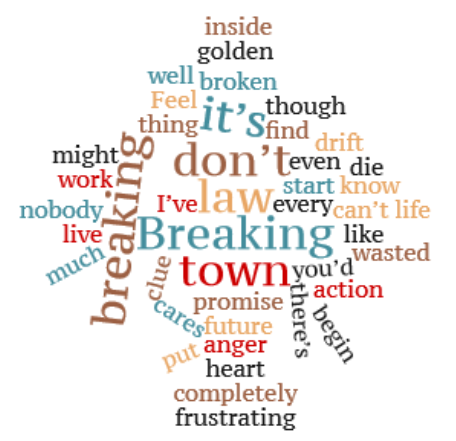
In red and bold, I marked the notions that are relevant for these heuristics. Analytically and philosophically, it might be very risky, even problematic to integrate not only individual notions (e.g. ‘law’ or ‘anger’) but entire word groups or clauses (e.g. ‘breaking the law’, ‘every promise broken’, ‘out of work’) into such a family of terms. This needs more and accurate thinking.
Yet what we gain from this is heuristically highly useful. We see very clearly that the categories of norm-related sonic knowledge in the lyrics (e.g. ‘law’, ‘breaking the law’) – in the constitution of their meanings – are closely linked to key aspects of metal culture like anger, frustration, or freedom. And further, these notions are linked to the sounds and music of heavy metal. ((R. Walser, Running with the Devil. Power, Gender, and Madness in Heavy Metal Music. Middletown, CT: Wesleyan University Press, 2014.)) A word cloud would arrange the lyrics in this way:
In a nutshell, these heuristics should make us able to identify the semantic and analytical links between the different categories of norm-related sonic knowledge. Moreover and equally important, they make visible the linkages to the mental, sonic, visual, and emotional ‘moods’ and dynamics of metal culture.
This week, I started working in the research project ‘Norm-Related Sonic Knowledge in Heavy Metal Culture: A Case Study of the Heavy Metal Scene in Graz and Styria‘ at the University of Graz. I have thematized it in a post some months ago. In this project, we want to find out how law-related phenomena (for instance, the topos of ‘Breaking the Law’ as a cultural narrative in metal since the early 1980s; the local scene ethics as ‘scene-laws’; the thematization of law and justice in local metal music; attitudes to law in the scene) affected the distinct cultural history of the local heavy metal scene in Styria, a ‘Bundesland‘ in the Southeast of Austria.
Asking for the ‘longue durée’ dimension of a scene history
In our research, oral history is one of the methods, that will be applied in the second, empirical phase of field work in 2021. With scene-members and stakeholders but also with professionals from the legal field (for instance lawyers and other professionals in the judicial system) from outside the scene, we will conduct interviews on their narratives of law (in metal). Already at this early stage, at the point of re-reading the crucial literatures in the field, it is necessary to reflect upon the question how exactly oral history can be applied fruifully in our research. ((See L. Abrams, Oral History Theory, London and New York: Routledge: 2010; R. Perks and A. Thomson, The Oral History Reader, Routledge: London and New York, 2000; D. Ritchie, Doing Oral History, 3rd ed., Oxford: Oxford University Press, 2015.))
For us, one of the critical aspects of present scene research is the sometimes rather ahistorical conceptualization of the histories of local metal communities. From the point of view of trained historians, current scene theories tend to rather oddly isolate scenes from the broader historical flux of culture and their surrounding contexts. ((See. E. Baulch, Making Scenes: Reggae, Punk, and Death Metal in 1990s Bali, Durham, NC: Duke University Press, 2007; A Bennett, and R. A. Peterson (eds.), Music Scenes: Local, Translocal, and Virtual. Nashville, TN: Vanderbilt University Press, 2004; K. Kahn-Harris, Extreme Metal: Music and Culture on the Edge, New York: Berg, 2007; J. Wallach and A. Levine,‘“I Want You to Support Local Metal!”: A Theory of Metal Scene Transformation’, in Popular Music History 6, 1/2, 2011, 116-34.)) In a nutshell, metal music studies needs ‘more history’. In this respect, we see our expertise as a chance to better grasp the longue durée dimension characteristic of history.
For this purpose, oral history – a methodological and theoretical discourse developed mostly in English-speaking academia since the 20th century – makes a ‘weapon of choice’. Qualitative interviewing is broadly used in many branches of cultural research nowadays. What we aim at is unwrapping the long-lasting narratives of scene ethics and ‘scene-laws’ in the Styrian metal community, as they seem to have continuties since the early 1980s. Today, they are deeply routed in this community.
Does metal have a long-lasting history in Styria?
Thus, the pivotal matter in applying oral history in this case is not only about the selection of interviewees; above all, it matters to develop a set of questions that makes scene-members and stakeholders remember their versions of these narratives since the early 1980s. Summarized in a short formula we have to ask our interviews right at the start: “Does metal have a long-lasting history in Styria?” This is the opening question for our oral history inquiries.
I ended my last post on the paradox at the heart of metal studies with the suggestion that cultural history, as one individual discipline in the transdisciplinary field of metal studies, could become an exciting enrichment. It gives us the promise of a structurally exploration of the the intertwined histories of fandom, scholarship and ‘fan scholarship’ in the field. In this (admittedly rather short) blog post, I take up this thought and attempt a first comparative analysis of ‘fandom’ and ‘scholarship’ as historically constructed cultural institutions. Once more, I take and stress the point of view of a historian.
There seems to be a consensus in metal research that the nexus between metal fandom and metal scholarship is a crucial one. In Salzburg, Keith Kahn-Harris and Rosemary Lucy Hill encouraged us to proactively embrace the arising tension between both by self-reflexively asking diffictult questions on racism, sexism, bigotry, misogyny, nazism and other critical phenomena in the scenes. In this, history with its focus on developments over periods of decades (for metal studies this means to study the whole period since the inception of metal culture around 1970) can provide a helpfully orientating narrative. ((Peter Pichler, Metal Music and Sonic Knowledge in Europe: A Cultural History Since 1970, Bingley: Emerald, forthcoming.))
Seen historically, both fandom and scholarship are not essentialist roles or identities but social formations, that both have long histories. The habitus, rituals and practices of that structure them can be traced back deep in history. If we view them as such complexes of historically constituted roles, the hybrid zone formed by them together in metal studies receives sharper contours. I start with fandom.
Fandom
Usually, metalheads are stereotyped as male, long-haired (semi-)adults wearing band t-shirts and battle vests. ((Once more, refer to Weinstein’s classic work: Deena Weinstein, Heavy Metal: The Music and its Culture, Boulder, CO: Da Capo Press, 2000; also, see Bettina Roccor, Heavy Metal. Die Bands, die Fans, die Gegner, Munich: Beck: 1998.)) Practices such as the formation of moshpits or showing the ‘metal horns’ at concerts complete the stereotypical imagery. They are expressions of scene members’ feelings of belonging to their communities, performed in public and addressing audiences within the scence as well as outside the scene.
If we take the point of view of cultural history things appear in another light. Popular culture – and fandom as a crucial functional position of people in it – have a history that in some of its forms can be traced back to early modern periods; at least to the 19th century, when mass media established new forms of public spheres for mass audiences. The masses became literate. ((For introductory texts, see LeRoy Ashby, With Amusement for All: A History of American Popular Culture since 1830, Lexington, KY: University Press of Kentucky, 2009; John Storey, Cultural Theory and Popular Culture: An Introduction, Harlow: Person, 2009; Kaspar Maase, Populärkulturforschung: Eine Einführung, Bielefeld, 2019.)) Thus, fandom is a cultural construction that, today, takes varying forms in different pop cultures (e.g. literature, music, film, gaming, sports etc.) but all of them stem from one root of comparable processes over decades, sometimes even centuries (as in the case of soccer culture or the passion for classical music).
Taking this view very much relativizes the allegedly absolute newness of metal fan culture since the 1970s. Yes, the practices installed over almost five decades in the global metal scene produced some innovative patterns; however, only being constructed after 1970, the new rituals, practices and scene rules built there heavily relied on what has been learnt, experienced and practiced in other fan cultures before Black Sabbath took the stage. So, metal fandom is a cultural institution that can best be studied in comparison to other forms of fandom in history. And even more crucial, it has to be compared to other cultural institutions.
Scholarship
Let us come to scholarship. At first glance, scholarship seems to be something completely different. Scholars usually are seen as rational, well-educated and distinguished personalities. Once more, the stereotype is a male one. Scholars wear glasses, speak of almost non-understandable things and live in the ivory towers of their universities. Yet, also scholarship – and the modern intellectual as a role in it – are historically constructed phenomena. The role of both cannot be separated from the history of the university in Europe and the world since the Middle Ages. ((For introductory texts, see Hilde de Ridder-Symoens et al., eds., A History of the University in Europe, 3 vols., Cambridge: Cambridge University Press, 1992-2004; Thomas Sowell, Intellectuals and Society, New York, NY: Basic Books, 2010; Dietz Bering, Die Epoche der Intellektuellen 1898–2001. Geburt – Begriff – Grabmal, Berlin: Berlin University Press.)) Since the Middle Ages, philosophers, scientists, theologians and intellectuals – scholars in a most broad sense – tell us how to make sense of the world.
As said before, this role appears to be very different from fandom. Nonetheless its realities work – basically and structurally – in ways comparable to any other spheres of community-building. Academia knows rituals, do’s and dont’s, forms of identity-building and othering. ((See Anthony Becher and Paul R. Trowler, Academic Tribes and Territories, 2nd edn., Buckingham: Open University Press, 2001.)) The essential question here is what sets this cultural institution, grown out of the tree of a history of almost thousand years, apart from other cultural institutions such as fandom.
Seen from this angle, what separates them and what makes them comparable at once belongs to the same sphere: their historical backgrounds. How, on the one hand, scholars use the centuries-old narratives of scientific wisdom in their lives and how, on the other hand, metal fans use their decades-old narratives of metalness can be compared, but only historically so. Both have come together in the history of the field of metal studies.
Metal studies as a transgressive laboratory of cultural institutions
What can we learn from this? If we take the point of view of history, metal music studies is they structural point where both histories come together. Seen this way, metal studies is nothing else than a cultural discourse, in which the insitutions of metal fandom and scholarship – with all their heritage – build a ‘match’. Thus, we should see the field as a transgressive laboratory, in which we work on these cultural institutions in the long term and, arguably, shape the new ‘sub-institution’ of the ‘metal scholar’. It is not about playing off one against each other but much more about thinking this new institution in visionary yet critical ways.
Over the last two days, I had the wonderful opportunity of taking part in the inspiring Hardwired VII conference at the University of Salzburg. Already the seventh conference in this series, it was an event of intense discussions on topics of transdisciplinarity and transgression in metal studies. As such a stimulating event, it was an oportunity of further developing the scientific community in the field.
In this post, I want to reflect upon what – probably – can be called the ‘heart of metal studies’. Intentionally, I use this notion of the ‘heart’, because as a metaphor it evokes associations of vitality, life, energy and of the identity of the metal studies community. Worth remembering, German metal veterans Accept released a classic album called Metal Heart in 1985. ((Accept, Metal Heart, Portrait Records, 1985.))
Now what is at the heart of our field? From my point of view, taken together the two keynote lectures of the conference, by Rosemary Lucy Hill and Keith Kahn-Harris, summed up the crucial challenges scholars have to master in the coming years. Of course, I cannot deliver a full solution to the central problems of metal research in this blog post. From the perspective of a cultural historian, I want to comment upon the paradox at the heart of metal research.
In her lecture ‘”You’re asking the Wrong Question!” Methodology, Standpoint and Fandon in Metal Research’, Hill delivered an excellent analysis of the main problem of the field in its ‘teenage years’. Metal research is dominantly conducted by scholars, who also take part in the culture as metalheads. With this comes an obvious, structural conflict between the obligation of the scholars in us to keep a distant and critical view on metal and the metal fans in us, who love the music. Hill encouraged scholars to keep asking hard questions on the difficult aspects of metal, e.g. sexual violence, fascim, racism and misogyny.
In his keynote ‘Too much Transgression – Metal in an Age of Explicit Knowledge’, Kahn-Harris took up his work on metal culture and the concept of ‘reflexive anti-reflexivety’. For Kahn-Harris, today’s metal culture is to be seen as a culture in an age of abundant knowledge. Transgression takes new forms. He called these forms ‘transgressive literalism’, ‘transgressive unintellegibility’ and ‘transgressive inversion’. Also in his view, conflicts between stances to problematic aspects of metal have to be reconsidered.
For a cultural historian, both lectures thematize a paradox, which seems to form something like the heart, perhaps the dark heart of the field. This heart pumps into the field (and its community) its vitality and is its key problem at the same time. The core issue seems to be to develop theories, strategies and a communal habitus or ‘thought style’, which enable us of coping with the tensions between our identities as scholars and identites as fans in a productive way.
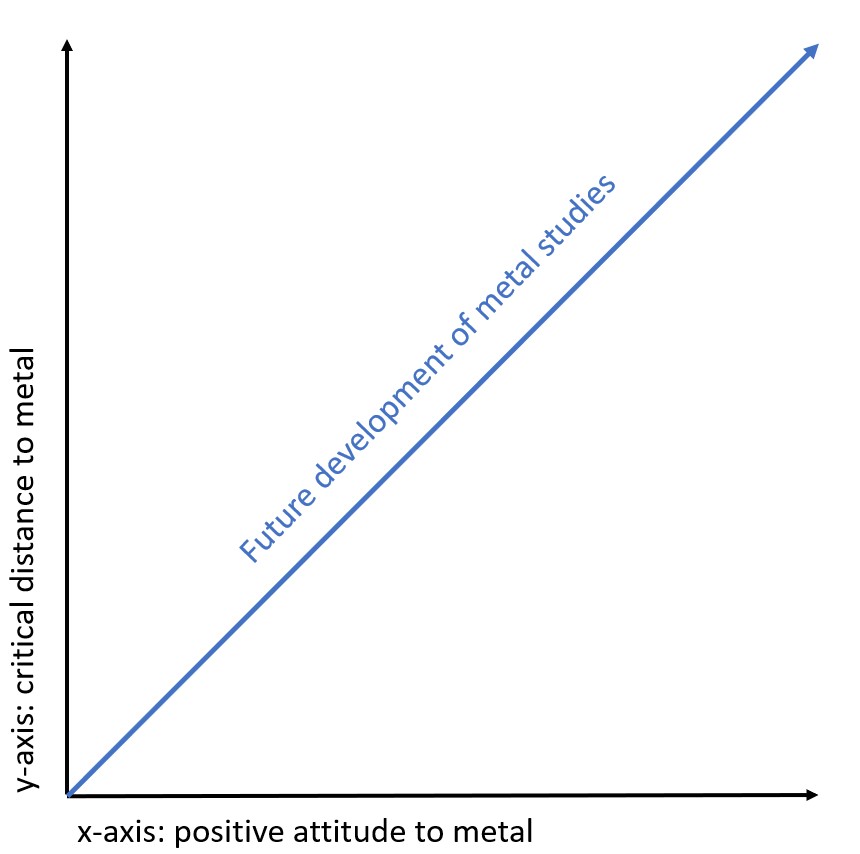
Logically, this is a classic paradox. The point here is, cultural-historical experience teaches us that usually paradoxes cannot be solved. ((For instance, for the paradoxical structure of the identity of the European Union between nation-state and ‘super-state’, see Peter Pichler, ‘European Union cultural history: introducing the theory of ‘paradoxical coherence’ to start mapping a field of research’, Journal of European Integration 1 (2018), pp. 1-16.)) In the long term, the identitary tensions that arise from such conflicts are solved only contigently by creating new spaces of knowledge, in that scholarship goes as far as possible in both directions: in the direction of critique and the direction of keeping a positive attitude to the culture. In a perfect metal studies world, which never will become reality, this could look a bit like this figure:
Thus, metal studies should not aim at defining a methodology or theory of metal that resolves the paradox. It should aim at constituting a new sphere of knowledge, in that we can go as far as possible into both directions. What Kahn-Harris called ‘engaged scholarship’ comes pretty close to this. With Hill, we should keep asking difficult questions. In this, history with its focus on longue durée developments over decades since 1970 could become an exciting enrichment. ((Peter Pichler, Metal Music and Sonic Knowledge in Europe: A Cultural History Since 1970, Bingley: Emerald, forthcoming.))
Currently, I am in a phase of revising some older texts on metal cultural history. During these revisions I realized that over the last five years since I started this blog, my approach to heavy metal records, as sonic sources of history, has changed quite a bit. In 2014, when I set out to write first pieces on albums like Behemoth’s The Satanist or Temple of Oblivion’s Traum und Trauma, I listened to those records like I did in the 20 years before – as a metalhead who happens to also be a historian.
When reading an older piece on Panopticon’s Revisions of the Past, I acknowledged that my identity as a metal listener developed into a new direction. There are times when I listen to Panopticon (or Behemoth or Temple of Oblivion) as a metalhead but there are also times when I listen to them intentionally as a metal scholar. Over the past few years, I developed a second, more ‘methodical’ mode of listening to records, as sonic historical sources. Herein, I do receive the music as ‘data’ and ‘process’ it in my texts.
I do not mention this career of my personal ‘metal ear’ ((I would like to thank all the participants at the ‘History’ panel at the ISMMS conference in Nantes on 19th June 2019 for sharing their thoughts on this matter.)) in order to celebrate it. I do so because, arguably, there is a significant methodological aspect hidden within such kind of self-reflection. Sound history, as a recent discourse of the new cultural history ((Burke, P. (2004). What is cultural history? Cambridge: Polity Press; Langenbruch, A. (2018). Klang als Geschichtsmedium. Perspektiven für eine auditive Geschichtsschreibung. Bielefeld: Transcript; Schrage, D. (2011). Erleben, Verstehen, Vergleichen. Eine soziologische Perspektive auf die auditive Wahrnehmung im 20. Jahrhundert. Studies in Contemporary History 8(2), 269-276.)) showed instructively that our ways of listening have changed significantly over the course of history. For instance, the sound of the motorization of modern cities in the early 20th century with car engines and car traffic changed how the inhabitants of the cities experienced urban worlds.
Analogically, in metal sound history, the structural situation of the metal ear in 2019 is very different from that of the early 1970s, i.e. when metal was ‘invented’. In 1970, fans listened to Black Sabbath’s debut on vinyl albums, at live concerts or on the radio. Today, we can listen to the debut and to their last LP 13 (and all of other recordings in their back catalogue) on one of the digital, globally available music platforms that are available via our smartphones. If we grow tired of Sabbath, it takes just a moment to jump to Rihanna, to Miley Cyrus or even to spoken content like comedy or audiobooks. Thus, our medial and structural situation of listening to metal and hearing metal today involves overwhelmingly more cross-genre and cross-media jumps, and hence there is also much more fluidness and transgression. Arguably, this affects the cultural metal ear.
On balance, this leads me to suggest to not only think of historical agents as ‘learning listeners’ or ‘conditioned listeners’ but also of ourselves as researchers in metal studies as potentially self-reflexive listeners. On myself, I can observe a kind of ‘distant listening’ when intentionally listening to metal records as a scholar. Having a certain potential of methodological meta-reflexivitiy, this kind of ‘distant listening’ could become an aspect of historical theorizing in metal. Strategically treating metal records as sonic historical sources, one could think of a sort of ‘training program’, in which this kind of listening would be consciously nurtured. This also implicates to claim a deeper interdisciplinary exchange between cultural and musicological research in metal studies.
Next week will see the 2019 edition of the black metal theory symposium in Ljubljana on 18 and 19 April. As I will not be able to make it there (but you should go there! 😉 ), though I want to take the event as my occasion for a short blog post on interidsciplinarity and metal culture.
Cultural-historically, black metal theory, both its journal and its symposia, is an immensely exciting phenomenon. The discourse attempts to bring together the robust spirit of black metal and metal studies. Hence, if taking its own credo seriously, it has to stay permanently pulsating, oscillating and on the move. In this way, it is hybrid. Historically, this discourse can be interpreted as a process of knowledge production, an attempt at creating knowledge practices in such a hybrid way.
Metal studies’ own credo stresses interdisciplinarity. It does not want to be an independent discipline, despite the fact that many of its current academic procedures, processes and gate-keeping rules tend to aim at a direction of canonization and discipline-building. As well, this is a process of knowledge history that influences significantly how metal will be researched in the next few years.
The fascinating historical fact is that we can bind back those processes of researching metal to metal history itself. ‘Invented’ and established above all in the UK in the 1970, then being diversified into mushrooming sub-genres and globalized in the 1980s, currently metal culture adapts itself to a new era of digitalization – with all its advantages and flaws of digital connectedness. Historian Wolfgang Schmale’s theory of a cultural ‘hypertext’ of history seems to be illumating when researching this history in a view of long durée. ((W. Schmale, Gender and Eurocentrism: A Conceptual Approach to European History, Stuttgart: Franz Steiner, 2016.))
Fascinatingly, all those 50 years of metal history permanently have consisted of processes, in that the knowledge forms and practices of metal culture relied on hybridity processes. Black Sabbath used established patterns, thrash and speed metal cultures combined eclectic elements into a new genre, so did death and black metal – always, newness started from established concepts and genres of doing and knowing rock culture. Genres are results of hybridization processes, so is metal itself.
The essential consequence, which arises from this, is quite a simple thought. Black metal theory tries to know metal culture using a hybrid paradigm. Metal heads and metal musicians know their music and culture in eclectically hybrid ways (despite all claims of ‘authenticity’ and ‘trueness’). This situation given, canonization, disciplinary narrowness and gate-keeping structues are metal music studies’ worst enemies. The academic field itself reflects the hybridity of the culture studied and will only work fruitfully if it will be capable of keeping its positive coherence of heterogenous approaches.
In this post, ((It is based on my conference talk at the conference “‘Music and Gender in Balance 2018”, Arctic University of Tromsö, Tromsö, Norway, 6 April 2018.)) I want to examine recent Scandinavian Extreme Metal music as a discourse, where gender balancing acts became a crucial field of negotiating the sub-genres’ structures. On the one hand, there is a growing number of female artists who perform harsh, “guttural” style vocals, which was a strictly male-connoted style of singing until about a decade ago.
This means there are transgressive gender constructions, which allow women aggressive, powerful and empowering enculturations of their gender identities. However, on the other hand, still hypermasculinity is prevailing in the field, being a major part of the genres’ codes of stylistic definition since the 1980s. I want to examine how this immensely conflictual contemporary history is kept in balance by artists, mediators, and their audience.
I start by giving a sketchy introduction to the field of Metal Studies and how contemporary history has an important position within its debates. I proceed by giving two examples of artists in the field: one of a female artist who represents the transgressive pole of the spectrum; and a second example of male gender constructions standing for the persisting and defining hypermasculine keycode. Third and finally, I will give a cultural-historical reading of this history, explaining how both can historically “work” and occur synchronically and meaningfully in a single regional discourse – with European and global implications.
Metal Music Studies and contemporary history
“Metal Music Studies” is a label for a global network of scholars who work on Heavy Metal music and culture, their interconnections, publications, conferences, and workshops. Roughly, research on Metal can be divided into three phases. ((Important works in the field are: D. Gaines, Teenage Wasteland: Suburbia’s Dead End Kids, New York, NY: Harper Collins, 1990; D. Weinstein, Heavy Metal: A Cultural Sociology, New York, NY: Lexington Books, 1991; R. Walser, Running with the Devil: Power, Gender and Madness in Heavy Metal Music, Hanover, NH: Wesleyan University Press, 1993: K. Kahn-Harris, Extreme Metal: Music and Culture on the Edge, New York, NY: Berg, 2007; H.M. Berger, Metal, Rock, and Jazz: Perception and the Phenomenology of Musical Experience, Hanover, NH: Wesleyan University Press 1999.)) A first phase between the early to mid-1990s saw pioneering monographic books by sociologists, anthropologists and musicologists. This was followed by a second phase of more intensified research and publications after 2000, but there was no such thing as Metal Studies yet.
This has changed since 2008. This year saw a conference called “Heavy Fundametalisms” in Salzburg, Austria. It catalysed the official launch of a learned society called the “International Society for Metal Music Studies” in 2013. ((www.metalstudies.org, accessed 31/03/2018.)) Since 2015, there also is an own peer-reviewed journal entitled “Metal Music Studies”. ((https://www.intellectbooks.co.uk/journals/view-Journal,id=236/, accessed 31/03/2018.)) In 2016, British sociologist Keith Kahn-Harris gave a description of the emergent field of Metal Studies:
What is the aim of metal studies? (…) At the one level the answer to this question is obvious. The aim of metal studies is to engage with metal in a scholarly fashion. This project needs no justification. (…) Yet there can also be a greater purpose for metal studies than simply the worthy creation of scholarship. The position of metal studies in relation to metal itself offers the opportunity for engaged scholarship. Most metal studies scholars are also engaged with metal as fans and metal scene members – but critically so. ((K. Kahn-Harris, ‘Introduction: The Next Steps in the Evolution of Metal Studies’, in B. Gardenour Walter e.a. (eds), Heavy Metal Studies and Popular Culture, Houndmills: Palgrave Macmillan, 2016, pp. 1-2; for introductory texts to the field see besides this anthology also A. R. Brown e.a. (eds), Global Metal Music and Culture: Current Directions in Metal Studies, Milton Park: Routledge, 2016; F. Heesch and A.K. Höpflinger (eds), Methoden der Heavy Metal-Forschung: Interdisziplinäre Zugänge, Münster and New York: Waxmann 2014; and the special issue of the Journal for Cultural Research 15, 3 (2011), devoted to ‘Metal Studies? Cultural Research in the Heavy Metal Scene’.))
This is a thoughtful commentary on the current state of Metal scholarship. It is a discourse on the brink of – probably – becoming an own specialized discipline or, at least, a highly specialized subfield. According to Kahn-Harris, ((Kahn-Harris, Introduction, pp. 3-7.)) Metal Music Studies should promote reflexivity by (1) nurturing resilience, (2) nurturing memory, (3) nurturing critique and (4) looking to the future.
All four of those goals can take several different forms. However, the second one, nurturing memory, is deeply connected to the engagement of historians. There exist many historical reflections on Metal and Metal Studies yet these histories have been written by sociologists, philosophers, anthropologists, linguists, musicologists or other disciplinary scholars. As in any other specialized discipline, historians ask their own questions, different from the ones in those disciplines. Thus, the nurturing of memory in the field needs reliable scientific narratives of Metal history by historians, too.
This is the background of my own research, which tries to help introducing the “historian’s gaze” to the field. ((https://www.peter-pichler-stahl.at/artikel/homo-ludens-metallicus-on-huizinga-cultural-history-and-sonic-knowledge-in-metal-music-studies/, accessed 31/03/2018.)) In our context, we can suppose a fundamental importance of two key research questions to be formulated by historians: (1) What have been the major historical developments of gender constructions in Heavy Metal music in recent years? (2) How has this particular history interfered, contrasted, or come together with a broader view on global and European gender history?
Two examples of Scandinavian Extreme Metal
In this respect, I choose Scandinavian Extreme Metal as an empirical example because it is a sub-discourse, where gender balancing happens in a dense, crystallized and symptomatic manner. This has at least three major reasons: (1) a first one being that specifically genres such as Thrash, Death Metal or Black Metal feature a pronounced gesture of hypermasculinity as one of their genre codes since the 1980s; (2) a second, regional reason being that several of the most influential forms of both Black and Death Metal music emerged in Scandinavia in the 1990s.
Finally, (3) a third can be found in the fact that, despite its hypermasculinity, Extreme Metal codified permanent transgression of the status quo, also concerning gender roles, as one of its other keycodes. Hence, in Scandinavia, the origin myths of Extreme Metal, its defining code of hypermasculinity as well as its permanent striving for transgression of boundaries form three highly conflictual strands interacting in a single regional discourse.
I want to give two examples of artists who represent both poles – one of empowering and transgressive female gender representation and one of persisting fundamentalist hypermasculinity; the latter should rather be called a “toxic” form of masculinity. ((A. Anderlin-Mahr, Vielfalt und Diversität anstatt toxischer Männlichkeit, in Blog W. Schmale, Mein Europa, https://wolfgangschmale.eu/andreas-enderlin-mahr_ueber_vielfalt-und-diversitaet-anstatt-toxischer-maennlichkeit/, accessed 02/04/2018.))
Representing Myrkur‘s identity after receiving death threats, the clip features differentiated strategies of female gender performance. At a first level, Bruun is shown as the conservative stereotype of a “soft woman” in a bright dress; on another, there also are sequences of female aggression, where blood is dripping from the artist’s mouth and she is screaming furiously. Both modes of female gender construction are shown alternating throughout the clip.
Here, the usual stereotype of male, Northern gutturally screaming Black Metal artists is transgressed, played with; in some ways, it even is dealt with and discussed in a parodistic and ironic manner. Myrkur can be both: “tender” woman and aggressive Black Metal frontwoman. The death threats sent to the artist give this cultural history of gender a very bitter taste; they show that this trend of transgressive and empowering female gender performance was partially perceived of as a “threat” to Extreme Metal’s definitional code of hypermasculinity.
Amon Amarth
Now, I go to my second example, representing the traditional gender codes of Extreme Metal, especially of the subgenres of Melodic Death Metal and Viking Metal. In these subgenres, Swedish band Amon Amarth is one of the most successful ones. Being founded in 1992, the group, so far, released ten albums. Their music fantastically constructs a vision of a pre-Christian, Viking Northern world.
Amon Amarth tell a history of the Vikings, in which brave and “real” men, weak women, violence, wars, and authenticity appear as the defining ingredients. In 2016, as a forerunner to their album “Jomsviking”, the band released a videoclip to the track “First Kill”:
The clip tells a very simple plot: a Viking man commits his first act of killing another man when this other man attempted to “steal his woman”. This form of hypermasculinity implies a representation of gender roles, in which women are men’s property; they can be “stolen” and a “real man” is forced to prevent other men from “stealing his women”. “he story gets even more extreme. After telling their audience of this “first kill”, the group continues the song with these lines:
(…) The first blood I spilled was the blood of a bard
I had to wipe the smile away
I was not yet a man, nor was I a boy
But still, I made that bastard pay (…) ((Lyrics to Amon Amarth, “First Kill”, released on the album “Jomsviking”. Metal Blade Records, 2016.))
In this quote, the “first kill” is told as a story of male initiation. A man’s first act of killing another man is narrated as a prerequisite of becoming a man. And the cause of committing this murder is that another man acted as a “threat” to his maleness.
Of course, Amon Amarth produce music as entertainment and fiction. However, in a frighteningly coherent way, this representation of toxic hypermasculinity, where a threat to one man’s maleness is perceived of as a matter of life and death, even of killing the supposed rival, also is a symptom of the logics of the death threats towards Myrkur. In her case, the artist was threatened to be killed because she invaded “male territory”.
In “First Kill”, the fictional story goes that one man must kill another man to defend or even in the first place achieve his full masculinity. Both cases follow the same logics of discourse: a threat to hypermasculinity requires such drastic reaction – but, shamefully and dangerously, the death threats towards Myrkur happened in the real world and today.
“Enter history”: making sense of the paradoxes
At this point, we know that the recent history of performances of gender in Scandinavian Extreme Metal music is one of the co-existence of seemingly binarily opposed poles: there is the transgressive pole represented by female artists like Myrkur; moreover, the toxic hypermasculinity which re-surfaces in “First Kill”. How can we make sense of this? How are those sharply divisive and contra-dictional gender performances balanced in a single discourse? My thesis is that we need deconstructive European cultural and gender history to start answering such questions.
In 2016, German historian Wolfgang Schmale published a thought-provoking book called “Gender and Eurocentrism: A Conceptual Approach to European History”. ((W. Schmale, Gender and Eurocentrism: A Conceptual Approach to European History, Stuttgart: Franz Steiner 2016.)) He put forward the hypothesis that, since Ancient times, a deep structural connection was established between performative discourses and gender discourses of masculinity. His theory of “collective performative speech acts” states that, since Antiquity, performative discourses were constructed to intrinsically, almost “logically” need such gender images to work at all.
This seems to be true for the Ancient performative speech act, which Schmale coins “homocentrism”, implying a dominance of the male. Most of all, this holds true for European cultural history since the 18th century and Enlightenment: since then, until very recently, history knows a collective performative speech act to be called “Eurocentrism”: performative discourses haveneeded visions of white, European and male hegemony to work at all.
This is a provocative claim because it states a deep and strong, almost “logical” discursive connection between male gender and performance at large. But this is not Schmale’s final conclusion. He comes to the argumentation that, today, history moves towards a new discursive structure of “post-performativity”, in which the almost “logical” connection between male gender and performance gets, step by step, discourse by discourse, deconstruction by deconstruction loosened – because of the disappearance of working speech collectives.
This thought-provoking result needs further research. However, this mode of explanation proves to be illuminating for our case study: it states that, since over 250 years, performative discourses were strategically constructed toneed logics of white, male and European hegemony to be able to balance their sense-making. This is no legitimization of any form of violence or discrimination arising from this; on the contrary, it emphasizes the constructivity of any gender constructions.
This can be applied straight-forwardly to our case: since its inception in the 1980s, Scandinavian Extreme Metal has continued the performative logics of hypermasculinity s to be able of performing performative speech acts at all. Nevertheless, today, we witness an emerging history of “post-performativity”, in which the strict coherence in sense-making between male gender and performance becomes loosened.
Exactly this is the way how artists like Myrkur and Amon Amarth can perform meaningfully in a single discourse. This, the slow trajectory towards a loosening between gender and performance is the way how the paradoxes are balanced. To conclude, this leads me to two main points as my result, perhaps furthermore significant for other discourses:
First, to balance gender and music in Scandinavian Extreme Metal, we need to establish a discourse in which the long-standing connection between hypermasculinity and performance since the 18th century can be discussed critically and historically. So to speak, Scandinavian Extreme Metal is a discourse in which, still today in 2018, the 18th century and the 21st century happen in the same place at the same time – however puzzling that is.
Second, even more puzzling, we need to examine exactly which inventory of strategies makes possible successful transgressions, which could even more loosen the shameful and dangerous connection between Eurocentrism and gender. In Myrkur’s case, it seems to be the trope of courageous irony, strategically juxtaposing hypermasculinity and female aggression.