Tag: interdisciplinarity

  • Writing about writing about heavy metal, part four: how do you explain (Styrian) heavy metal?

    Since my last blog post on the “Mexican experience” of writing about metal, quite some time has passed. Also in writing my book about the history of the Styrian heavy metal scene. At the moment, the focus of the writing is on the phase of the 1990s with its pluralisation tendencies and the 2000s with the beginning digitalisation of the scene.

    What is formative for this phase and therefore now also characterises the reflection on writing are both continuities and processes of change in the Styrian metalness identity in those years compared to the 1980s as the founding period. The scene consolidated and pluralised in the 1990s, finally becoming digital around 2000.

    In writing, this touches on a theoretical core question of metal studies, namely how heavy metal (in Styria) can be theoretically explained. For these decades, the history of the Styrian metal scene is about determining the interplay of law, morality and sound for the construction of the local metalness identity. There is the “pure” historiographical, the “pure” musicological and the “pure” legal view – or the possibility, which seems wiser to me, of thinking all three integrally and together.

    It therefore seems most appropriate to me at this stage of writing to see the history of metal in Styria since 1990 as a “hybrid” of musical, moral and legal aspects. All together make up the specific “soundness” of this scene. Metal can therefore perhaps be explained as the “trinity” of law, morality and sound – at least in this specific scene at this specific time.

  • Writing about writing about heavy metal, part three: the Mexican experience

    Over a month ago now, I had the great pleasure of attending the fifth conference of the “International Society for Metal Music Studies” in Mexico City. This central event of Metal Studies usually takes place every two years, but in this case was held this year instead of last year due to the Corona pandemic. In this blogpost, I want to reflect on how this event – possibly – changed my own writing about metal, especially about the history of the Styrian metal scene, which I have been researching intensively for two and a half years now.

    The conference in Mexico City, which was attended by about seventy of the leading researchers in Metal Studies, was dedicated to the topic of “Heavy Metal in the Global South: Multiregional Perspectives”. I gave a presentation on my research project on the Styrian metal scene. My central thesis was that the theoretical worlds of “Global South Studies” could potentially help to better explain cultural transfers between metal scenes across the “Iron Curtain” before 1989/90. My talk can be seen online here.

    With the temporal distance of about a month that exists today for me to this conference, it becomes more and more clear to me that in a certain sense it has had an influence on my thinking and writing about metal. One could speak of a “Mexican experience” that has had an impact – possibly not only on me – on personal and individual Metal Studies discourse. How can this be and what kind of change is it? What is this “Mexican experience” supposed to be?

    Basically, there are two points to be made in the reflection. The first is a sociological one of scholarship, the second a thematic one in the choice of the research object. On the first level of this conference as a collective academic experience of the participating researchers, it is hardly surprising that such a major event has an influence on the personal metal paradigm. At this conference, the latest findings in the field were presented and discussed, renegotiating the way scholarship writes and talks about metal. It is compellingly logical at this level  that paradigmatic shifts manifested here individually and collectively.

    The second point is then particularly interesting – and I think also particularly transformatively effective. In Mexico City, the “southern” perspective on metal and Metal Studies was in the foreground. For me, as a scholar from the “global north,” the themes and the values and notions of norms that were linked to the study of metal at this event made a crucial thematic aspect much clearer. It is always dangerous to speak of historical tendencies, as they invite stereotyping and essentialization of complex historical processes.

    If one nevertheless attempts such a historiographical trend survey, it can be summed up as follows: in the “global north” metal has already become much more commodified, an expression of northern affluence saturation. Here, metal is only “dangerous” or profoundly socially transformative in exceptional cases. In the “south,” on the other hand – and this was the “Mexican experience” that for me still burned itself in much more strongly than before – metal and Metal Studies are still inextricably linked to the struggle for social equality, decolonization, and protest against injustice. Here metal is even more socially transformative.

    For my own writing about metal, this Mexican experience is extremely enriching and important. For the remaining stages of my book on the Styrian metal scene since 1980, which I am currently working on, it follows that I should look in particular at those historical times and spaces where metal had a liberalizing and socially transformative effect in this sense. For example, in the confrontation with still existing catholic-conservative traditions in Graz in the early 1980s, when the scene was founded, or in the fight against right-wing extremist and neo-Nazi tendencies in the 1990s. The Mexican experience is a call to write about metal again more strongly also as scientific-cultural empowerment, enlightenment in the most original sense.

  • “Aren’t you the guy doing this metal studies interview stuff?”: On distance and self-reflection

    In my recent post, I wrote about oral history as a the method of choice to decode the Styrian metal scene’s emerging collective memory. This scene memory depends on the the scene’s shared attitude towards law. Since then, my research has progressed. Another series of interviews was conducted, the discourse analysis has been continued.

    Still, I have the feeling the empirical research is progressing well. The last third of the field research period has begun. In this post, I do not want to go into details about the data collected (this will happen in later posts). Rather, I want to focus on one issue, which – once more – has proven to be crucial: the question of closeness and distance in metal studies.

    Prior to my research, I was a member of this local heavy metal community. I knew scene members and attended concerts. It was – more or less – a silent leisure pleasure. After 21 months of local scene research and consequently many intense contacts with the scene members, I am the ‘metal studies dude’ now. “Aren’t you the guy doing this metal studies interview stuff?”, is a question I am approached with regurlarly at scene events.

    This means that my position in the community seems to have changed. The knowledge about the project circulating, there comes even more support from the scene. I am eternally to the scene members for their neverending patience with my questions. This patience is metal.

    However, with the growing visibility the key issue of the position of the researcher in the community investigated has become vital once more. As now my position has turned from a silent academic watcher to a more visible role, I have to re-reflect upon the question of distance and closeness.

    I would suggest that, in metal studies, each step of data collection in the scene should be reflected upon by the researcher carefully and thoroughly right after having taken the step. Hence, I do not want to be only the guy doing the metal studies interviews stuff but as well the guy thinking about the interview stuff.

  • The Styrian metal scene in 2021: ‘Pandemism’ and localism

    Copyright of the elements of the title image: cover artwork ‘Thrashing Death Squad’ EP © MDD/Black Sunset Records 2021; branding artwork ‘Metal on the Hill 2021’ © Napalm Records 2020.

    In my project on the Styrian metal scene since 1980, I am currently conducting oral history interviews in this local metal community. I have already talked with several stakeholders, musicians, studio owners, record producers, and other community members. I am very grateful to them for beeing so cooperative and open during the interview sessions. While some of my initial assumptions about the scene have proven to be right, others have been corrected or modified. Steadily, the evaluation of the interview recordings opens up new insights. This phase of research will last about a year until early 2022.

    Of course, the Covid19 pandemic has been one of the crucial topics in most of these interviews. Scene members experience the pandemic in different ways, depending on many individual and social factors. However, some shared patterns of experiencing the pandemic seem to be recognizable. Most of the local metalheads share a very understandable frustration about the lack of concerts and scene events. Also, most of them feel an uncertainty or are worrying about the scene community’s future.

    On balance, the pandemic crisis seems to catalyze the trend of digitalization that was already transforming the scene before 2020. Digital concert streams and many other forms of digital scene life are gaining momentum. Because of the present lack of opportunities to play gigs, the scene moreover witnesses a productivity boost. Bands focus on studio recordings – as far as this is possible under the current conditions.

    Fascinatingly, in this phase of a new productitivity in the Styrian metal scene, a new localism is gaining momentum. A number of new Styrian records  – for example, the new split EP by Darkfall and Mortal Strike shown in the title image – thematize local semiotics. They rework cultural themes from Styria and Graz – for instance, the traditional Styrian blazon. Another example is the branding of the ‘Metal on the Hill’ festival scheduled for August 2021, also shown in the title image.

    Intriguingly, the new productivity in the scene promotes feelings of local Styrian beloging, identity, and history. The new music is more ‘Styrian’ than ever before. This recent phenomenon, which I am tempted to call the scene’s ‘pandemism’ (in a sense of trying to culturally cope with the pandemic crisis in form of musical self-empowerment), is crystalizing currently. Hence, from 2021 onwards, the ‘glocal’ character of the scene seems to be even more important than before. We should keep an eye on both the ‘pandemism’ and the localism.

  • What lies ahead in 2021: Empirical fieldwork

    For my project on the metal scene in Graz and Styria since 1980, I am currently finalizing the framework for the empirical research in 2021. As written in an earlier post, the overall aim is to reconstruct the history of the ‘local metallic association chain’ in Styria.

    Most of the second year of the project will be devoted to intense empirical work. The project teams employs three methodical streams – musicological analysis, oral history, and semantic discourse analysis – to grasp the multidimensional phenomenon of the Styrian scene. In the following, I give a rough sketch of what lies ahead for the ‘Norikum’ project in 2021.

    Analyzing Styrian metal music…

    As already my terminology of metal indicates (I call it ‘sonic knowledge’), I treat music and sound as the ‘heart’ of metal culture. Everything in metal depends from knowing and experiencing the music and its sonic sphere. My project colleague Charalampos Efthymiou now proceeds to analyze the musical production from the local scene. In his analysis, he will focus on the aspect of ‘law’. Together, we already have set up a corpus of relevant songs and albums. About 15 song will be analyzed formally and in the contexts of their albums – to identify ‘law patterns’ in the musical language. ((See D. Elflein, Schwermetallanalysen: Die musikalische Sprache des Heavy Metal, Bielefeld: 2010.))

    Analyzing how the scene history is narrated…

    Since at least the second half of the 20th century, oral history is one oft he most prominent research methods in contemporary history. ((See L. Abrams, Oral History Theory, London and New York: Routledge: 2010; R. Perks and A. Thomson, The Oral History Reader,  Routledge: London and New York, 2000; D. Ritchie, Doing Oral History, 3rd ed., Oxford: Oxford University Press, 2015.)) Oral history interviews make open forms of creating the historical source in the dialogue between the interviewee and the researcher. The first must be given the chance to construct his narrative, the latter must nourish this process. I (and another member of the project team) will lead oral history interviews with about twenty interviewees. The sample of interviewees will be constructed to represent the gender and class structure of the local scene as well as include non-scene members with their perspectives on local metal. I already have identified the key interviewees.

    Analyzing the local scene discourse…

    Though music and sound – sonic knowledge – are at the heart of Styrian metal, its history can only really be understood when interpreting its textual, visual and fashion artefacts – tshirts, album covers, texts, flyers – as integral elements of the scene discourse. Music, sounds, images, texts and fashion make a fabric of meanings that has to be decoded integrally. ((See A.-K. Höpflinger, Religiöse Codes in der Populärkultur. Kleidung der Black Metal-Szene, Baden-Baden: Nomos, 2020;also, see A. Frings e.a. (eds.), Vergangenheiten auf der Spur. Indexikalische Semiotik in den historischen Kulturwissenschaften, Bielefeld: Transcript, 2012.))

    I am constructing a corpus of about twenty locally worn tshirts, about fifteen to twenty flyers (refering to crucial events in the scene history since 1980) and about twenty album covers (of well-known local metal records) as semiotic sources. A discourse analysis of the semantic relations between visuals, sound, texts and fashion should enable us to reconstruct this scene discourse for the decades since 1980.

    What lies ahead in 2021

    To sum up, in the ‘Norikum’ project 2021 will be devoted to intense empirical work. Analyzing the local metal music, leading oral history interviews and analyzing the fabric of the local scene culture will provide us with the necessary research data to start writing this history in 2022. Later this year, I will post an research report summarizing the key findings of the first year on the project website.


  • Wittgenstein, Davidson and Halford: the heuristics of studying norm-related sonic knowledge

    This is the first post, which ‘officially’ discusses my research in the new project ‘Norm-related sonic knowledge in Heavy Metal culture’. We started on 1 February and are currently working on the project website, which will go online in a few days. There, blog posts from the project will be featured in a special section and appear in the newsfeed too.

    In this first post, I want to address a topic which is crucial in our research: the heuristics of what I called ‘norm-related sonic knowledge’. The main question here is how we plan to map this realm of knowledge.  This sphere is constituted by law-related phenomema in metal culture, metal practices, metal music and metal networks. We need a good heuristical strategy to map the field.

    Here, the result of a fruitful conversation I had recently with my colleague Christian Hiebaum (a legal philosopher and legal sociologist at the University of Graz) is key. In our discussion, Christian raised the point that, philosophically and analytically, all the terms involved (e.g. justice, law, legal system, crime, moral, ethics, law-breaking, rule-breaking etc.) form something like a ‘family’ or a ‘Sprachspiel’ of terms.

    Taking up the thoughts of analytical philosophers like Donald Davidson ((See D. Davidson, The Essential Davidson. Oxford: Oxford University Press. 2006; D. Davidson, Truth, Language, and History: Philosophical Essays, Oxford: Oxford University Press. 2005; D. Davidson, Truth and Predication. Cambridge, Mass.: Harvard University Press. 2005.)) and Ludwig Wittgenstein ((See C. Bezzel: Wittgenstein zur Einführung. Junius, Hamburg 2000, L. Wittgenstein, Philosophische Untersuchungen. Frankfurt: WBG, 2001.)), it is quite easy to recognize that all the categories of norm-related sonic knowledge form a ‘pool’ or a ‘family’ of notions and meanings. Heuristically, the crucial point is how the meaning of each individual term is constituted within this family.

    Herein, each of the terms – in its individual meaning – depends on the other ones. Let us think of some examples. To be understood and fulfill its function in culture,  the notion ‘law’ relies on its links to related notions like ‘justice’, ‘ruling’, ‘order’ ‘legality’ or ‘law-breaking’. The notion ‘breaking the law’ needs a presupposed and in the metal scene shared understanding of terms like ‘law’, ‘morality’ or ‘crime’.

    If we take Judas Priest’s classic ‘Breaking The Law’ once more as a paradigmatic example, this approach makes us look at the lyrics in a new way:

    There I was completely wasted, out of work and down
    All inside it’s so frustrating as I drift from town to town
    Feel as though nobody cares if I live or die
    So I might as well begin to put some action in my life

    Breaking the law, breaking the law
    Breaking the law, breaking the law
    Breaking the law, breaking the law
    Breaking the law, breaking the law

    So much for the golden future I can’t even start
    I’ve had every promise broken, there’s anger in my heart
    You don’t know what it’s like, you don’t have a clue
    If you did you’d find yourselves doing the same thing too

    Breaking the law, breaking the law
    Breaking the law, breaking the law
    Breaking the law, breaking the law
    Breaking the law, breaking the law… ((Lyrics to Judas Priest, ‘Breaking The Law’, on British Steel, 1980.))

    In red and bold, I marked the notions that are relevant for these heuristics. Analytically and philosophically, it might be very risky, even problematic to integrate not only individual notions (e.g. ‘law’ or ‘anger’) but entire word groups or clauses (e.g. ‘breaking the law’, ‘every promise broken’, ‘out of work’) into such a family of terms. This needs more and accurate thinking.

    Yet what we gain from this is heuristically highly useful. We see very clearly that the categories of norm-related sonic knowledge in the lyrics (e.g. ‘law’, ‘breaking the law’) – in the constitution of their meanings – are closely linked to key aspects of metal culture like anger, frustration, or freedom. And further, these notions are linked to the sounds and music of heavy metal. ((R. Walser, Running with the Devil. Power, Gender, and Madness in Heavy Metal Music. Middletown, CT: Wesleyan University Press, 2014.)) A word cloud would arrange the lyrics in this way:
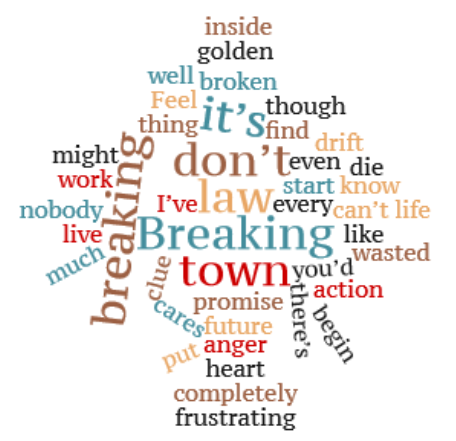
    In a nutshell, these heuristics should make us able to identify the semantic and analytical links between the different categories of norm-related sonic knowledge. Moreover and equally important, they make visible the linkages to the mental, sonic, visual, and emotional ‘moods’ and dynamics of metal culture.

  • On the history of the ‘metal ear’ and methodological ‘distant listening’

    Currently, I am in a phase of revising some older texts on metal cultural history. During these revisions I realized that over the last five years since I started this blog, my approach to heavy metal records, as sonic sources of history, has changed quite a bit. In 2014, when I set out to write first pieces on albums like Behemoth’s The Satanist or Temple of Oblivion’s Traum und Trauma, I listened to those records like I did in the 20 years before – as a metalhead who happens to also be a historian.

    When reading an older piece on Panopticon’s Revisions of the Past, I acknowledged that my identity as a metal listener developed into a new direction. There are times when I listen to Panopticon (or Behemoth or Temple of Oblivion) as a metalhead but there are also times when I listen to them intentionally as a metal scholar. Over the past few years, I developed a second, more ‘methodical’ mode of listening to records, as sonic historical sources. Herein, I do receive the music as ‘data’ and ‘process’ it in my texts.

    I do not mention this career of my personal ‘metal ear’ ((I would like to thank all the participants at the ‘History’ panel at the ISMMS conference in Nantes on 19th June 2019 for sharing their thoughts on this matter.)) in order to celebrate it. I do so because, arguably, there is a significant methodological aspect hidden within such kind of self-reflection. Sound history, as a recent discourse of the new cultural history ((Burke, P. (2004). What is cultural history? Cambridge: Polity Press; Langenbruch, A. (2018). Klang als Geschichtsmedium. Perspektiven für eine auditive Geschichtsschreibung. Bielefeld: Transcript; Schrage, D. (2011). Erleben, Verstehen, Vergleichen. Eine soziologische Perspektive auf die auditive Wahrnehmung im 20. Jahrhundert. Studies in Contemporary History 8(2), 269-276.)) showed instructively that our ways of listening have changed significantly over the course of history. For instance, the sound of the motorization of modern cities in the early 20th century with car engines and car traffic changed how the inhabitants of the cities experienced urban worlds.

    Analogically, in metal sound history, the structural situation of the metal ear in 2019 is very different from that of the early 1970s, i.e. when metal was ‘invented’. In 1970, fans listened to Black Sabbath’s debut on vinyl albums, at live concerts or on the radio. Today, we can listen to the debut and to their last LP 13 (and all of other recordings in their back catalogue) on one of the digital, globally available music platforms that are available via our smartphones. If we grow tired of Sabbath, it takes just a moment to jump to Rihanna, to Miley Cyrus or even to spoken content like comedy or audiobooks. Thus, our medial and structural situation of listening to metal and hearing metal today involves overwhelmingly more cross-genre and cross-media jumps, and hence there is also much more fluidness and transgression. Arguably, this affects the cultural metal ear.

    On balance, this leads me to suggest to not only think of historical agents as ‘learning listeners’ or ‘conditioned listeners’ but also of ourselves as researchers in metal studies as potentially self-reflexive listeners. On myself, I can observe a kind of ‘distant listening’ when intentionally listening to metal records as a scholar. Having a certain potential of methodological meta-reflexivitiy, this kind of ‘distant listening’ could become an aspect of historical theorizing in metal. Strategically treating metal records as sonic historical sources, one could think of a sort of ‘training program’, in which this kind of listening would be consciously nurtured. This also implicates to claim a deeper interdisciplinary exchange between cultural and musicological research in metal studies.

  • On interdisciplinary and transdisciplinary cooperations in metal music studies

    Currently, I am putting final touches on the manuscript of my book on European metal cultural history. ((P. Pichler, Metal Music and Sonic Knowledge in Europe: A Cultural History, Bingley: Emerald, Forthcoming.)) In this stage of revision, I have been thinking a lot about the forms interdisciplinary and transdisciplinary cooperations take in metal studies. In the following, I elaborate upon my view of these in our field crucial processes and invite my peers to discussion.

    In each of the currently existing introductory books to our field (and also in more specialized studies), the character of metal research is described as interdisciplinary and transdisciplinary. It is a discourse, in that since its inception around 1990 scholars from musicology, sociology, philosophy, linguistics, the study of religion etc. cooperate and discuss a shared subject: metal.

    However, often we approach the shared subject from very different angles and speak different disciplinary languages. For each of us, the epistemic and theoretical vocabularies we use are informed by our various disciplinary trainings. In my case, I live in the world of an Austrian historian, educated in this small country in central Europe. Thus metal studies, beneath the surface, is not only an interdisciplinary and transdisciplinary enterprise but also an ‘inter-identitary’ and ‘trans-identitary’ one, transgressing the boundaries between our sociological, musicological, historiographical, philosophical etc. identities.

    This has serious consequences. In metal studies, at conferences, in book projects, in collaborations and cooperations, we regularly face situations of conflict, of nonunderstanding and of misunderstanding caused by our various disciplinary traditions. From my point of view, there can be only one solution to this crucial issue: more theoretical self-reflection and and a clearly and explicitly defined theoretical language.

    In the sense of Savigny and Schaap’s recent essay on ‘putting the studies back into metal music studies’, ((H. Savigny and J. Schaap, ‘Putting the ‘studies’ back into metal music studies’, Metal Music Studies 4, 3 pp. 549-557)) we should lead an open discussion on key terms like ‘metal’ itself, but also on ‘scene’, ‘time’, ‘space’, ‘sound,’ ‘history’, ‘identity’, ‘culture’…obviously, the list ist opend-ended. The point here is to put more emphasis on explicit work on terminologies – in order to perhaps give birth to an independent language of metal studies.

  • Interdisciplinarity, crossover, black metal theory: a single cultural history

    Next week will see the 2019 edition of the black metal theory symposium in Ljubljana on 18 and 19 April. As I will not be able to make it there (but you should go there! 😉 ), though I want to take the event as my occasion for a short blog post on interidsciplinarity and metal culture.

    Cultural-historically, black metal theory, both its journal and its symposia, is an immensely exciting phenomenon. The discourse attempts to bring together the robust spirit of black metal and metal studies. Hence, if taking its own credo seriously, it has to stay permanently pulsating, oscillating and on the move. In this way, it is hybrid. Historically, this discourse can be interpreted as a process of knowledge production, an attempt at creating knowledge practices in such a hybrid way.

    Metal studies’ own credo stresses interdisciplinarity. It does not want to be an independent discipline, despite the fact that many of its current academic procedures, processes and gate-keeping rules tend to aim at a direction of canonization and discipline-building. As well, this is a process of knowledge history that influences significantly how metal will be researched in the next few years.

    The fascinating historical fact is that we can bind back those processes of researching metal to metal history itself. ‘Invented’ and established above all in the UK in the 1970, then being diversified into mushrooming sub-genres and globalized in the 1980s, currently metal culture adapts itself to a new era of digitalization – with all its advantages and flaws of digital connectedness. Historian Wolfgang Schmale’s theory of a cultural ‘hypertext’ of history seems to be illumating when researching this history in a view of long durée. ((W. Schmale, Gender and Eurocentrism: A Conceptual Approach to European History, Stuttgart: Franz Steiner, 2016.))

    Fascinatingly, all those 50 years of metal history permanently have consisted of processes, in that the knowledge forms and practices of metal culture relied on hybridity processes. Black Sabbath used established patterns, thrash and speed metal cultures combined eclectic elements into a new genre, so did death and black metal – always, newness started from established concepts and genres of doing and knowing rock culture. Genres are results of hybridization processes, so is metal itself.

    The essential consequence, which arises from this, is quite a simple thought. Black metal theory tries to know metal culture using a hybrid paradigm. Metal heads and metal musicians know their music and culture in eclectically hybrid ways (despite all claims of ‘authenticity’ and ‘trueness’). This situation given, canonization, disciplinary narrowness and gate-keeping structues are metal music studies’ worst enemies. The academic field itself reflects the hybridity of the culture studied and will only work fruitfully if it will be capable of keeping its positive coherence of heterogenous approaches.