In 1979, Motörhead released the song ‘Too Late Too Late’ as a b-side to the ‘Overkill’ single. If we take the song title as a question, it seems to fit the history of female emancipation in heavy metal culture. As already Deena Weinstein stated in her pivotal cultural sociology of metal, ((D. Weinstein, Heavy Metal: The Music and its Culture, Boulder, CO: Da Capo Press, 2000.)) metal culture has been imbued with conservative gender stereotypes right from the start. Nonetheless, metal itself as well as metal studies have diversified in terms of gender roles since. ((A. Digioia & L. Helfrich, ‘”I’m sorry, but it’s true, you’re bringin’ on the heartache”: The antiquated methodology of Deena Weinstein’, in Metal Music Studies Volume 4, Number 2, 1 June 2018, pp. 365-374; also, see more globally: H. Savigny & J. Schaap, ‘Putting the “studies” back into metal music studiesPutting the ‘studies’ back into metal music studies’, in Metal Music Studies Volume 4, Number 3, 1 September 2018, pp. 549-557.))
In this blog post, I want to take up these reflections on female gender roles in metal and discuss them under the auspices of the theoretical notion of ‘norm-related sonic knowledge’. This notion is at the heart of the research project on law-related phenomena in metal cultural history I am leading in the three coming years. In this project, we want to research how law and law-related phenonema contributed to the specific scene-building process in Graz and Styria from the 1980s to the present.
In one of the two peer-reviews of the research proposal, the reviewer mentioned critically that gender roles are an important matter in this project and should be researched more prominently. Undoubtedly, the reviewer was insofar right as law is intrinsically connected to the normative spheres of metalness and thus touches upon gender normativities. However, since this is the first research on this topic at all, we cannot deliver a ‘full’ history of all facets. Perhaps, systematically, it would make sense thinking of such more specifical research after the basic research on this scene is done. In this post, I will raise some points that could lead into this direction.
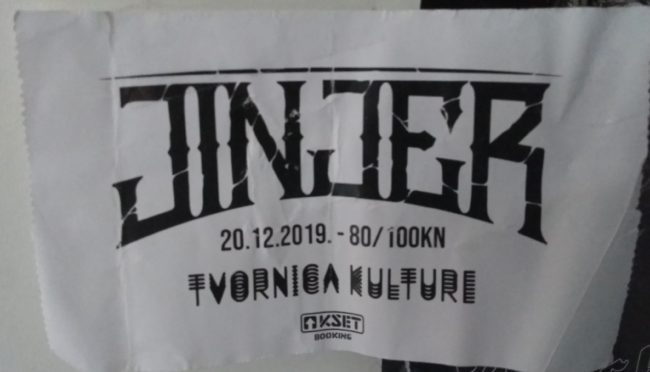
Jinjer in Zagreb
Last Friday, I had the opportunity to see the Ukrainian band Jinjer live in the venue of Tvornica Kulture in Zagreb, Croatia. The experience of a Jinjer concert is a great occasion to discuss this topic, because the band in highly interestingly ways breaks up usual gender standards in their music. Their music can be described as a mixture of death metal, djent and groove metal. Their musical language is characterized by ‘bouncing’ guitar riffs (that reminded me of Rage Against The Machine’s Tom Morello) and, most of all, the versatile vocals by singer Tatiana Shmailyuk .
It is this vocal style and the singer’s on stage performance that is worth taking a closer look. Being such a versatile vocalist, Shmailyuk performs both harsh guttural parts and clean melodic singing parts. The result is a combination of very aggressive parts and mellow melodic parts, usually within one individual song. Hence, reminding of black metal artisy Myrkur, the singer can play both roles of the 'tender' woman and of the aggressive female. These two short clips I recorded at the concert illustrate the band's musical language:
What I witnessed at the venue in Zagreb in front of an highly energetic, sometimes almost rowdily mosh-pitting crowd also was a musical perfomance of gender roles in metal. In her vocals, the singer delivered both aggression and softness. In this specific historical event of a concert, repeated during a tour cycle on an almost daily base, Jinjer broke up the normativities of metal gender roles and created something new. I do not know whether it was this sheer overwhelming experience of an emotional rollercoaster that dynamized the crowd's behaviours in such dramatic ways.
The norm-related sonic knowledge of gender in metal
In our project, we will use the mentioned concept of norm-related sonic knowledge as an analytical description of the longue durée dimension of sense-making in metal by law-related phenomena and topics. The notion describes how such phenomena were used in metal culture to constitute the normative sphere of the regional scene in Graz and Styria.
Already applied to the event of Jinjer’s performance in Zagreb, the notion leads to so far not asked questions on gender roles. If we see the history of female metalness as a long, diversifying and ambiguous development of normative ‘gender laws’ over almost fifty years since Black Sabbath took the stage, then this concert in late 2019 was a play in this history and with this history.
Jinjer took some of the key norms (conservative female gender roles), broke them into pieces and re-assembled them into a new set of rules that probably could contribute to new, more progressive ‘scene laws’ in the future. If we think of this recomposition as a deeply cultural-historical act refering to five decades of women in metal, this seems to come late but not too late – but only so if the culture itself and also metal studies seriously keep up engaging with ‘difficult’ topics such as racism, misogyny or nazism.
I ended my last post on the paradox at the heart of metal studies with the suggestion that cultural history, as one individual discipline in the transdisciplinary field of metal studies, could become an exciting enrichment. It gives us the promise of a structurally exploration of the the intertwined histories of fandom, scholarship and ‘fan scholarship’ in the field. In this (admittedly rather short) blog post, I take up this thought and attempt a first comparative analysis of ‘fandom’ and ‘scholarship’ as historically constructed cultural institutions. Once more, I take and stress the point of view of a historian.
There seems to be a consensus in metal research that the nexus between metal fandom and metal scholarship is a crucial one. In Salzburg, Keith Kahn-Harris and Rosemary Lucy Hill encouraged us to proactively embrace the arising tension between both by self-reflexively asking diffictult questions on racism, sexism, bigotry, misogyny, nazism and other critical phenomena in the scenes. In this, history with its focus on developments over periods of decades (for metal studies this means to study the whole period since the inception of metal culture around 1970) can provide a helpfully orientating narrative. ((Peter Pichler, Metal Music and Sonic Knowledge in Europe: A Cultural History Since 1970, Bingley: Emerald, forthcoming.))
Seen historically, both fandom and scholarship are not essentialist roles or identities but social formations, that both have long histories. The habitus, rituals and practices of that structure them can be traced back deep in history. If we view them as such complexes of historically constituted roles, the hybrid zone formed by them together in metal studies receives sharper contours. I start with fandom.
Fandom
Usually, metalheads are stereotyped as male, long-haired (semi-)adults wearing band t-shirts and battle vests. ((Once more, refer to Weinstein’s classic work: Deena Weinstein, Heavy Metal: The Music and its Culture, Boulder, CO: Da Capo Press, 2000; also, see Bettina Roccor, Heavy Metal. Die Bands, die Fans, die Gegner, Munich: Beck: 1998.)) Practices such as the formation of moshpits or showing the ‘metal horns’ at concerts complete the stereotypical imagery. They are expressions of scene members’ feelings of belonging to their communities, performed in public and addressing audiences within the scence as well as outside the scene.
If we take the point of view of cultural history things appear in another light. Popular culture – and fandom as a crucial functional position of people in it – have a history that in some of its forms can be traced back to early modern periods; at least to the 19th century, when mass media established new forms of public spheres for mass audiences. The masses became literate. ((For introductory texts, see LeRoy Ashby, With Amusement for All: A History of American Popular Culture since 1830, Lexington, KY: University Press of Kentucky, 2009; John Storey, Cultural Theory and Popular Culture: An Introduction, Harlow: Person, 2009; Kaspar Maase, Populärkulturforschung: Eine Einführung, Bielefeld, 2019.)) Thus, fandom is a cultural construction that, today, takes varying forms in different pop cultures (e.g. literature, music, film, gaming, sports etc.) but all of them stem from one root of comparable processes over decades, sometimes even centuries (as in the case of soccer culture or the passion for classical music).
Taking this view very much relativizes the allegedly absolute newness of metal fan culture since the 1970s. Yes, the practices installed over almost five decades in the global metal scene produced some innovative patterns; however, only being constructed after 1970, the new rituals, practices and scene rules built there heavily relied on what has been learnt, experienced and practiced in other fan cultures before Black Sabbath took the stage. So, metal fandom is a cultural institution that can best be studied in comparison to other forms of fandom in history. And even more crucial, it has to be compared to other cultural institutions.
Scholarship
Let us come to scholarship. At first glance, scholarship seems to be something completely different. Scholars usually are seen as rational, well-educated and distinguished personalities. Once more, the stereotype is a male one. Scholars wear glasses, speak of almost non-understandable things and live in the ivory towers of their universities. Yet, also scholarship – and the modern intellectual as a role in it – are historically constructed phenomena. The role of both cannot be separated from the history of the university in Europe and the world since the Middle Ages. ((For introductory texts, see Hilde de Ridder-Symoens et al., eds., A History of the University in Europe, 3 vols., Cambridge: Cambridge University Press, 1992-2004; Thomas Sowell, Intellectuals and Society, New York, NY: Basic Books, 2010; Dietz Bering, Die Epoche der Intellektuellen 1898–2001. Geburt – Begriff – Grabmal, Berlin: Berlin University Press.)) Since the Middle Ages, philosophers, scientists, theologians and intellectuals – scholars in a most broad sense – tell us how to make sense of the world.
As said before, this role appears to be very different from fandom. Nonetheless its realities work – basically and structurally – in ways comparable to any other spheres of community-building. Academia knows rituals, do’s and dont’s, forms of identity-building and othering. ((See Anthony Becher and Paul R. Trowler, Academic Tribes and Territories, 2nd edn., Buckingham: Open University Press, 2001.)) The essential question here is what sets this cultural institution, grown out of the tree of a history of almost thousand years, apart from other cultural institutions such as fandom.
Seen from this angle, what separates them and what makes them comparable at once belongs to the same sphere: their historical backgrounds. How, on the one hand, scholars use the centuries-old narratives of scientific wisdom in their lives and how, on the other hand, metal fans use their decades-old narratives of metalness can be compared, but only historically so. Both have come together in the history of the field of metal studies.
Metal studies as a transgressive laboratory of cultural institutions
What can we learn from this? If we take the point of view of history, metal music studies is they structural point where both histories come together. Seen this way, metal studies is nothing else than a cultural discourse, in which the insitutions of metal fandom and scholarship – with all their heritage – build a ‘match’. Thus, we should see the field as a transgressive laboratory, in which we work on these cultural institutions in the long term and, arguably, shape the new ‘sub-institution’ of the ‘metal scholar’. It is not about playing off one against each other but much more about thinking this new institution in visionary yet critical ways.
Over the last two days, I had the wonderful opportunity of taking part in the inspiring Hardwired VII conference at the University of Salzburg. Already the seventh conference in this series, it was an event of intense discussions on topics of transdisciplinarity and transgression in metal studies. As such a stimulating event, it was an oportunity of further developing the scientific community in the field.
In this post, I want to reflect upon what – probably – can be called the ‘heart of metal studies’. Intentionally, I use this notion of the ‘heart’, because as a metaphor it evokes associations of vitality, life, energy and of the identity of the metal studies community. Worth remembering, German metal veterans Accept released a classic album called Metal Heart in 1985. ((Accept, Metal Heart, Portrait Records, 1985.))
Now what is at the heart of our field? From my point of view, taken together the two keynote lectures of the conference, by Rosemary Lucy Hill and Keith Kahn-Harris, summed up the crucial challenges scholars have to master in the coming years. Of course, I cannot deliver a full solution to the central problems of metal research in this blog post. From the perspective of a cultural historian, I want to comment upon the paradox at the heart of metal research.
In her lecture ‘”You’re asking the Wrong Question!” Methodology, Standpoint and Fandon in Metal Research’, Hill delivered an excellent analysis of the main problem of the field in its ‘teenage years’. Metal research is dominantly conducted by scholars, who also take part in the culture as metalheads. With this comes an obvious, structural conflict between the obligation of the scholars in us to keep a distant and critical view on metal and the metal fans in us, who love the music. Hill encouraged scholars to keep asking hard questions on the difficult aspects of metal, e.g. sexual violence, fascim, racism and misogyny.
In his keynote ‘Too much Transgression – Metal in an Age of Explicit Knowledge’, Kahn-Harris took up his work on metal culture and the concept of ‘reflexive anti-reflexivety’. For Kahn-Harris, today’s metal culture is to be seen as a culture in an age of abundant knowledge. Transgression takes new forms. He called these forms ‘transgressive literalism’, ‘transgressive unintellegibility’ and ‘transgressive inversion’. Also in his view, conflicts between stances to problematic aspects of metal have to be reconsidered.
For a cultural historian, both lectures thematize a paradox, which seems to form something like the heart, perhaps the dark heart of the field. This heart pumps into the field (and its community) its vitality and is its key problem at the same time. The core issue seems to be to develop theories, strategies and a communal habitus or ‘thought style’, which enable us of coping with the tensions between our identities as scholars and identites as fans in a productive way.
Logically, this is a classic paradox. The point here is, cultural-historical experience teaches us that usually paradoxes cannot be solved. ((For instance, for the paradoxical structure of the identity of the European Union between nation-state and ‘super-state’, see Peter Pichler, ‘European Union cultural history: introducing the theory of ‘paradoxical coherence’ to start mapping a field of research’, Journal of European Integration 1 (2018), pp. 1-16.)) In the long term, the identitary tensions that arise from such conflicts are solved only contigently by creating new spaces of knowledge, in that scholarship goes as far as possible in both directions: in the direction of critique and the direction of keeping a positive attitude to the culture. In a perfect metal studies world, which never will become reality, this could look a bit like this figure:
Thus, metal studies should not aim at defining a methodology or theory of metal that resolves the paradox. It should aim at constituting a new sphere of knowledge, in that we can go as far as possible into both directions. What Kahn-Harris called ‘engaged scholarship’ comes pretty close to this. With Hill, we should keep asking difficult questions. In this, history with its focus on longue durée developments over decades since 1970 could become an exciting enrichment. ((Peter Pichler, Metal Music and Sonic Knowledge in Europe: A Cultural History Since 1970, Bingley: Emerald, forthcoming.))
Currently, I am in a phase of revising some older texts on metal cultural history. During these revisions I realized that over the last five years since I started this blog, my approach to heavy metal records, as sonic sources of history, has changed quite a bit. In 2014, when I set out to write first pieces on albums like Behemoth’s The Satanist or Temple of Oblivion’s Traum und Trauma, I listened to those records like I did in the 20 years before – as a metalhead who happens to also be a historian.
When reading an older piece on Panopticon’s Revisions of the Past, I acknowledged that my identity as a metal listener developed into a new direction. There are times when I listen to Panopticon (or Behemoth or Temple of Oblivion) as a metalhead but there are also times when I listen to them intentionally as a metal scholar. Over the past few years, I developed a second, more ‘methodical’ mode of listening to records, as sonic historical sources. Herein, I do receive the music as ‘data’ and ‘process’ it in my texts.
I do not mention this career of my personal ‘metal ear’ ((I would like to thank all the participants at the ‘History’ panel at the ISMMS conference in Nantes on 19th June 2019 for sharing their thoughts on this matter.)) in order to celebrate it. I do so because, arguably, there is a significant methodological aspect hidden within such kind of self-reflection. Sound history, as a recent discourse of the new cultural history ((Burke, P. (2004). What is cultural history? Cambridge: Polity Press; Langenbruch, A. (2018). Klang als Geschichtsmedium. Perspektiven für eine auditive Geschichtsschreibung. Bielefeld: Transcript; Schrage, D. (2011). Erleben, Verstehen, Vergleichen. Eine soziologische Perspektive auf die auditive Wahrnehmung im 20. Jahrhundert. Studies in Contemporary History 8(2), 269-276.)) showed instructively that our ways of listening have changed significantly over the course of history. For instance, the sound of the motorization of modern cities in the early 20th century with car engines and car traffic changed how the inhabitants of the cities experienced urban worlds.
Analogically, in metal sound history, the structural situation of the metal ear in 2019 is very different from that of the early 1970s, i.e. when metal was ‘invented’. In 1970, fans listened to Black Sabbath’s debut on vinyl albums, at live concerts or on the radio. Today, we can listen to the debut and to their last LP 13 (and all of other recordings in their back catalogue) on one of the digital, globally available music platforms that are available via our smartphones. If we grow tired of Sabbath, it takes just a moment to jump to Rihanna, to Miley Cyrus or even to spoken content like comedy or audiobooks. Thus, our medial and structural situation of listening to metal and hearing metal today involves overwhelmingly more cross-genre and cross-media jumps, and hence there is also much more fluidness and transgression. Arguably, this affects the cultural metal ear.
On balance, this leads me to suggest to not only think of historical agents as ‘learning listeners’ or ‘conditioned listeners’ but also of ourselves as researchers in metal studies as potentially self-reflexive listeners. On myself, I can observe a kind of ‘distant listening’ when intentionally listening to metal records as a scholar. Having a certain potential of methodological meta-reflexivitiy, this kind of ‘distant listening’ could become an aspect of historical theorizing in metal. Strategically treating metal records as sonic historical sources, one could think of a sort of ‘training program’, in which this kind of listening would be consciously nurtured. This also implicates to claim a deeper interdisciplinary exchange between cultural and musicological research in metal studies.
Currently, I am putting final touches on the manuscript of my book on European metal cultural history. ((P. Pichler, Metal Music and Sonic Knowledge in Europe: A Cultural History, Bingley: Emerald, Forthcoming.)) In this stage of revision, I have been thinking a lot about the forms interdisciplinary and transdisciplinary cooperations take in metal studies. In the following, I elaborate upon my view of these in our field crucial processes and invite my peers to discussion.
In each of the currently existing introductory books to our field (and also in more specialized studies), the character of metal research is described as interdisciplinary and transdisciplinary. It is a discourse, in that since its inception around 1990 scholars from musicology, sociology, philosophy, linguistics, the study of religion etc. cooperate and discuss a shared subject: metal.
However, often we approach the shared subject from very different angles and speak different disciplinary languages. For each of us, the epistemic and theoretical vocabularies we use are informed by our various disciplinary trainings. In my case, I live in the world of an Austrian historian, educated in this small country in central Europe. Thus metal studies, beneath the surface, is not only an interdisciplinary and transdisciplinary enterprise but also an ‘inter-identitary’ and ‘trans-identitary’ one, transgressing the boundaries between our sociological, musicological, historiographical, philosophical etc. identities.
This has serious consequences. In metal studies, at conferences, in book projects, in collaborations and cooperations, we regularly face situations of conflict, of nonunderstanding and of misunderstanding caused by our various disciplinary traditions. From my point of view, there can be only one solution to this crucial issue: more theoretical self-reflection and and a clearly and explicitly defined theoretical language.
In the sense of Savigny and Schaap’s recent essay on ‘putting the studies back into metal music studies’, ((H. Savigny and J. Schaap, ‘Putting the ‘studies’ back into metal music studies’, Metal Music Studies 4, 3 pp. 549-557)) we should lead an open discussion on key terms like ‘metal’ itself, but also on ‘scene’, ‘time’, ‘space’, ‘sound,’ ‘history’, ‘identity’, ‘culture’…obviously, the list ist opend-ended. The point here is to put more emphasis on explicit work on terminologies – in order to perhaps give birth to an independent language of metal studies.
In the recent stage of gaining clearer contours as an independent field, metals studies scholars have demanded more theoretical self-reflection and rigor. On balance, they said we ought to more carefully reflect upon our theoretical and methodological approaches. ((Online version of my talk at ISMMS 2019 conference, Nantes 19 June 2019.)) Or as Savigny and Schaap put it, we had to ‘put the “studies” back into metal studies’. ((ThSee H. Savigny and J. Schaap, ‘Putting the “studies” back into metal music studies’, Metal Music Studies 4, 3 (2018) 549-557.)) I want to address this claim from the point of view of a trained historian.
That said, I hope to make clear how the careful introduction of history as a discipline into the multi-disciplinary realm of metal studies could enrich the field in the years to come. From my point of view, locating metal means locating metal in history. But also, in turn, it means locating history in metal. Putting metal into its time, more accurately putting metal into history, requires us to become more aware of some crucial epistemological points, we should adhere to when researching metal and history. I want to elaborate upon these points.
I go three steps. First, I give a very short description of the position of history as a discipline in metal studies, from my point of view. Second, at the base of an empirical example, I try to illuminate the consequences from my first section. Finally, as my conclusion, I attempt formulating four points we should be aware of when putting metal into history in this sense.
1. Metal studies and sound history: the longue durée
We already do have an eclectic range of reflections on metal and history. ((See D. Weinstein Heavy metal: A cultural sociology. New York, NY: Lexington Books, 1991; R. Walser, Running with the devil: Power, gender, and madness in heavy metal music. Hanover, NH: Wesleyan University Press, 1993; A.R. Brown et. al. (eds.), Global metal music and culture: Current directions in metal studies. Milton Park and New York: Routledge, 2016; B. Hickam, Amalgamated anecdotes: Perspectives on the history of metal music and culture studies. Metal Music Studie 1, 1 (2015), 5-23.)) However, so far, those reflections have come from cultural studies, sociology, musicology or other disciplines. Now, the questions that historians ask are not better than those questions; but they differ from them in theoretical and empirical terms. Thus, the current relationship between metal studies as a field and history as a discipline is characterized by the fact that history, as a discipline, is not satisfyingly represented in the field – again from the point of view of a historian.
Thus, I think the specific perspective of ‘the new cultural history’, that was developed by Lynn Hunt and other scholars in history since around 1990, could be an enrichment to already existing research on history and metal. Above all, the innovative theories from the recent discourse of ‘sound history’, a fruit of the new cultural history, have the potential of bringing in more historical awareness.
Sound history, a research strand developed by scholars such as Dominik Schrage, David Hendy, Gerhard Paul, Ralph Schock, Anna Langenbruch and others, ((See D. Schrage, Erleben, Verstehen, Vergleichen. Eine soziologische Perspektive auf die auditive Wahrnehmung im 20. Jahrhundert. Zeithistorische Forschungen/Studies in Contemporary History, 2, 8 (2011), 268-276; D. Hendy, Noise: A human history of sound and listening. London: Profile Books, 2013; G. Paul and R. Schock, Sound der Zeit. Geräusche, Töne, Stimmen – 1889 bis heute. Göttingen: Wallstein, 2013; A. Langenbruch (ed.), Klang als Geschichtsmedium. Perspektiven für eine auditive Geschichtsschreibung, Bielefeld: Transcript, 2013. )) examines the ways how sonic sense-making changed over longer periods during the 20th century. Sound historians ask how hearing and listening developed over periods of decades during that century. They suppose that our cultural framing and habitus of hearing and listening prefigure the ways we make sense of the world we live.
Crucially, in the second half of the 20th century, musical pop cultures and their sounds became a structural framework, that conditioned our ways of hearing and listening. On a global scale, we cannot think of the sound of the second half of that century without referring to the sound of the electric guitar – however stereotypical and flat this observation may be today. Sound historians analyze the patterns of the diachronic longue durée of those more than seventy years since the Second World War. A German-language article by Dominik Schrage explains this perspective:
The musical mode of hearing enables us as subjects to experience comprehensibly the effects of sounds and rhythms, be it contemplatively or expressively – plunging into music or dancing to it. Like images, sounds cannot be transferred to linguistic meaning without fractures; but both are experienced as being in harmony with each other, correspond with moods, affections, and emotions in the experiencing subject. Sounds, melodies, chords, and rhythms share a fundament across cultures, but in different musical cultures they are encoded, systematized and linked to harmony theories in different ways. ((Schrage, Verstehen, 269-276. Author’s translation.))
Thinking of metal’s history of almost half a century, we can assume that also metal has its own sound history since 1970; its specific frame of auditive and cultural sense-making. We can suppose that the historically varying settings, in that people have heard metal and listened to metal, influenced crucially how metalness identities have been constructed. Likely, this sound history prefigured heavy metal’s cultural frame, the construction of scenes.
For instance, the frame of hearing and listening in the early 1970s, when Black Sabbath’s (1970) self-titled debut was released, differed eminently from the frame in 2013, when their last LP 13 was issued. The frame differed in terms of media, of networks, of listening conditions in the broadest thinkable way. Today we listen to both records on Spotify, inform us on them on the Encyclopaedia Metallum website, and jump from them to Rihanna if we have a bad taste. Researching this frame requires the diachronic perspective of sound history.
Thus, this main question for the changes or stabilizations of the forms of cultural sense-making in the sound history of heavy metal, interpreted as a history of now almost fifty years, is the fresh aspect that could be introduced by history as a discipline. Historians using their expertise and knowledge of historical processes, also their expertise in interpreting and reading historical sources, could bring in new aspects to metal studies. On balance, the currently lacking expertise from historians promises more historical awareness and self-reflexivity.
2. An empirical example: Heathen Foray’s ‘Mei laund’
To this point, I have dealt with history on merely a theoretical level. Theory is there to be applied on empirical realities. Thus, in this second step of my thoughts, I turn to an empirical example, aiming at illustrating what I just said about sound history.
Some weeks ago, with a colleague from musicology, I have submitted a proposal for a three-years research project to the Austrian Science Funds. Herein, we plan to examine the sound history of the metal scene in my hometown of Graz, Styria, located in Southern Austria, close to the Slovenian border, since about 1980. We want to research the local scene’s sound history.
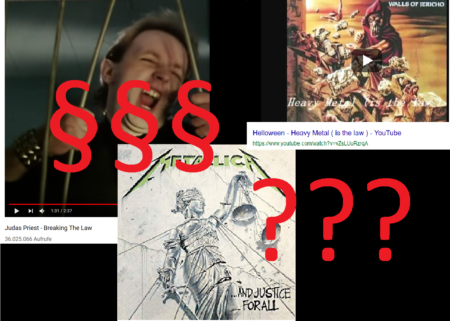
We specifically ask for the role of law-related phenomena in this case study. Since Judas Priest’s classic anthem ‘Breaking the Law’ (1980), topoi of law-breaking and other norm-related imaginations of law and justice are important in metal around the world. They seem to have played a role in scene-construction in Graz, Styria an Austria.
For the proposal, we conducted first research and had first oral history contacts with scene stakeholders. I want to show you an example of a song by a local band. I hope, on the base of this song one can see the potential of the approach I just described.
Our example artists, Heathen Foray, are a pagan metal/ melodic death metal group from Graz. They are well-known in the local scene and had some international success since 2004. On their album Inner Force (2013), we find the track ‘Mei Laund’ (Engl., ‘My land’) with lyrics written in Styrian dialect:
These are the quintessential parts of the lyrics with an approximative translation to English language:
((Lyrics to Heathen Foray, ‘Mei laund’, on Inner Force, Independent, 2013. Author’s translation.))
At a first glance, this track seems to be a ‘usual’ song of the pagan metal and folk metal sub-genres. But there is more to it. The narrative of the song presents the story of a local man. His father died and, now, the man inherits the family’s land. So, he becomes the landlord. This is a clearly patriarchic narrative, taking place in a rural, early modern setting or a medieval setting, perhaps also a fantasy setting. The male landlord has to defend his land. The protagonist tells us his story and that he will teach his son exactly what he learned from his late father.
Looking at the track as a product of 21st century heavy metal sound history, we find a quite unique way of acoustic and cultural sense-making. At the heart of the song is a distinct concept of law and legal norms. Only the son can inherit the land from his father. Those are very strict and archaic, deeply conservative and patriarchic ideas of law and the private property of land. Put into extreme metal sound, those ideas formed the cultural protocol that structures the entire story. It characterizes the song from the beginning to the end.
In order to really historically understand the song, to put it into history, in our project we plan to perform quite a broad spectrum of sound-historical close readings.
First, we will have to read Heathen Foray’s ideas of law and heritage before the backdrop of disciplinary historical research results on medieval and early modern law systems.
Secondly, in a musicological analysis, my colleague Charris Efthymiou will answer the question whether this specific idea of law is represented by distinct musical and formal patterns.
Thirdly, we plan to put those results into the longer history of the local scene since 1980 and of ‘glocal’ developments. So, sound-historical expertise, in this case, intends to performs a broad contextualization in the disciplinary knowledge of history and seeks permanent interdisciplinary contact with musicology
3. Conclusion
I come to my conclusion. I tried to show that history, most of all the recent discourse of sound history, has the potential of probably enriching recent metal studies discourse. Its expertise of researching the longue durée dimensions of auditive cultural sense-making could support our search for more theoretical rigor. On balance, the result of my reflections can be summarized in four points. When we put metal into history, we should
• make full use of history’s disciplinary expertise in reading and interpreting historical sources, • always read metal history before the backdrop of broader research results in global cultural history, • pay crucial attention to the analysis of the longue durée dimensions of sound-historical sense-making, • and permanently keep the dialogue with other disciplines in metal studies.
In 1980, Judas Priest released their classic heavy metal anthem ‘Breaking the Law’ on the British Steel album. In the song’s lyrics, the protagonist thematizes law-breaking as his way of empowerment. This topos of ‘breaking the law’ is relevant in metal until present days. It is connected to metal’s idea of ‘metalness’ and scene-internal norms. Metalheads all around the world know the lyrics, at least the chorus.
In a video clip of a live performance of the song, Rob Halford introduces the classic by saying that it would have become ‘synonymous’ to his band and metal at large:
A second well-known example is Metallica’s album …And Justice for All (1988). Its cover and title-track work with narratives and semiotics of the allegedly corrupted laws of the American legal system. Here, law is represented as a field of oppressive norms.
The cover takes up the ancient imagination of the Roman goddess of Justitia and reworks it in a metalness version. It was ‘translated’ to the semiotic aesthetics of 1980s thrash metal:
Even more telling, since decades, metal’s scene language knows idioms like ‘heavy metal rules’ or even ‘Heavy Metal (is the Law)’, which is a song title by early Helloween. Here, literally metal-as-law is synonymous to scene-internal norms and rules. Metal makes the law. Despite this evident empirical relevance of law-related phenomena in metal, there currently is practically no research on this.
Addressing the gap: a research agenda
Addressing this substantial gap in scholarship, the author has applied for funds from the Austrian Science Funds (FWF) for a three-years research project. It is planned to research the role of law-related phenomena in the scene-building process in Graz and Styria since the 1980s.
The proposal is affiliated with the Institute of the Foundations of Law at the University Graz. The project team consists of the author as a cultural historian, of a musicologist, and a of board of legal scholars. Also scholars from other disciplines are involved.
In the project, which centres empirically on Styria, Graz and Austria, we want to answer three questions, that also have relevance when addressing the gap on a fuller scale:
How did ‘law’ function cultural-historically as a category in sense-making processes?
Did that (those) mode(s) of sense-making change over the period from the early 1970s to the present?
What role did ‘law’ play in the construction of a scene community in the long run?
On balance, we hope this could be a fruitful addition to metal music studies.
Next week will see the 2019 edition of the black metal theory symposium in Ljubljana on 18 and 19 April. As I will not be able to make it there (but you should go there! 😉 ), though I want to take the event as my occasion for a short blog post on interidsciplinarity and metal culture.
Cultural-historically, black metal theory, both its journal and its symposia, is an immensely exciting phenomenon. The discourse attempts to bring together the robust spirit of black metal and metal studies. Hence, if taking its own credo seriously, it has to stay permanently pulsating, oscillating and on the move. In this way, it is hybrid. Historically, this discourse can be interpreted as a process of knowledge production, an attempt at creating knowledge practices in such a hybrid way.
Metal studies’ own credo stresses interdisciplinarity. It does not want to be an independent discipline, despite the fact that many of its current academic procedures, processes and gate-keeping rules tend to aim at a direction of canonization and discipline-building. As well, this is a process of knowledge history that influences significantly how metal will be researched in the next few years.
The fascinating historical fact is that we can bind back those processes of researching metal to metal history itself. ‘Invented’ and established above all in the UK in the 1970, then being diversified into mushrooming sub-genres and globalized in the 1980s, currently metal culture adapts itself to a new era of digitalization – with all its advantages and flaws of digital connectedness. Historian Wolfgang Schmale’s theory of a cultural ‘hypertext’ of history seems to be illumating when researching this history in a view of long durée. ((W. Schmale, Gender and Eurocentrism: A Conceptual Approach to European History, Stuttgart: Franz Steiner, 2016.))
Fascinatingly, all those 50 years of metal history permanently have consisted of processes, in that the knowledge forms and practices of metal culture relied on hybridity processes. Black Sabbath used established patterns, thrash and speed metal cultures combined eclectic elements into a new genre, so did death and black metal – always, newness started from established concepts and genres of doing and knowing rock culture. Genres are results of hybridization processes, so is metal itself.
The essential consequence, which arises from this, is quite a simple thought. Black metal theory tries to know metal culture using a hybrid paradigm. Metal heads and metal musicians know their music and culture in eclectically hybrid ways (despite all claims of ‘authenticity’ and ‘trueness’). This situation given, canonization, disciplinary narrowness and gate-keeping structues are metal music studies’ worst enemies. The academic field itself reflects the hybridity of the culture studied and will only work fruitfully if it will be capable of keeping its positive coherence of heterogenous approaches.
The field we are working in is commonly referred to as metal studies or metal music studies. I prefer the second because it makes clear it is research on a music culture, and in this way avoids already possible questions on the subject of research. Recently, Heather Savigny and Julian Schaap reminded us of ‘putting the “studies” back into metal music studies’. ((See H. Savigny and J. Schaap (2018), ‘Putting the “studies” back into metal music studies’, Metal Music Studies, 4:3, pp. 549–557, doi: 10.1386/mms.4.3.549_1.)) In their critique, they demand more methodological rigour and more reflexivety in questions of epistemology. In this short post, I want to take up this point and throw in some questions from the point of view of a trained cultural historian.
My preferred name of our discourse is metal music studies. It contains three words. ‘Metal’, which is rather obvious (not mentioning the broad debates on the definition of metal) and names the subject of research. ‘Music’, the second element, is significant due to the fact that it tells non-insiders that we examine a popular music culture, i.e. heavy metal music. ‘Studies’, the third and the one which Savigny and Schaap problematized rightly, is the crucial one. It points out that this is an independent academic field.
From the point of view of a trained historian, the current state of the art is still characterized by a lack of historical awareness and of historic depth. There are books and conferences, which have the word ‘history’ in their titles. ((See, L. Meller (2018), Iron Maiden: A journey through history, Curitiba: Appris; also, see the call for paper for the conference ‘Somewhere in Time: A Conference on Metal and History’, Victoria, BC, 23 to 25 August 2019, at: https://www.facebook.com/download/1138331633226652/Somewhere%20in%20Time%20CFP%20.pdf?hash=AcpU2f1kwval0Th3. Accessed 8 March 2019.)) However, so far the history and cultural history of metal have been written by scholars ouside history as a discipline. On the one hand, this is good think because it sets history on the agenda of our discourse.
On the other hand, however, ‘putting the “studies” back into metal music studies’ consequently would also mean to take much more seriously the expertise of trained historians. Their expertise and knowledge of reading and examining sources, of historiography as a form narratology, and finally their knowledege of the broad contexts of the global history of the second half of the 20th century is key to writing a history of metal with more rigour. My upcoming book will not fix this issue but I address these questions. ((P. Pichler (2019), Metal music and sonic knowledge in Europe: A cultural history, Bingley: Emerald Publishers, forthcoming.))
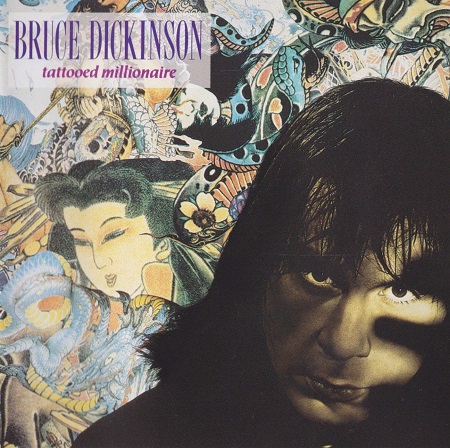
When Bruce Dickinsion released his first solo album Tattoed Millionaire in 1990, he could not know that today every good hipster needs to have tattoos. They have become mainstream and, apparently, they are here to stay. In this post, I want to approach tattoos from another perspective. I reflect upon the question how they can serve as historiographic sources for a professional cultural history of metal music. This is a methodological question. ((M. Howell and W. Prevenier, From Reliable Sources. An Introduction to Historical Methods. Ithaca and London: Cornell University Press, 2001.))
It is quite evident to see tattoos as cultural-historiographic sources. Following Foucault’s discourse analysis, body history is an established approach to history. ((L. Kalof and William Bynum (eds.), A Cultural History of the Human Body, 6 vols., Oxford: Berg, 2010.)) Body history researches the role(s) of the human body/human bodies in history. Also, we have detailled research on the history of tattooing as a practice of body modification. ((M. DeMello, Bodies of Inscription: A Cultural History of the Modern Tattoo Community, Durham, NC: Duke University Press, 2000; J. Caplan (ed.), Written on the Body: The Tattoo in European and American History, Princeton, NJ: Princeton University Press, 2000; M. Mifflin, Bodies of Subversion: A Secret History of Women and Tattoo, New York, NY: Powerhouse Books, 2013.))
In our field of metal music studies, tattoos as semiotic traces are examined, too. ((S. Holland and K. Spracklen (eds.), Subcultures, Bodies and Spaces: Essays on Alternativity and Marginalization, Bingley: Emerald: 2018.)) What we do not have at this point, is detailled methodological analysis of the question how tattoos can serve as historiographic sources for a professional cultural history of metal. Of course, I cannot provide a full discussion of this in a short blog post but I attempt to discuss important points.
Four methodological dimensions
First, thinking of tattoos as sources, a definitional feature is their ‘materiality’. They are highly personal, intimate and often unique inscriptions on a human body. Like the human body itself, they do not last but wither, change, and when the individual dies, the original source usually disappears in history. Yet, the tattoo as a bearer of a certain meaning, constituted in the intersectional sphere between personal life and the colllective discourse, is there for a limited period. This first thought defines this kind of sources temporally. They are contingent and available only for a certain period of time, at least as originals.
Second, tattoos are very private and individual. They belong to a person’s private life. However, usually they are thought to be seen by (some) other people. Methodologically, this implies if we want to research tattoos, each scientist doing so has to be fully aware of and act in accordance with good legal and ethical principles of personal integrity, respect and approval by the tattoo’s wearer.
Third, tattoos are texts or pictures, or a combination of both. They require scholars in metal studies to decrypt the source’s sense by thinking either textually or figuratively, or a combination of both. In this way, tattoos are comparable to other sources of history. ((Howell and Prevenier, Introduction.)) Cultural historians have to place their interpretation of the source and the wearer’s own statement/narrative in the context of broader metal discourse.
This brings us to our fourth aspect. Tattoos are an established code in metal culture around the globe. They constitute metalness. Combining this collective aspect with the prior three points makes us see tattoos as historic sources by which wearers express their individual metalness in the context of global metal discourse. They are a way of individualizing a person within a certain collective framework of meaning, i.e. the cultural framework of metal. Methodologically, this requires metal historians to ask for indivual identities within an established framework.
In a nutshell, tattoos are fascinating sources of a cultural history of metal. They are contingent, transient, individual, private and hybrid (textual and/or pictorial) sources of history, which render a person distinct in metal’s collective sphere. Hence, methodologically historians have to research them as sources which tell history in these ways.