Tag: self-reflection

  • Writing about writing about heavy metal, part three: the Mexican experience

    Over a month ago now, I had the great pleasure of attending the fifth conference of the “International Society for Metal Music Studies” in Mexico City. This central event of Metal Studies usually takes place every two years, but in this case was held this year instead of last year due to the Corona pandemic. In this blogpost, I want to reflect on how this event – possibly – changed my own writing about metal, especially about the history of the Styrian metal scene, which I have been researching intensively for two and a half years now.

    The conference in Mexico City, which was attended by about seventy of the leading researchers in Metal Studies, was dedicated to the topic of “Heavy Metal in the Global South: Multiregional Perspectives”. I gave a presentation on my research project on the Styrian metal scene. My central thesis was that the theoretical worlds of “Global South Studies” could potentially help to better explain cultural transfers between metal scenes across the “Iron Curtain” before 1989/90. My talk can be seen online here.

    With the temporal distance of about a month that exists today for me to this conference, it becomes more and more clear to me that in a certain sense it has had an influence on my thinking and writing about metal. One could speak of a “Mexican experience” that has had an impact – possibly not only on me – on personal and individual Metal Studies discourse. How can this be and what kind of change is it? What is this “Mexican experience” supposed to be?

    Basically, there are two points to be made in the reflection. The first is a sociological one of scholarship, the second a thematic one in the choice of the research object. On the first level of this conference as a collective academic experience of the participating researchers, it is hardly surprising that such a major event has an influence on the personal metal paradigm. At this conference, the latest findings in the field were presented and discussed, renegotiating the way scholarship writes and talks about metal. It is compellingly logical at this level  that paradigmatic shifts manifested here individually and collectively.

    The second point is then particularly interesting – and I think also particularly transformatively effective. In Mexico City, the “southern” perspective on metal and Metal Studies was in the foreground. For me, as a scholar from the “global north,” the themes and the values and notions of norms that were linked to the study of metal at this event made a crucial thematic aspect much clearer. It is always dangerous to speak of historical tendencies, as they invite stereotyping and essentialization of complex historical processes.

    If one nevertheless attempts such a historiographical trend survey, it can be summed up as follows: in the “global north” metal has already become much more commodified, an expression of northern affluence saturation. Here, metal is only “dangerous” or profoundly socially transformative in exceptional cases. In the “south,” on the other hand – and this was the “Mexican experience” that for me still burned itself in much more strongly than before – metal and Metal Studies are still inextricably linked to the struggle for social equality, decolonization, and protest against injustice. Here metal is even more socially transformative.

    For my own writing about metal, this Mexican experience is extremely enriching and important. For the remaining stages of my book on the Styrian metal scene since 1980, which I am currently working on, it follows that I should look in particular at those historical times and spaces where metal had a liberalizing and socially transformative effect in this sense. For example, in the confrontation with still existing catholic-conservative traditions in Graz in the early 1980s, when the scene was founded, or in the fight against right-wing extremist and neo-Nazi tendencies in the 1990s. The Mexican experience is a call to write about metal again more strongly also as scientific-cultural empowerment, enlightenment in the most original sense.
  • Writing about writing about heavy metal

    The past year in my project on the history of the law myth in the Styrian metal scene was dedicated to empirical research. Discourse-analytical, oral-history and musicological data on the history of this scene was collected.This phase is now over and the third and last year of the project, which just started, is dedicated to writing up the results in a book.

    I have just started writing this book. This also changes the function of the posts in my blog. Whereas previously they had the function of documenting the project, its genesis, and then the empirical research, now they are about reflexively accompanying the writing process. It is about writing about writing; more precisely, it is about writing about writing about heavy metal.

    Such a reflection of one’s own academic writing activity on the meta-level is nothing new. Pierre Bourdieu already held a famous leçon sur la leçon, and history as an academic discipline in particular is increasingly engaged in research on such writing. ((See Pierre Bourdieu, Leçon sur la leçon, Paris: Les Éditions de Minuit, 1982; Wolfgang Schmale, Schreib-Guide Geschichte, Vienna et al.: Böhlau, 2006.)) The new book series Meta/Metal: Exploring the Complexities of Metal Cultures will also make a contribution in this regard of the meta-level of Metal Studies.

    I don’t yet know exactly where this writing journey will lead. But it’s clear to me that I don’t think much of the famous quote “writing about music is like dancing to architecture”. I am much more interested in looking for discursive points of contact for reflecting on the radiations of this subculture – also the radiations into the universities of Austria and the world.

  • “Aren’t you the guy doing this metal studies interview stuff?”: On distance and self-reflection

    In my recent post, I wrote about oral history as a the method of choice to decode the Styrian metal scene’s emerging collective memory. This scene memory depends on the the scene’s shared attitude towards law. Since then, my research has progressed. Another series of interviews was conducted, the discourse analysis has been continued.

    Still, I have the feeling the empirical research is progressing well. The last third of the field research period has begun. In this post, I do not want to go into details about the data collected (this will happen in later posts). Rather, I want to focus on one issue, which – once more – has proven to be crucial: the question of closeness and distance in metal studies.

    Prior to my research, I was a member of this local heavy metal community. I knew scene members and attended concerts. It was – more or less – a silent leisure pleasure. After 21 months of local scene research and consequently many intense contacts with the scene members, I am the ‘metal studies dude’ now. “Aren’t you the guy doing this metal studies interview stuff?”, is a question I am approached with regurlarly at scene events.

    This means that my position in the community seems to have changed. The knowledge about the project circulating, there comes even more support from the scene. I am eternally to the scene members for their neverending patience with my questions. This patience is metal.

    However, with the growing visibility the key issue of the position of the researcher in the community investigated has become vital once more. As now my position has turned from a silent academic watcher to a more visible role, I have to re-reflect upon the question of distance and closeness.

    I would suggest that, in metal studies, each step of data collection in the scene should be reflected upon by the researcher carefully and thoroughly right after having taken the step. Hence, I do not want to be only the guy doing the metal studies interviews stuff but as well the guy thinking about the interview stuff.

  • Covid19, metal studies, and oral history research: A methodological rant

    In my last blog post, I attempted to describe the thoroughly digitalized research environment I discovered in our project on the history of the Styrian metal scene. Our research is progressing very well. My colleague Charris Efthimiou already provided no less less than thirteen very detailled analyses of law-themed metal songs and albums. Besides the crucial referential frame of globally famous classics (such as Judas Priest’s ‘Breaking the Law’) Charris focused on Styrian music. Hence, we now have a good data set on the musical production in the Styrian scene.

    As  the project leader, I spent the last few weeks gathering data on the cultural production in the scene since the early 1980s. I am constructing a permanently growing corpus of cultural artefacts from the scene. I am collecting T-shirts (as crucial pieces of clothing), album covers (as pictorial historical sources that ‘cover’ the music on records), concert flyers, posters, and other forms of sources. This body of sources currently comprises dozens of artefacts, images, and texts. It will grow steadily. Still, I am very thankful to receive information on further source materials.

    Thus, at this point, the project team is in midst of the process of researching our empirical data. Thanks to Charris’ brilliant work the musicological stream is advancing very well. The same holds true for the semiotic discourse analysis of the scene. Most texts and images, in many cases also of T-shirts, are available from the web. As well, many pieces of clothes can be ordererd to really hold them in hands. In this respect, digitalization makes things possible that would not have been possible five or ten years ago.

    Yet, I do face a highly ambivalent situation in respect of the oral history stream of my project. For almost a year now, face-to-face interviews have been difficult, often even impossible to conduct. Currently, we are experiencing (again) a quite strict form of a ‘lockdown’ here in Austria – with an open ending point. Of course, in many other places around the globe the situation is the same or – sadly – even worse. Of course, this is frustrating. Yet, I also think this is a very good occasion to globally rethink using oral history methodologies in metal studies. From my point of view, two aspects are crucial to reflect upon.

    First, there already is a rather dense discourse on experiences and practical information on how to conduct interviews online. For instance, the British Oral History Society gives good advice on this. Also, metal studies scholars have started to discuss this problem in their field. Hence, perhaps relieving the frustration a bit, no oral history researcher is alone with this problem! Nonetheless, we need a broader discussion on this issue in metal studies!

    Second, as a historian it is fascinating to think of the fact that, now in 2020/21, digitalization as the crucial historical ‘mega trend’ of the last two decades has not only transformed the scene I am researching but also the ways I am researching it. Doubtless, both aspects depend on each other. Yet, in the pandemic period, digitalization is more relevant than ever before. Metal studies is almost fully digital – at least for the moment.

    Hence, we should not only see this as a frustrating attack on our used ways of research. Much more it is the historically logical catalysis of a development which already was transforming metal studies before the pandemic. The pandemic did not start the process, it only catalysed it. Hence, for my project, I try to see it as a valuable opportunity to experiment with new forms of conducting interviews remotely. I would expect that after the pandemic we will have gained a big deal of important experiences in this changed world of research.

  • Wittgenstein, Davidson and Halford: the heuristics of studying norm-related sonic knowledge

    This is the first post, which ‘officially’ discusses my research in the new project ‘Norm-related sonic knowledge in Heavy Metal culture’. We started on 1 February and are currently working on the project website, which will go online in a few days. There, blog posts from the project will be featured in a special section and appear in the newsfeed too.

    In this first post, I want to address a topic which is crucial in our research: the heuristics of what I called ‘norm-related sonic knowledge’. The main question here is how we plan to map this realm of knowledge.  This sphere is constituted by law-related phenomema in metal culture, metal practices, metal music and metal networks. We need a good heuristical strategy to map the field.

    Here, the result of a fruitful conversation I had recently with my colleague Christian Hiebaum (a legal philosopher and legal sociologist at the University of Graz) is key. In our discussion, Christian raised the point that, philosophically and analytically, all the terms involved (e.g. justice, law, legal system, crime, moral, ethics, law-breaking, rule-breaking etc.) form something like a ‘family’ or a ‘Sprachspiel’ of terms.

    Taking up the thoughts of analytical philosophers like Donald Davidson ((See D. Davidson, The Essential Davidson. Oxford: Oxford University Press. 2006; D. Davidson, Truth, Language, and History: Philosophical Essays, Oxford: Oxford University Press. 2005; D. Davidson, Truth and Predication. Cambridge, Mass.: Harvard University Press. 2005.)) and Ludwig Wittgenstein ((See C. Bezzel: Wittgenstein zur Einführung. Junius, Hamburg 2000, L. Wittgenstein, Philosophische Untersuchungen. Frankfurt: WBG, 2001.)), it is quite easy to recognize that all the categories of norm-related sonic knowledge form a ‘pool’ or a ‘family’ of notions and meanings. Heuristically, the crucial point is how the meaning of each individual term is constituted within this family.

    Herein, each of the terms – in its individual meaning – depends on the other ones. Let us think of some examples. To be understood and fulfill its function in culture,  the notion ‘law’ relies on its links to related notions like ‘justice’, ‘ruling’, ‘order’ ‘legality’ or ‘law-breaking’. The notion ‘breaking the law’ needs a presupposed and in the metal scene shared understanding of terms like ‘law’, ‘morality’ or ‘crime’.

    If we take Judas Priest’s classic ‘Breaking The Law’ once more as a paradigmatic example, this approach makes us look at the lyrics in a new way:

    There I was completely wasted, out of work and down
    All inside it’s so frustrating as I drift from town to town
    Feel as though nobody cares if I live or die
    So I might as well begin to put some action in my life

    Breaking the law, breaking the law
    Breaking the law, breaking the law
    Breaking the law, breaking the law
    Breaking the law, breaking the law

    So much for the golden future I can’t even start
    I’ve had every promise broken, there’s anger in my heart
    You don’t know what it’s like, you don’t have a clue
    If you did you’d find yourselves doing the same thing too

    Breaking the law, breaking the law
    Breaking the law, breaking the law
    Breaking the law, breaking the law
    Breaking the law, breaking the law… ((Lyrics to Judas Priest, ‘Breaking The Law’, on British Steel, 1980.))

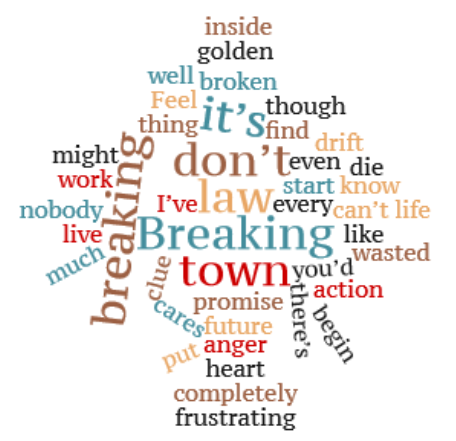
    In red and bold, I marked the notions that are relevant for these heuristics. Analytically and philosophically, it might be very risky, even problematic to integrate not only individual notions (e.g. ‘law’ or ‘anger’) but entire word groups or clauses (e.g. ‘breaking the law’, ‘every promise broken’, ‘out of work’) into such a family of terms. This needs more and accurate thinking.

    Yet what we gain from this is heuristically highly useful. We see very clearly that the categories of norm-related sonic knowledge in the lyrics (e.g. ‘law’, ‘breaking the law’) – in the constitution of their meanings – are closely linked to key aspects of metal culture like anger, frustration, or freedom. And further, these notions are linked to the sounds and music of heavy metal. ((R. Walser, Running with the Devil. Power, Gender, and Madness in Heavy Metal Music. Middletown, CT: Wesleyan University Press, 2014.)) A word cloud would arrange the lyrics in this way:

    In a nutshell, these heuristics should make us able to identify the semantic and analytical links between the different categories of norm-related sonic knowledge. Moreover and equally important, they make visible the linkages to the mental, sonic, visual, and emotional ‘moods’ and dynamics of metal culture.

  • The paradox at the heart of metal studies

    Over the last two days, I had the wonderful opportunity of taking part in the inspiring Hardwired VII conference at the University of Salzburg. Already the seventh conference in this series, it was an event of intense discussions on topics of transdisciplinarity and transgression in metal studies. As such a stimulating event, it was an oportunity of further developing the scientific community in the field.

    In this post, I want to reflect upon what – probably – can be called the ‘heart of metal studies’. Intentionally, I use this notion of the ‘heart’, because as a metaphor it evokes associations of vitality, life, energy and of the identity of the metal studies community. Worth remembering, German metal veterans Accept released a classic album called Metal Heart in 1985. ((Accept, Metal Heart, Portrait Records, 1985.))

    Now what is at the heart of our field? From my point of view, taken together the two keynote lectures of the conference, by Rosemary Lucy Hill and Keith Kahn-Harris, summed up the crucial challenges scholars have to master in the coming years. Of course, I cannot deliver a full solution to the central problems of metal research in this blog post. From the perspective of a cultural historian, I want to comment upon the paradox at the heart of metal research.

    In her lecture ‘”You’re asking the Wrong Question!” Methodology, Standpoint and Fandon in Metal Research’, Hill delivered an excellent analysis of the main problem of the field in its ‘teenage years’. Metal research is dominantly conducted by scholars, who also take part in the culture as metalheads. With this comes an obvious, structural conflict between the obligation of the scholars in us to keep a distant and critical view on metal and the metal fans in us, who love the music. Hill encouraged scholars to keep asking hard questions on the difficult aspects of metal, e.g. sexual violence, fascim, racism and misogyny.

    In his keynote ‘Too much Transgression – Metal in an Age of Explicit Knowledge’, Kahn-Harris took up his work on metal culture and the concept of ‘reflexive anti-reflexivety’. For Kahn-Harris, today’s metal culture is to be seen as a culture in an age of abundant knowledge. Transgression takes new forms. He called these forms ‘transgressive literalism’, ‘transgressive unintellegibility’ and ‘transgressive inversion’. Also in his view, conflicts between stances to problematic aspects of metal have to be reconsidered.

    For a cultural historian, both lectures thematize a paradox, which seems to form something like the heart, perhaps the dark heart of the field. This heart pumps into the field (and its community) its vitality and is its key problem at the same time. The core issue  seems to be to develop theories, strategies and a communal habitus or ‘thought style’, which enable us of coping with the tensions between our identities as scholars and identites as fans in a productive way.

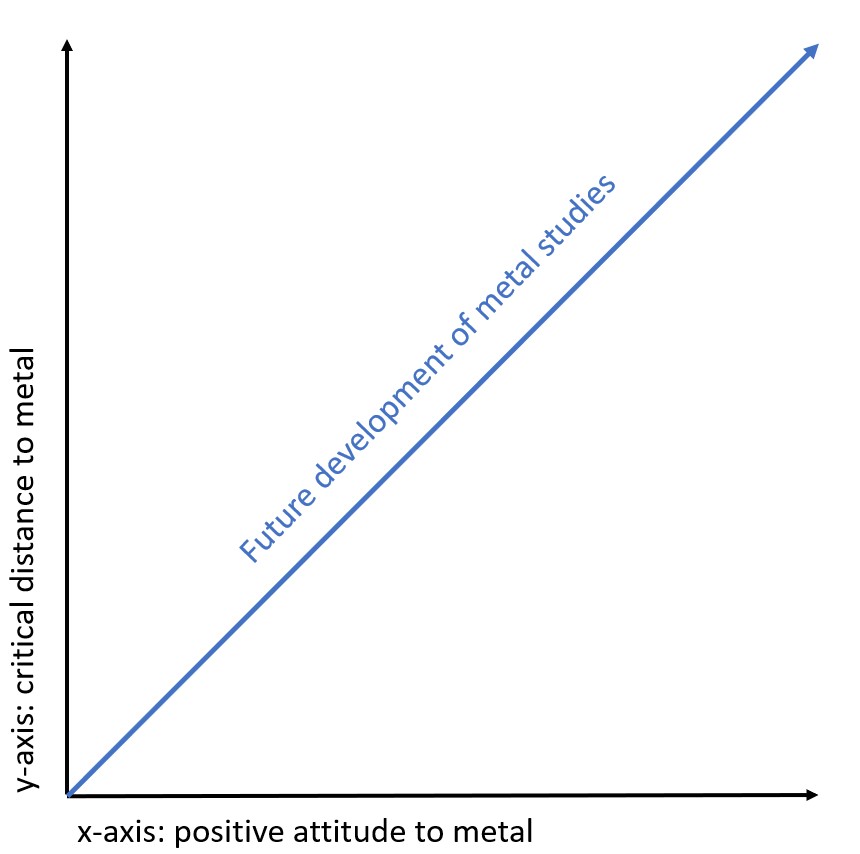
    Logically, this is a classic paradox. The point here is, cultural-historical experience teaches us that usually paradoxes cannot be solved. ((For instance, for the paradoxical structure of the identity of the European Union between nation-state and ‘super-state’, see Peter Pichler, ‘European Union cultural history: introducing the theory of ‘paradoxical coherence’ to start mapping a field of research’, Journal of European Integration 1 (2018), pp. 1-16.)) In the long term, the identitary tensions that arise from such conflicts are solved only contigently by creating new spaces of knowledge, in that scholarship goes as far as possible in both directions: in the direction of critique and the direction of keeping a positive attitude to the culture. In a perfect metal studies world, which never will become reality, this could look a bit like this figure:

    Thus, metal studies should not aim at defining a methodology or theory of metal that resolves the paradox. It should aim at constituting a new sphere of knowledge, in that we can go as far as possible into both directions. What Kahn-Harris called ‘engaged scholarship’ comes pretty close to this. With Hill, we should keep asking difficult questions. In this, history with its focus on longue durée developments over decades since 1970 could become an exciting enrichment. ((Peter Pichler, Metal Music and Sonic Knowledge in Europe: A Cultural History Since 1970, Bingley: Emerald, forthcoming.))


  • Metal (music) studies: What’s in a name?

    The field we are working in is commonly referred to as metal studies or metal music studies. I prefer the second because it makes clear it is research on a music culture, and in this way avoids already possible questions on the subject of research. Recently, Heather Savigny and Julian Schaap reminded us of  ‘putting the “studies” back into metal music studies’. ((See H. Savigny and J. Schaap (2018), ‘Putting the  “studies” back into metal music studies’, Metal Music Studies, 4:3, pp. 549–557, doi: 10.1386/mms.4.3.549_1.)) In their critique, they demand more methodological rigour and more reflexivety in questions of epistemology. In this short post, I want to take up this point and throw in some questions from the point of view of a trained cultural historian.

    My preferred name of our discourse is metal music studies. It contains three words. ‘Metal’, which is rather obvious (not mentioning the broad debates on the definition of metal) and names the subject of research. ‘Music’, the second element, is significant due to the fact that it tells non-insiders that we examine a popular music culture, i.e. heavy metal music. ‘Studies’, the third and the one which Savigny and Schaap problematized rightly, is the crucial one. It points out that this is an independent academic field.

    From the point of view of a trained historian, the current state of the art is still characterized by a lack of historical awareness and of historic depth. There are books and conferences, which have the word ‘history’ in their titles. ((See, L. Meller (2018), Iron Maiden: A journey through history, Curitiba: Appris; also, see the call for paper for the conference ‘Somewhere in Time: A Conference on Metal and History’, Victoria, BC, 23 to 25 August 2019, at: https://www.facebook.com/download/1138331633226652/Somewhere%20in%20Time%20CFP%20.pdf?hash=AcpU2f1kwval0Th3. Accessed 8 March 2019.)) However, so far the history and cultural history of metal have been written by scholars ouside history as a discipline. On the one hand, this is good think because it sets history on the agenda of our discourse.

    On the other hand, however, ‘putting the “studies” back into metal music studies’ consequently would also mean to take much more seriously the expertise of trained historians. Their expertise and knowledge of reading and examining sources, of historiography as a form narratology, and finally their knowledege of the broad contexts of the global history of the second half of the 20th century is key to writing a history of metal with more rigour. My upcoming book will not fix this issue but I address these questions. ((P. Pichler (2019), Metal music and sonic knowledge in Europe: A cultural history, Bingley: Emerald Publishers, forthcoming.))

  • Between scholarliness and fandom: on distance and closeness, objectivity and subjectivity in Metal Music Studies

    In my last post, I reflected on the identities of Metal scholars, in terms of the transgressive potential of Metal Music Studies, as an academic discourse. This discourse is constitutively interdisciplinary and breaks disciplinary boundaries. I stressed that this situation of  an emerging filed of study requires its scholars to work self-reflexively. We have to construct our subject and our ‘Metal scholar-identities’ between and often in conflict to traditional disciplines.

    These conflicts make the emergence of our field a deeply ambivalent and ambiguous process. On the one hand, we need to employ the theoretical approaches of ‘conservative’ academic fields (in my case again the theories of cultural history) to find our own subject and areas of research; on the other hand, at least in the long run, we have to build our own ‘toolbox’ of theories, at least of own theoretical approaches which fit our interests of research.

    This ambivalence of an emerging field of scholarship is the reason why we should put a strong focus on theorizing in our work. Of course, there is theoretical work in Metal Music Studies ((Cf. Stephen Hudsons blog ‘Metal In Theory. Sourcebook for Scholarship on Heavy Music’ at: http://metalintheory.com/about-metalintheory-com/, retrieved 9.7.2017; also, cf. the distinct and own discourse of a blog and journal of ‘Black Metal Theory’ at: http://blackmetaltheory.blogspot.co.at/, retrieved 9.7.2017; another fine example is this article: Martin Morris, Extreme Heavy Metal Music and Critical Theory, in: The Germanic Review: Literature, Culture, Theory  90, 4 (2015), pp. 285-303)) but most of it follows modes of thinking which try to adapt successful and established theories from other fields on Metal music. However, our discourse as an emerging field ought to find its own theoretical tools – at least in a long-term perspective.

    In this respect, I want to put forward the hypothesis, or to be more precisely, the hypothetic thought that the identitary situation of most Metal scholars is an important source of reflection, maybe even of theorizing; or at least, a point from which to start theoretical self-reflection. Most Metal scholars are both: ‘Metalheads’ and academic researchers and/or teachers. In their hearts and in their heads, there are, usually, both identities which regularly come into conflict.

    Why do they come in conflict? This identitary situation is very ambiguous: we have to find a balance between scholarliness and fandom, between closeness and distance to our subject of research. We have to find identitary ways  to balance the fan’s subjectivity and the scholar’s objectivity. I think, this situation – as complicated, conflictuous, ambivalent and even paradoxical it may be – actually favours theoretical progress in our discourse.

    This situation forces us to find theoretical and formal language to express the newly found balance between the fan and the scholar. In most cases, this new formal vocabulary to describe our own transgression from subjective interest to ‘objectified’ scholarly work is nothing else than a theory. ((For instance, again the example of ‘Black Metal Theory’ can be seen from this angle; again, cf. http://blackmetaltheory.blogspot.co.at/, retrieved 9.7.2017)) In a nutshell, the identitary situation of scholars in Metal research drives them to formalize their language; thus, what we ought to do is not to come up with brand new or unprecedented abstract vocabulary but just try to find  formal language which suits our reflection and thoughts; vocabularies which create the Metal Music Studies scholars inside us.