Tag: metal

  • Covid19, metal studies, and oral history research: A methodological rant

    In my last blog post, I attempted to describe the thoroughly digitalized research environment I discovered in our project on the history of the Styrian metal scene. Our research is progressing very well. My colleague Charris Efthimiou already provided no less less than thirteen very detailled analyses of law-themed metal songs and albums. Besides the crucial referential frame of globally famous classics (such as Judas Priest’s ‘Breaking the Law’) Charris focused on Styrian music. Hence, we now have a good data set on the musical production in the Styrian scene.

    As  the project leader, I spent the last few weeks gathering data on the cultural production in the scene since the early 1980s. I am constructing a permanently growing corpus of cultural artefacts from the scene. I am collecting T-shirts (as crucial pieces of clothing), album covers (as pictorial historical sources that ‘cover’ the music on records), concert flyers, posters, and other forms of sources. This body of sources currently comprises dozens of artefacts, images, and texts. It will grow steadily. Still, I am very thankful to receive information on further source materials.

    Thus, at this point, the project team is in midst of the process of researching our empirical data. Thanks to Charris’ brilliant work the musicological stream is advancing very well. The same holds true for the semiotic discourse analysis of the scene. Most texts and images, in many cases also of T-shirts, are available from the web. As well, many pieces of clothes can be ordererd to really hold them in hands. In this respect, digitalization makes things possible that would not have been possible five or ten years ago.

    Yet, I do face a highly ambivalent situation in respect of the oral history stream of my project. For almost a year now, face-to-face interviews have been difficult, often even impossible to conduct. Currently, we are experiencing (again) a quite strict form of a ‘lockdown’ here in Austria – with an open ending point. Of course, in many other places around the globe the situation is the same or – sadly – even worse. Of course, this is frustrating. Yet, I also think this is a very good occasion to globally rethink using oral history methodologies in metal studies. From my point of view, two aspects are crucial to reflect upon.

    First, there already is a rather dense discourse on experiences and practical information on how to conduct interviews online. For instance, the British Oral History Society gives good advice on this. Also, metal studies scholars have started to discuss this problem in their field. Hence, perhaps relieving the frustration a bit, no oral history researcher is alone with this problem! Nonetheless, we need a broader discussion on this issue in metal studies!

    Second, as a historian it is fascinating to think of the fact that, now in 2020/21, digitalization as the crucial historical ‘mega trend’ of the last two decades has not only transformed the scene I am researching but also the ways I am researching it. Doubtless, both aspects depend on each other. Yet, in the pandemic period, digitalization is more relevant than ever before. Metal studies is almost fully digital – at least for the moment.

    Hence, we should not only see this as a frustrating attack on our used ways of research. Much more it is the historically logical catalysis of a development which already was transforming metal studies before the pandemic. The pandemic did not start the process, it only catalysed it. Hence, for my project, I try to see it as a valuable opportunity to experiment with new forms of conducting interviews remotely. I would expect that after the pandemic we will have gained a big deal of important experiences in this changed world of research.

  • Wittgenstein, Davidson and Halford: the heuristics of studying norm-related sonic knowledge

    This is the first post, which ‘officially’ discusses my research in the new project ‘Norm-related sonic knowledge in Heavy Metal culture’. We started on 1 February and are currently working on the project website, which will go online in a few days. There, blog posts from the project will be featured in a special section and appear in the newsfeed too.

    In this first post, I want to address a topic which is crucial in our research: the heuristics of what I called ‘norm-related sonic knowledge’. The main question here is how we plan to map this realm of knowledge.  This sphere is constituted by law-related phenomema in metal culture, metal practices, metal music and metal networks. We need a good heuristical strategy to map the field.

    Here, the result of a fruitful conversation I had recently with my colleague Christian Hiebaum (a legal philosopher and legal sociologist at the University of Graz) is key. In our discussion, Christian raised the point that, philosophically and analytically, all the terms involved (e.g. justice, law, legal system, crime, moral, ethics, law-breaking, rule-breaking etc.) form something like a ‘family’ or a ‘Sprachspiel’ of terms.

    Taking up the thoughts of analytical philosophers like Donald Davidson ((See D. Davidson, The Essential Davidson. Oxford: Oxford University Press. 2006; D. Davidson, Truth, Language, and History: Philosophical Essays, Oxford: Oxford University Press. 2005; D. Davidson, Truth and Predication. Cambridge, Mass.: Harvard University Press. 2005.)) and Ludwig Wittgenstein ((See C. Bezzel: Wittgenstein zur Einführung. Junius, Hamburg 2000, L. Wittgenstein, Philosophische Untersuchungen. Frankfurt: WBG, 2001.)), it is quite easy to recognize that all the categories of norm-related sonic knowledge form a ‘pool’ or a ‘family’ of notions and meanings. Heuristically, the crucial point is how the meaning of each individual term is constituted within this family.

    Herein, each of the terms – in its individual meaning – depends on the other ones. Let us think of some examples. To be understood and fulfill its function in culture,  the notion ‘law’ relies on its links to related notions like ‘justice’, ‘ruling’, ‘order’ ‘legality’ or ‘law-breaking’. The notion ‘breaking the law’ needs a presupposed and in the metal scene shared understanding of terms like ‘law’, ‘morality’ or ‘crime’.

    If we take Judas Priest’s classic ‘Breaking The Law’ once more as a paradigmatic example, this approach makes us look at the lyrics in a new way:

    There I was completely wasted, out of work and down
    All inside it’s so frustrating as I drift from town to town
    Feel as though nobody cares if I live or die
    So I might as well begin to put some action in my life

    Breaking the law, breaking the law
    Breaking the law, breaking the law
    Breaking the law, breaking the law
    Breaking the law, breaking the law

    So much for the golden future I can’t even start
    I’ve had every promise broken, there’s anger in my heart
    You don’t know what it’s like, you don’t have a clue
    If you did you’d find yourselves doing the same thing too

    Breaking the law, breaking the law
    Breaking the law, breaking the law
    Breaking the law, breaking the law
    Breaking the law, breaking the law… ((Lyrics to Judas Priest, ‘Breaking The Law’, on British Steel, 1980.))

    In red and bold, I marked the notions that are relevant for these heuristics. Analytically and philosophically, it might be very risky, even problematic to integrate not only individual notions (e.g. ‘law’ or ‘anger’) but entire word groups or clauses (e.g. ‘breaking the law’, ‘every promise broken’, ‘out of work’) into such a family of terms. This needs more and accurate thinking.

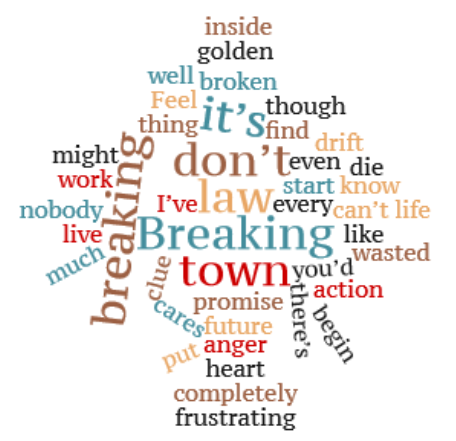
    Yet what we gain from this is heuristically highly useful. We see very clearly that the categories of norm-related sonic knowledge in the lyrics (e.g. ‘law’, ‘breaking the law’) – in the constitution of their meanings – are closely linked to key aspects of metal culture like anger, frustration, or freedom. And further, these notions are linked to the sounds and music of heavy metal. ((R. Walser, Running with the Devil. Power, Gender, and Madness in Heavy Metal Music. Middletown, CT: Wesleyan University Press, 2014.)) A word cloud would arrange the lyrics in this way:

    In a nutshell, these heuristics should make us able to identify the semantic and analytical links between the different categories of norm-related sonic knowledge. Moreover and equally important, they make visible the linkages to the mental, sonic, visual, and emotional ‘moods’ and dynamics of metal culture.

  • ‘Fandom’ and ‘scholarship’: Comparing two cultural-historical institutions

    I ended my last post on the paradox at the heart of metal studies with the suggestion that cultural history, as one individual discipline in the transdisciplinary field of metal studies, could become an exciting enrichment. It gives us the promise of a structurally exploration of the the intertwined histories of fandom, scholarship and ‘fan scholarship’ in the field. In this (admittedly rather short) blog post, I take up this thought and attempt a first comparative analysis of ‘fandom’ and ‘scholarship’ as historically constructed cultural institutions. Once more, I take and stress the point of view of a historian.

    There seems to be a consensus in metal research that the nexus between metal fandom and metal scholarship is a crucial one. In Salzburg, Keith Kahn-Harris and Rosemary Lucy Hill encouraged us to proactively embrace the arising tension between both by self-reflexively asking diffictult questions on racism, sexism, bigotry, misogyny, nazism and other critical phenomena in the scenes. In this, history with its focus on developments over periods of decades (for metal studies this means to study the whole period since the inception of metal culture around 1970) can provide a helpfully orientating narrative. ((Peter Pichler, Metal Music and Sonic Knowledge in Europe: A Cultural History Since 1970, Bingley: Emerald, forthcoming.))

    Seen historically, both fandom and scholarship are not essentialist roles or identities but social formations, that both have long histories. The habitus, rituals and practices of that structure them can be traced back deep in history. If we view them as such complexes of historically constituted roles, the hybrid zone formed by them together in metal studies receives sharper contours. I start with fandom.

    Fandom

    Usually, metalheads are stereotyped as male, long-haired (semi-)adults wearing band t-shirts and battle vests. ((Once more, refer to Weinstein’s classic work: Deena Weinstein, Heavy Metal: The Music and its Culture, Boulder, CO: Da Capo Press, 2000; also, see Bettina Roccor, Heavy Metal. Die Bands, die Fans, die Gegner, Munich: Beck: 1998.)) Practices such as the formation of moshpits or showing the ‘metal horns’ at concerts complete the stereotypical imagery. They are expressions of scene members’ feelings of belonging to their communities, performed in public and addressing audiences within the scence as well as outside the scene.

    If we take the point of view of cultural history things appear in another light. Popular culture – and fandom as a crucial functional position of people in it – have a history that in some of its forms can be traced back to early modern periods; at least to the 19th century, when mass media established new forms of public spheres for mass audiences. The masses became literate. ((For introductory texts, see LeRoy Ashby, With Amusement for All: A History of American Popular Culture since 1830, Lexington, KY: University Press of Kentucky, 2009;  John Storey, Cultural Theory and Popular Culture: An Introduction, Harlow: Person, 2009; Kaspar Maase, Populärkulturforschung: Eine Einführung, Bielefeld, 2019.)) Thus, fandom is a cultural construction that, today, takes varying forms in different pop cultures (e.g. literature, music, film, gaming, sports etc.) but all of them stem from one root of comparable processes over decades, sometimes even centuries (as in the case of soccer culture or the passion for classical music).

    Taking this view very much relativizes the allegedly absolute newness of metal fan culture since the 1970s. Yes, the practices installed over almost five decades in the global metal scene produced some innovative patterns; however, only being constructed after 1970, the new rituals, practices and scene rules built there heavily relied on what has been learnt, experienced and practiced in other fan cultures before Black Sabbath took the stage. So, metal fandom is a cultural institution that can best be studied in comparison to other forms of fandom in history. And even more crucial, it has to be compared to other cultural institutions.

    Scholarship

    Let us come to scholarship. At first glance, scholarship seems to be something completely different. Scholars usually are seen as rational, well-educated and distinguished personalities. Once more, the stereotype is a male one. Scholars wear glasses, speak of almost non-understandable things and live in the ivory towers of their universities. Yet, also scholarship – and the modern intellectual as a role in it – are historically constructed phenomena. The role of both cannot be separated from the history of the university in Europe and the world since the Middle Ages. ((For introductory texts, see Hilde de Ridder-Symoens et al., eds., A History of the University in Europe, 3 vols., Cambridge: Cambridge University Press, 1992-2004; Thomas Sowell, Intellectuals and Society, New York, NY: Basic Books, 2010; Dietz Bering, Die Epoche der Intellektuellen 1898–2001. Geburt – Begriff – Grabmal, Berlin: Berlin University Press.)) Since the Middle Ages, philosophers, scientists, theologians and intellectuals – scholars in a most broad sense – tell us how to make sense of the world.

    As said before, this role appears to be very different from fandom. Nonetheless its realities work – basically and structurally – in ways comparable to any other spheres of community-building. Academia knows rituals, do’s and dont’s, forms of identity-building and othering. ((See Anthony Becher and Paul R. Trowler, Academic Tribes and Territories, 2nd edn., Buckingham: Open University Press, 2001.)) The essential question here is what sets this cultural institution, grown out of the tree of a history of almost thousand years, apart from other cultural institutions such as fandom.

    Seen from this angle, what separates them and what makes them comparable at once belongs to the same sphere: their historical backgrounds. How, on the one hand, scholars use the centuries-old narratives of scientific wisdom in their lives and how, on the other hand, metal fans use their  decades-old narratives of metalness can be compared, but only historically so. Both have come together in the history of the field of metal studies.

    Metal studies as a transgressive laboratory of cultural institutions

    What can we learn from this? If we take the point of view of history, metal music studies is they structural point where both histories come together. Seen this way, metal studies is nothing else than a cultural discourse, in which the insitutions of metal fandom and scholarship – with all their heritage – build a ‘match’. Thus, we should see the field as a transgressive laboratory, in which we work on these cultural institutions in the long term and, arguably, shape the new ‘sub-institution’ of the ‘metal scholar’. It is not about playing off one against each other but much more about thinking this new institution in visionary yet critical ways.

  • Breaking the law!? A research agenda for a gap in scholarschip

    A gap in research

    In 1980, Judas Priest released their classic heavy metal anthem ‘Breaking the Law’ on the British Steel album. In the song’s lyrics, the protagonist thematizes law-breaking as his way of empowerment. This topos of ‘breaking the law’ is relevant in metal until present days. It is connected to metal’s idea of ‘metalness’ and scene-internal norms. Metalheads all around the world know the lyrics, at least the chorus.

    In a video clip of a live performance of the song, Rob Halford introduces the classic by saying that it would have become ‘synonymous’ to his band and metal at large:


    A second well-known example is Metallica’s album …And Justice for All (1988). Its cover and title-track work with narratives and semiotics of the allegedly corrupted laws of the American legal system. Here, law is represented as a field of oppressive norms.

    The cover takes up the ancient imagination of the Roman goddess of Justitia and reworks it in a metalness version. It was ‘translated’ to the semiotic aesthetics of 1980s thrash metal:

    Even more telling, since decades, metal’s scene language knows idioms like ‘heavy metal rules’ or even ‘Heavy Metal (is the Law)’, which is a song title by early Helloween. Here, literally metal-as-law is synonymous to scene-internal norms and rules. Metal makes the law. Despite this evident empirical relevance of law-related phenomena in metal, there currently is practically no research on this.

    Addressing the gap: a research agenda

    Addressing this substantial gap in scholarship, the author has applied for funds from the Austrian Science Funds (FWF) for a three-years research project. It is planned to research the role of law-related phenomena in the scene-building process in Graz and Styria since the 1980s.

    The proposal is affiliated with the Institute of the Foundations of Law at the University Graz. The project team consists of the author as a cultural historian, of a musicologist, and a of board of legal scholars. Also scholars from other disciplines are involved.

    In the project, which centres empirically on Styria, Graz and Austria, we want to answer three questions, that also have relevance when addressing the gap on a fuller scale:

    1.  How did ‘law’ function cultural-historically as a category in sense-making processes?
    2. Did that (those) mode(s) of sense-making change over the period from the early 1970s to the present?
    3. What role did ‘law’ play in the construction of a scene community in the long run?

    On balance, we hope this could be a fruitful addition to metal music studies.

  • A ‘trans-scene-ary’ fashion: some notes on the cultural-material history of Dr. Martens boots

    Widely known, Dr. Martens boots (usually refered to as ‘Doc Martens’, ‘Docs’ or ‘Dr. Martens’) are one of the established fashion codes of several different subcultures. Being initially worn in Mod- and Skinhead-subcultures from the 1960s onwards, they were soon worn by Punks, ‘Goths’, and members of the EBM-, Wave- and Dark-Wave-scenes, too. Until today, they also are an established code in Metal culture. Being introduced to subcultural discourses in the 1960s, they until today bear with them an ‘aura’ of protest, proletarian spirit, of noncomformist identities. Given that today they are part of a huge branding and marketing discourse, whose final very conservative purpose is to earn money, it is somehow surprising that this code still ‘works’.

    The boots were invented by German medical doctor Klaus Märtens shortly after World War II. ((For their history, cf. Martin Roach, Dr. Martens. The Story of an Icon. London: Chrysalis Impact, 2003.)) In 1945, he injured his ankle and was looking for solid yet comfortable boots when recovering from his injury. He designed a boot using soft leather and air-padded soles made of tires. The new footwear was not an instant success; but in 1947, when meeting his university friend Herbert Funck, who was  impressed by Märtens’ invention, things changed. In 1952, they opened a factory in Munich. In 1959, the boots became marketed internationally, and British company R. Griggs Group Ltd. bought patent rights to manufacture the boots in the United Kingdom, where they were sold for the first time in 1960.

    The company introduced the until today common name, slightly re-shaped the heel and, most of all, added the trademark yellow stitching. Also, in this first process of branding the soles were branded as ‘AirWair’ soles. Soon, the new shoewear was worn by police officers, postmen and factory workers. By the late 1960s, they were used as a cultural-material code in the early Skinhead-scene. In the 1970s and 1980s, as mentioned, they became part of the Punk-, ‘Goth’-, Wave- and Dark-Wave-Scenes, too. Also members of EBM-groups and Metalheads wore and wear their Docs.

    Being a rather late starter, I decided to buy my first Docs this year (being 37 years old, this maybe is one of the first symptoms of a Metalhead’s midlife crisis). Buying these boots made me remember their history; as a cultural historian interested in Metal Music Studies, I am interested in how this shoewear managed to become a ‘working’ code in so many different cultural discourses over five decades. They were common when I was teenager, and still in in my twens. Today, they seem to experience a certain revival.  But, most of all, as a historian in Metal Music studies, I want to ask what these shoes can tell us about writing the history of Metal culture – in the context of a broader historiography of subcultures since the 1960s.

    In this context, the mentioned ‘omnipotent’ subcultural capital of the Dr. Martens boots seems to be their most important historical feature. They ‘work’ in at least seven different subcultures: Skinheads, Punks, ‘Goths’, Wavers and New Wavers, EBM-Fans and Metalheads wear their Doc Martens. So, their cultural main feature is that they are a ‘trans-scene-ary’ code of shoewear. They construct these different identities and, at the same time, the transgress the boundaries between the scenes.

    What could a cultural historian of Metal music learn from this? I suppose, we can discover two major aspects: first, the history of material artefacts, such as shoes, is a very good way to tell Metal history. Secondly, when writing this history, we have to be aware of these ‘trans-scene-ary’ features of cultural codes. They are liquid, form varying and oscillating circles of negation and the construction of identities. To tell the history of Metal culture, means to deal with material items that bear in them very heterotopic semiotic structures. We do not have to essentialize these codes but to see them as objects of constant definition and re-definition.

  • Getting naive in Metal Music Studies: can (Metal) music change the world?

    In my last post, I reflected upon cultural-historical tendencies and processes in the year of 2016. I tried to elaborate on the question how this year, with its seemingly fundamental political ruptures, in a global and European perspective, could be told in scientific historical storytelling. Already this essay, as I ‘dared’ to measure the relevancy of one year in history without the advantage of temporal distance (I wrote my post on January 1st 2017), did not lack a certain degree of naivety. In this post I want to take, so to speak, ‘naivety as an epistemic tool’ and reflect upon a seemingly highly naive question: can (Metal) music change the world?

    Yet, I think this a question, if our theoretical and methodological  prerequisites of cultural history are presented and used self-reflexively, being aware of the fundamental limits  inherent to them, can be elaborated on in a scientifically serious way. I suggest, trying to think of a conceptual answer to this question might add ‘ontological awareness’ to the research agenda of Metal Music Studies.

    Getting naive…

    Our starting point is a very simple thought: in the year of 2017, having in mind the first weeks of the new Trump administration and its policies, the coming important elections in France and Germany, the overall global network-like atmosphere of tension, uncertainty, even fear and panic, we could want to live in a better world; culturally, socially, legally, politically and economically. All the frictions and tensions of discourse in early 2017 – i.e. terrorism, migration, political radicalization, war-like conflicts – could make us long for a better world. And, this  being the decisive fact, wanting concepts from science to get into such a world.

    So, the question, leigitimized culturally and morally, we have to think about, in ontological and discursively structural terms, is: can science provide us with ways to get into this ‘better world’? And, for Metal Music Studies, and cultural history in this subfield of academie, that question is to be modified to its specific subject of research: can Metal music change the world?

    As mentioned above, this question seems to be one of purest naivity, even if taking it as ‘innocent’ naivity. How should music, even Metal music as subcultural field of popular culture, be able to change the world for the better? I think, on the very contrary, this naivety could be a good starting point for ontological reflection in Metal research; namely suggesting this naivety as an epistemic tool which enables us to open up for fresh perspectives.

    …in Metal Music Studies

    When we see this question as a a legtitimized one, this opens up a series of questions which penetrate into the deepest layers of the discourse of Metal Music Studies, its ontological prereqisites . Asking whether Metal music can improve the world’s current historical condition, we ask for a new evaluation of the theoretical core notions of cultural history in Metal Music Studies. These questions include the following: (1) what is Metal music in cultural history?; (2) how does Metal music connect and interfere with global discourse of culture?; (3) does this interference allow Metal music to change the world?

    What is Metal music?

    I address these very serious ontological questions (they basically define the subject of cultural history in Metal Music Studies as a field of research)  in exactly the order mentioned. Ad (1): trying to give a definition of Metal music in cultural history, means to give a preliminary description of a conceptual and empirical field of global history, since at least the 1970s. Starting in the early 1970s (having roots in the decades before), bands like Black Sabbath created a new, ‘heavy’ sound. Since then, this ‘heavy’ discourse emerged as an own cultural discourse. It developed its own narratives, imaginaries, style of clothes, gesticulation and networks to institutionalize them. ((Cf., for instance, Jeremy Wallach e.a. (eds.), Metal Rules the Globe. Heavy Metal Music Around the World. Durham and London: Duke University Press, 2011; also, cf.  Deena Weinstein, Rock’n America: A Social and Cultural History. Toronto: University of Toronto Press, 2015.; and: Dietmar Elflein, Schwermetallanalysen: Die musikalische Sprache des Heavy Metal. Bielefeld: transcript, 2011; finally: Rolf Nohr and Herbert Schwaab (eds.), Metal Matters: Heavy Metal als Kultur und Welt. Münster e.a.: Lit, 2012. )).

    So, from the broadest possible perspective, Metal music can be understood as an own and distinct cultural discourse of popular culture. Today, it has its own history (and self-narratives of  this history) since over four decades. ((Cf. ibid.)) It is a structural sphere of culture, having its own rules of creating meaning, in its styles of clothes, music, practices, marketing and performing. In a nutshell, for cultural history Metal music is a discourse which globally creates meaning in an own way – according its protocol of the new cultural style encoded as ‘heavyness’.

    How does Metal music connect and interfere with global discourse of culture?

    Now, we can address the second question, again rather globally. Ad (2): The core argument of my ontological definition of Metal music is the adjective of ‘global’. This adjective, indeed, is of utmost importance for the second question. Here, we want to find an answer to the question how Metal music does interfere with global discourses of culture – the ones like politics, media, society etc. The adjective ‘global’ gives us the ontological key to find an cultural-historical answer. ((Cf. ibid.)).

    This short word, ‘global’, implies that Metal music itself spans around the world. It is not only a product of this world, or a by-product of discoures lying hierarchally above it, but an own and, scale-wise and hierarchically, equal discourse. Metal music acts globally, therefore, it has the same and exactly equal rights as other discourses – such as politics, media, society etc. It may not have the same ‘discursive power’ but from a structural perspective it is global, and thus has the equal rights: to construct meaning, to construct the world. In a nutshell, aiming to formulate an answer to this second question: Metal music inteferes with global discourse of culture on an equally-righted base. Its demands of identity and narratives are no less important than any other – but not more important either.

    Does this interference allow Metal music to change the world?

    Ad (3): our third and final analysis is, probably, the most important one. Taking Metal music in global history as an eually-righted one, this leads us to formulate an answer which is promising and disappointing at once. It is promising because, when conceptualizing Metal music as an equally-righted sphere of culture, that implicates that it is on same hierarchical level as other discourses; hence, it, logically and normatively, can influence the world. The disappointig aspect is that, because it is one discourse among myriads of others, is potential of influencing the world is limited.

    So, our answer to the third point is: Yes, Metal music has the potential to change the world; to be more specifically: it has the potential of changing its world. As an emancipative discourse, it can create (and indeed does create) ((cf. ibid.)) its own visions and utopias of a better world. To me as a cultural historian, the most challenging task of examining these questions is to reflect upon the limits of cultural history in Metal Music Studies: where does the influence of Metal discourse meet its imits? Which limits and boundaries are the ones, maybe imposed by other discourses, which restrain its influence? How are these limits and boundaries, identities and non-identities, negotiated and fixated? ((Source of the title image of this post: http://s2.quickmeme.com/img/d2/d2c1e23ecee906584f0a6844db58aa2070bf0666afe7407a7df27caf07937087.jpg, retrieved 6.2.2017.))