Tag: identity

  • Writing about writing about heavy metal, part three: the Mexican experience

    Over a month ago now, I had the great pleasure of attending the fifth conference of the “International Society for Metal Music Studies” in Mexico City. This central event of Metal Studies usually takes place every two years, but in this case was held this year instead of last year due to the Corona pandemic. In this blogpost, I want to reflect on how this event – possibly – changed my own writing about metal, especially about the history of the Styrian metal scene, which I have been researching intensively for two and a half years now.

    The conference in Mexico City, which was attended by about seventy of the leading researchers in Metal Studies, was dedicated to the topic of “Heavy Metal in the Global South: Multiregional Perspectives”. I gave a presentation on my research project on the Styrian metal scene. My central thesis was that the theoretical worlds of “Global South Studies” could potentially help to better explain cultural transfers between metal scenes across the “Iron Curtain” before 1989/90. My talk can be seen online here.

    With the temporal distance of about a month that exists today for me to this conference, it becomes more and more clear to me that in a certain sense it has had an influence on my thinking and writing about metal. One could speak of a “Mexican experience” that has had an impact – possibly not only on me – on personal and individual Metal Studies discourse. How can this be and what kind of change is it? What is this “Mexican experience” supposed to be?

    Basically, there are two points to be made in the reflection. The first is a sociological one of scholarship, the second a thematic one in the choice of the research object. On the first level of this conference as a collective academic experience of the participating researchers, it is hardly surprising that such a major event has an influence on the personal metal paradigm. At this conference, the latest findings in the field were presented and discussed, renegotiating the way scholarship writes and talks about metal. It is compellingly logical at this level  that paradigmatic shifts manifested here individually and collectively.

    The second point is then particularly interesting – and I think also particularly transformatively effective. In Mexico City, the “southern” perspective on metal and Metal Studies was in the foreground. For me, as a scholar from the “global north,” the themes and the values and notions of norms that were linked to the study of metal at this event made a crucial thematic aspect much clearer. It is always dangerous to speak of historical tendencies, as they invite stereotyping and essentialization of complex historical processes.

    If one nevertheless attempts such a historiographical trend survey, it can be summed up as follows: in the “global north” metal has already become much more commodified, an expression of northern affluence saturation. Here, metal is only “dangerous” or profoundly socially transformative in exceptional cases. In the “south,” on the other hand – and this was the “Mexican experience” that for me still burned itself in much more strongly than before – metal and Metal Studies are still inextricably linked to the struggle for social equality, decolonization, and protest against injustice. Here metal is even more socially transformative.

    For my own writing about metal, this Mexican experience is extremely enriching and important. For the remaining stages of my book on the Styrian metal scene since 1980, which I am currently working on, it follows that I should look in particular at those historical times and spaces where metal had a liberalizing and socially transformative effect in this sense. For example, in the confrontation with still existing catholic-conservative traditions in Graz in the early 1980s, when the scene was founded, or in the fight against right-wing extremist and neo-Nazi tendencies in the 1990s. The Mexican experience is a call to write about metal again more strongly also as scientific-cultural empowerment, enlightenment in the most original sense.
  • “The end complete?”: finishing the empirical phase

    The picture above shows part of the table of contents of the catalogue for the exposition “Palette” by the Austrian artists Helmut and Johanna Kandl. I contributed an article to the catalogue. ((Peter Pichler, Vom Schwermetall als Lautfarbe in der Palette, oder: Wie das Eisenerz vom Erzberg nach Gleisdorf in den Heavy Metal kam, in: Kunsthaus Graz/Landesgalerie Niederösterreich, eds., Helmut und Johanna Kandl: Material + Archive, Wien: Verlag für moderne Kunst,  2021, 114-120.)) The publication of this article and the opening of the exhibition with a section on heavy metal mark in a way the end of the empirical phase in my research project.

    I spent the last year empirically researching the local heavy metal scene in Graz and Styria. Two research methods were the focus: oral history and semiotic discourse analysis. The Covid19 pandemic did not make conducting the research any easier, but I think the “hunt for data” was successful. I have a rich body of oral history data and cultural artifacts from all four decades of the scene’s history. Those artefacts will be analyzed as historical sources. Musicological research from the first year of the project is an important component of the scholarly examination of this scene. A first article about our results can be read online.

    In these weeks of completing the empirical phase, it finally struck me the fundamental extent to which the specific values, individual rules and local music of this scene form one integral cultural fabric. In order to understand this cultural history, it is necessary to analyze it at the intersection of morals, attitudes towards law and the musical language of metal, that is, to explore what I call the local norm-related sonic knowledge. This perspective on the junctures of texts, images, practices and sounds will be the focus of the book I will begin writing in early 2022.

  • Metal scenes: Multi-role agents and scene ethics

    In the last few days, I had quite some intense exchanges with crucial agents in the Styrian metal scene, which I am researching in my project. When reflecting upon how these members of the local scene have constructed their community over now more than fourty years, I realized how diverse their multiple scene roles have been throughout their scene biographies. Many of them have acted as ‘multi-role agents’ in the scene.

    In a single person, they have combined and integrated meaningfully their scene roles as – for instance – musicians, journalists, fans, concert organizers, peers, and so on; usually various scene identites in a single person. Looking at the already dense discourse on scene research, most of all on the early periods and founding scenarios of scene, this finding comes as no suprise. ((Just to mention a few important titles, see the case studies in: Jeremy Wallach e.a. (eds.): Metal Rules the Globe: Heavy Metal Music arount the World, Durham, NC: Duke University Press, 2011; Anna-Katharina Höpflinger/Florian Heesch (eds.), Methoden der Heavy Metal-Forschung: Interdisziplinäre Zugänge, Münster and New York, Waxmann: 2014; Andy R, Brown e.a. (eds.), Gobal Metal Music and Culture: Current Directions in Metal Studies, London e.a.: Routledge, 2016.)) From this research we know very well that metal scenes usually grow out of a DIY ethos but strive intensively for professionalization (whatever it might mean to be a professional metalhead).

    From this finding follow crucial conceptual and emprical implications for the oral history research I am doing on the history of the Styrian metal scene since 1980 (most of all I deal with matters of the scene’s ethics, its values and scene laws, and then how these norm-related aspects depend on global metal’s attitude to law). If  one assumes that the crucial agents of the scene – for example in the founding period in the 1980s – have been such ‘multi-role agents’ then they also must have been equally multifaceted in respect of developing their scene community ethics. The values they attached to their ermerging community were the values of musicians, fans, organizes, entrepreneurs – in many cases all in a single actor. This is key to keep in mind when leading oral history interviews.

  • Politics, values, norms, and ethics in metal and metal studies: ‘Reflexive anti-reflexivity’ has a history!

    Our project on metal and law at the University of Graz is advancing. We are even a bit ahead of our planned schedule. In the past months, I have worked my way through existing metal research literatures, also paying close attention to older metal studies works’ take on questions of politics, ethics, norms, in short on the norm-related sonic knowledge of metal. ((Once more, here we have to mention the ‘usual suspects’ of classic metal studies works; among them, see H.M Berger, Metal, Rock, and Jazz: Perception and Phenomenology of Musical Experience, University of New England Press: Hanover and London, 1999; D. Elflein, Schwermetallanalysen, Die musikalische Sprache des Heavy Metal, Bielfeld: Transcript, 2010; R. Walser, Running wit the Devil: Power, Gender, and Madness in Heavy Metal Music,Middletown, CT: Wesleyan University Press, 2014; D. Weinstein, Heavy Metal: The Music and its Culture, Boulder, CO: Da Capo, 2000.))

    As explained in my recent last blog post, cultural-historically, we now have a pretty solid impression of how metal culture, most of all since the early 1980s, developed its discourse centered on law and norm-related phenomena, on a European and global level. Starting from this broad framework, the next steps are to engage critically with the key results from this first phase and develop the final empirical framework (questionnaires for interviewees, selection of interviewees) for researching the norm-related sonic knowledge in the Styrian heavy metal scene.

    This is the point where we go from the macrosphere of the European and the global to the microsphere of the local in the Austrian region of Styria with its capital city Graz. In this step, it seems crucial to me to reflect upon an aspect which frequently ‘popped up’ in existing research literatures and also when talking with potential interviewees and local scene stakeholders.

    An apparent blind spot in metal studies

    Frequently, when re-reading existing works in metal studies, I was struck (or to be more frank: hit) by the fact that actually metal studies has rather serious issues when it comes to addressing the moralities, polictics, values, and ethics of metal culture since the 1970s. So far, it is only clear that metal has its ever-varying values, moralities, and political agendas.

    But as shown brilliantly by Rosemary Lucy Hill in her excellent key note lecture in Salzburg last year, metal studies has serious issues when it comes to developing a convincing grip on phenomena in the culture that belong to the sphere of values, norms, or moralities. We know that there are ‘problematic aspects’ and partially we understand them, but we do not really know how to explain and deal with them in metal studies in a historical longue durée perspective.

    Of course, I have no full solution to this problem in a short blog post. But I want to raise two points that seem to be relevant and so far neglected. Much more than now, we should also take these discussions (and the apparent non-ability of metal studies to deal with them) as historical phenomena, that have a past, yet today still effective history of their own.

    Still, Kahn-Harris’ concept of the ‘reflexive anti-reflexivety’ in the extreme metal scene is the most convincing analysis of how a specific subgenre of metal developed its norm-related discourse. (( K. Kahn-Harris, Extreme Music: Music and Culture on the Edge, London and New York: Berg, 2007, 157-166)) Kahn-Harris showed that extreme metal scene members consciously and reflexively decided to ignore ‘problematic aspects’ like violence, racism, homophobia, or simply hatred in their culture.

    This is true. But if we approach this issue historically, two serious challenges are not solved convingly in his analysis. Reflexive-antireflexivity is a habitus the extreme metal scene seems to have encultured. However, as a first aspect, we have to intepret this habitus as a culminating point of a history of living metal since the 1970s. Reflexive anti-reflexivety did not fall from the sky in the early 1990s. It simply never was the case that extreme metal fans were historically independent from  their contexts and 100% consciously or independently decided to adopt this concept. So far, the analysis is biased towards a rather ahistorical presentism.

    Much more than currently, we have to acknowledge that this way of approaching their own culture has deep roots in metal culture and outside metal culture; it developed at the points where the moral spheres of both touched upon each other. In short: reflexive anti-reflexivety has a history. Unambiguously, it is a history we do not know much about (to formulate it cautiously). ((I hope my  upcoming book on the European cultural history of metal can be a first step into this direction; see P. Pichler, Metal Music, Sonic Knowledge, and the Cultural Ear in Europe since 1970: A Historiographic Exploration, Stuttgart, Franz Steiner, in press, 2020.)) This habitus is a historically created way of knowing metal and we have to research how exactly metalheads learnt to know metal in this way.

    The second point, perhaps, is even more critical for metal studies in its current phase of becoming an independent field of studies. Most metal scholars are metal heads themselves. This fact for itself is no problem; I even think it is a big advantage because with fandom comes a lot empirical knowledge.

    However, with the fact that many metal studies scholars are (extreme) metalheads  reflexive anti-reflexivety found its logical way into metal academia. Hence, the concept Kahn-Harris described could wander beneath the surface into the the moral sphere of metal studies. We should look sharp at this point of moral intersections. I hope a cultural-historical take on this discussion can bring in new insights – by scrutinizing the history of metal’s norm-related discourse.


  • ‘Fandom’ and ‘scholarship’: Comparing two cultural-historical institutions

    I ended my last post on the paradox at the heart of metal studies with the suggestion that cultural history, as one individual discipline in the transdisciplinary field of metal studies, could become an exciting enrichment. It gives us the promise of a structurally exploration of the the intertwined histories of fandom, scholarship and ‘fan scholarship’ in the field. In this (admittedly rather short) blog post, I take up this thought and attempt a first comparative analysis of ‘fandom’ and ‘scholarship’ as historically constructed cultural institutions. Once more, I take and stress the point of view of a historian.

    There seems to be a consensus in metal research that the nexus between metal fandom and metal scholarship is a crucial one. In Salzburg, Keith Kahn-Harris and Rosemary Lucy Hill encouraged us to proactively embrace the arising tension between both by self-reflexively asking diffictult questions on racism, sexism, bigotry, misogyny, nazism and other critical phenomena in the scenes. In this, history with its focus on developments over periods of decades (for metal studies this means to study the whole period since the inception of metal culture around 1970) can provide a helpfully orientating narrative. ((Peter Pichler, Metal Music and Sonic Knowledge in Europe: A Cultural History Since 1970, Bingley: Emerald, forthcoming.))

    Seen historically, both fandom and scholarship are not essentialist roles or identities but social formations, that both have long histories. The habitus, rituals and practices of that structure them can be traced back deep in history. If we view them as such complexes of historically constituted roles, the hybrid zone formed by them together in metal studies receives sharper contours. I start with fandom.

    Fandom

    Usually, metalheads are stereotyped as male, long-haired (semi-)adults wearing band t-shirts and battle vests. ((Once more, refer to Weinstein’s classic work: Deena Weinstein, Heavy Metal: The Music and its Culture, Boulder, CO: Da Capo Press, 2000; also, see Bettina Roccor, Heavy Metal. Die Bands, die Fans, die Gegner, Munich: Beck: 1998.)) Practices such as the formation of moshpits or showing the ‘metal horns’ at concerts complete the stereotypical imagery. They are expressions of scene members’ feelings of belonging to their communities, performed in public and addressing audiences within the scence as well as outside the scene.

    If we take the point of view of cultural history things appear in another light. Popular culture – and fandom as a crucial functional position of people in it – have a history that in some of its forms can be traced back to early modern periods; at least to the 19th century, when mass media established new forms of public spheres for mass audiences. The masses became literate. ((For introductory texts, see LeRoy Ashby, With Amusement for All: A History of American Popular Culture since 1830, Lexington, KY: University Press of Kentucky, 2009;  John Storey, Cultural Theory and Popular Culture: An Introduction, Harlow: Person, 2009; Kaspar Maase, Populärkulturforschung: Eine Einführung, Bielefeld, 2019.)) Thus, fandom is a cultural construction that, today, takes varying forms in different pop cultures (e.g. literature, music, film, gaming, sports etc.) but all of them stem from one root of comparable processes over decades, sometimes even centuries (as in the case of soccer culture or the passion for classical music).

    Taking this view very much relativizes the allegedly absolute newness of metal fan culture since the 1970s. Yes, the practices installed over almost five decades in the global metal scene produced some innovative patterns; however, only being constructed after 1970, the new rituals, practices and scene rules built there heavily relied on what has been learnt, experienced and practiced in other fan cultures before Black Sabbath took the stage. So, metal fandom is a cultural institution that can best be studied in comparison to other forms of fandom in history. And even more crucial, it has to be compared to other cultural institutions.

    Scholarship

    Let us come to scholarship. At first glance, scholarship seems to be something completely different. Scholars usually are seen as rational, well-educated and distinguished personalities. Once more, the stereotype is a male one. Scholars wear glasses, speak of almost non-understandable things and live in the ivory towers of their universities. Yet, also scholarship – and the modern intellectual as a role in it – are historically constructed phenomena. The role of both cannot be separated from the history of the university in Europe and the world since the Middle Ages. ((For introductory texts, see Hilde de Ridder-Symoens et al., eds., A History of the University in Europe, 3 vols., Cambridge: Cambridge University Press, 1992-2004; Thomas Sowell, Intellectuals and Society, New York, NY: Basic Books, 2010; Dietz Bering, Die Epoche der Intellektuellen 1898–2001. Geburt – Begriff – Grabmal, Berlin: Berlin University Press.)) Since the Middle Ages, philosophers, scientists, theologians and intellectuals – scholars in a most broad sense – tell us how to make sense of the world.

    As said before, this role appears to be very different from fandom. Nonetheless its realities work – basically and structurally – in ways comparable to any other spheres of community-building. Academia knows rituals, do’s and dont’s, forms of identity-building and othering. ((See Anthony Becher and Paul R. Trowler, Academic Tribes and Territories, 2nd edn., Buckingham: Open University Press, 2001.)) The essential question here is what sets this cultural institution, grown out of the tree of a history of almost thousand years, apart from other cultural institutions such as fandom.

    Seen from this angle, what separates them and what makes them comparable at once belongs to the same sphere: their historical backgrounds. How, on the one hand, scholars use the centuries-old narratives of scientific wisdom in their lives and how, on the other hand, metal fans use their  decades-old narratives of metalness can be compared, but only historically so. Both have come together in the history of the field of metal studies.

    Metal studies as a transgressive laboratory of cultural institutions

    What can we learn from this? If we take the point of view of history, metal music studies is they structural point where both histories come together. Seen this way, metal studies is nothing else than a cultural discourse, in which the insitutions of metal fandom and scholarship – with all their heritage – build a ‘match’. Thus, we should see the field as a transgressive laboratory, in which we work on these cultural institutions in the long term and, arguably, shape the new ‘sub-institution’ of the ‘metal scholar’. It is not about playing off one against each other but much more about thinking this new institution in visionary yet critical ways.

  • Gender in Black Metal: a cultural-historical note on Myrkur’s new album ‘Mareridt’

    Myrkur is a one-woman Black Metal project from Denmark. It is the brainchild of songwriter/pianist/guitarist/singer Amalie Bruun. Bruun started out performing with her father and the band Ex Cops as a Rock, Pop and Alternative artist. In 2014, she published, now as Myrkur, an eponymous EP, followed by the debut album ‘M’ in 2015, and a live EP, ‘Mausoleum’, in 2016. ((Cf. Myrkur, Myrkur, released 12th September 2014, Relapse Records; idem, M, released  21st August 2015, Relapse Records; idem, Mausoleum,  released 19th August 2016, Relapse Records.)) All of these records gathered rather wide attention, were partially well acclaimed by critics. But also they were partially criticized as being ‘superficial’, ‘not real Black Metal’ or a ‘sell-out’.

    All the way through these debates – as a cultural discourse of most recent history of European and global Extreme Metal – the fact that Myrkur is led and controlled by a woman was one of the most intensely discussed issues. Bruun even received death threats on her Facebook page. So, this discourse on Myrkur and her art, first and foremost, is a history of gender in Extreme Metal.

    On 15th September 2017, Bruun as Myrkur released her second full-lenght record, ‘Mareridt’. ((Cf. Myrkur, Mareridt, released 15th September 2017, Relapse Records)) From a musical point of view, this album is a progression of her work on the mentioned earlier records. However, aggressive parts of Extreme and Black Metal riffing, blastbeasts and guttural screaming (by Bruun) got fewer; and on two tracks (‘Funeral’, ‘Kvindelil’) the artist cooperates with singer/songwriter Chelsea Wolfe. This new record, at least at its point of release, was well received. ((Cf., for instance, the review of the album on the German webzine www.metal.de, receiving a score of nine out of ten points; Url: http://www.metal.de/reviews/myrkur-mareridt-275140/, accessed 15/09/2017.)) This is the videoclip to the track ‘Ulvinde’ which accompanied Mareridt’s release:

    This videoclip, representing Myrkur’s current identity as an artist, features a combination of hybrid emotional aspects and strategies of narration which are rather unusual in Black Metal: Bruun is shown, on the one hand, as the classic female gender stereotype of a ‘soft woman’ in a bright dress; but then there also are sequences of female aggression where blood is dripping from the artist’s mouth and she is screaming furiously. Both styles and modes of female gender construction are shown alternating throughout the clip. Thus, Amalie Bruun as Myrkur is both: a ‘soft woman’ and a harshly screaming, seemingly suffering female.

    From a cultural-historical point of view, especially this videoclip but also the mentioned records and the artist’s live shows are a remarkable strand of discourse. Here, the usual stereotype of male, Northern gutturally screaming Black Metal artists is trangressed, played with; in some ways (ie. the alternating strategies of softness and fury in the ‘Ulvinde’ clip), it even is dealt with and discussed, at least shown visually in a parodistic and ironic manner. The irony is – and remains – that Myrkur can be both: ‘tender’ woman and aggressive Black Metal frontwoman. The death threats sent to the artist by male fans give this cultural history of gender a bitter taste,  yet a transgressive and important quality too.

  • ‘Colourful Black Metal’: Darkthrone’s New Album ‘Arctic Thunder’

    On 14th October 2016, Nowergian Black Metal veterans and pioneers Darkthrone will release their new full-length record ‘Arctic Thunder’. It is the follow-up to 2013’s ‘The Underground Resistance’. Having only two constant members, Gylve Fenris ‘Fenriz’ Nagell (born 1971, most of all known as the band’s drummer)  and Ted ‘Nocturno Culto’ Skjellum (born 1972, most of all acting as the group’s vocalist and lead guitarist), the band is considered to be one of the pioneering und most important acts of early 1990s’ Norwergian, then European and global Black Metal music and culture. (( For Black Metal and Extreme Metal cultural history, cf. Keith Kahn-Harris: Extreme Metal. Music and Culture on the Edge. Oxford 2007; Dayal Patterson: Black Metal. Evolution of the Cult. New York 2013; also, cf. idem: Black Metal. Prelude to the Cult.  N.p. 2013; idem: Black Metal. The Cult Never Dies. N.p. 2015; idem: Black Metal. Into the Abyss. N.p. 2016.))

    Their early albums, such as ‘Panzerfaust’ (1995) or ‘Transilvanian Hunger’ (1994), clearly made references to fascist, Nazist and racist  ideologies. Still, there is a lot of dispute and discussion if this is to be seen as ‘provocation’ or as ‘authentic’ political statements. The latter album even had printed ‘Norsk Arisk Black Metal’ (‘Norwegian Aryan Black Metal’) on it. So, from my point of view, this aspect of the band’s cultural history is to be seen more than critically; it has to be rejected. In Black Metal discourse, as an artistic and ‘rebellious’, therefore, emancipative discourse, there can be no discursive space for racism.

    This said, there is a an aspect in the band’s  cultural history of identity, taking a very clear form in the aesthetics of ‘Arctic Thunder’ (at this time, the promotional release of the album is available already). Darkthrone started out as a Death Metal outfit in 1986, turning to Black Metal aesthetics in 1991. The ‘blackish’ design of the band’s identity, claiming it to be a ‘true’ Black Metal group, was kept up to around the year of 2005; with the album ‘The Cult Is Alive’ (2006), the two artitsts decided to incorporate Punk, Rock and Classic Metal elements into their music. They became a ‘Black’n’Roll’-band which they can be seen to still be in 2016.

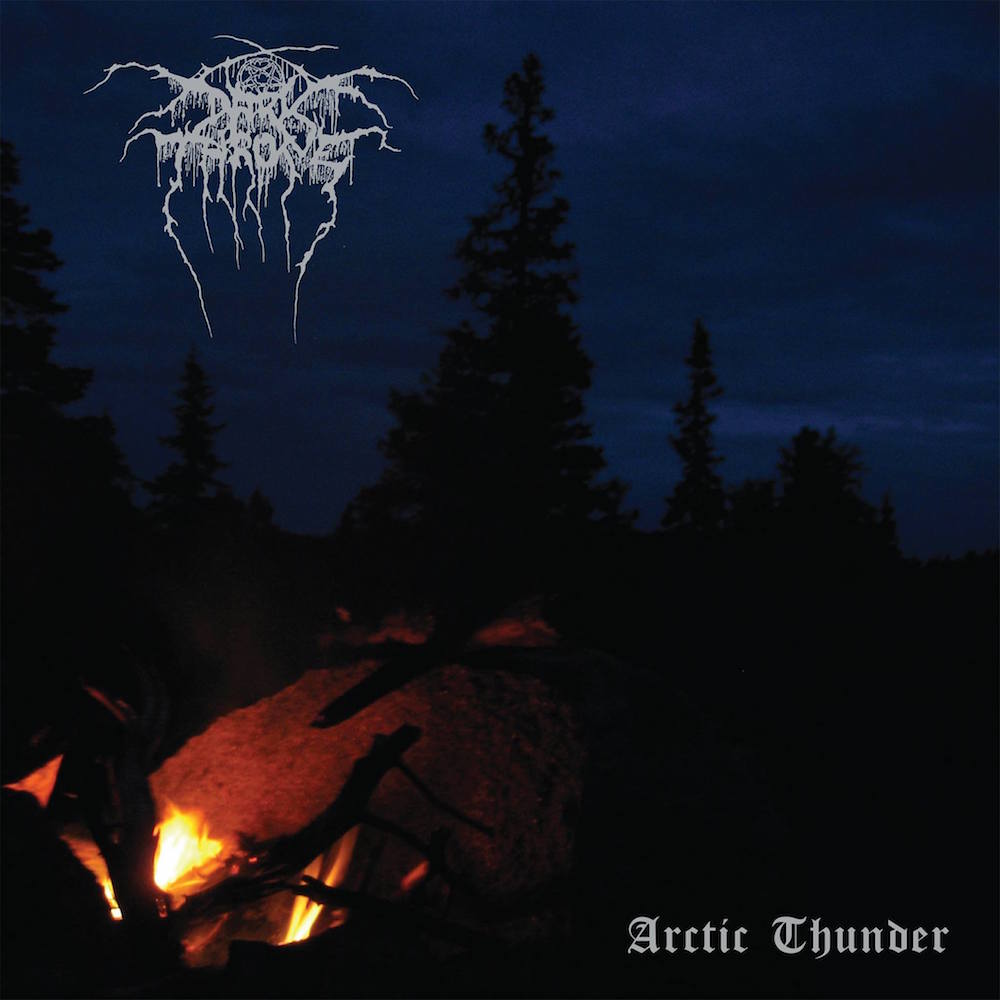
    Yet, reflecting on the band’s history of identity, a ‘micro-macro-history’ of their cultural identity from 1986 until today, focusing on the ‘microscopic’ topic of the band’s identitary aesthetics, the new album is – in a certain way – an extraordinary one. The music heard on the record seems to be a progression of what the band is doing but the overall aesthetics hark back to the band’s classical black metal phase from 1991 to 1995. This is the record’s cover:

    index ((Source: http://www.nuclearblast.de/static/articles/253/253324-1.jpg/1000×1000.jpg, retrieved 12/10/2016.))

    This cover’s features are, in a cultural ‘micro-macro’ perspective of the band’s history of identity, very interesting – and, special. The cover shows dark woods, fire (I guess, a campfire), the band’s logo and the record’s title. This is a very straight codification of early 1990’s Black Metal aesthetics: the topics and metaphors of fire and woods have become standout topics of Black Metal in its cultural orthodoxy. But, when looking back at the band’s classical records from 1991 to 1995, they all had a black and white outfit. So, what is, in a certain way, the key move on ‘Arctic Thunder’ is to use a orthodox, very traditional and classical black metal identity but to paint it colourfully.

    This move can be seen in both ways, literally and metaphorically: literally the band follows, now, a more colourful approach in their aesthetics of identity. Metaphorically, and this is from the mentioned ‘micro-macro’ perspective of history the more interesting one, the band breaks classical Black Metal monochromy and re-composes it in colour. Black Metal is – self-conciously, and, somehow, courageously – hybridized with Rock’n’Roll. The band did so since ten years but, in 2016, they start to do it more explicitly. So, from this allegorical perspective, we can see a new era beginning in the group’s cultural history of identity. In 2016, the band plays ‘colourful Black Metal’.

    So, reflecting on it in a broad cultural historical perspective, this is a tempting move. In 1966, exactly fifty years ago, the Rolling Stones wanted to ‘paint it black‘, releasing a single of this title. In 2016, the seemingly most extreme one of popular music cultures, Black Metal, at least one of their key-players, wants to ‘paint it colourfully‘. I am eager to see and listen what kind of broader trends in cultural history this can be seen to represent metaphorically.

  • ‘European Solidarity’, the ‘European Soul’ and the Metal Music Community as a Cultural Community of Solidarity – Are There any Connections?

    Nine days ago, on the day of the ‘Brexit’-votum in Great Britain, I took part in a scientific conference dealing with the ‘notorious’ topic of “European Solidarity”: there, we discussed the question wether European solidarity is to be seen, historically, as ‘the bonds that unite’ Europe. Doing so, on the day of the success of the ‘Leave’-campaign in Great Britain, made me feel a bit like being trapped in a mental state of British black humour – we discussed European solidarity while one of the biggest EU member countries voted to turn its back on European solidayrity.

    This was not only a case of cultural cynism but of an overall trend in global and EU political discourse where emotional arguments and strategies  had been successfully employed to reach certain nationalist and authoritarian political aims. The ‘Leave’-campaign used the fears of a split society (‘older vs. younger’; ‘educated vs. less educated’; ‘rural vs. urban’; ‘poor vs. “rich’) to pursue its nationalist and populist agenda. To vote “Leave”  in Britain on 24th June, had its politico-cultural counterpart in the success in elections of Austria’s FPÖ, of France’s Front national, of the AfD in Germany, etc. All these “movements” and their discourses clinge to a global trend of leaving behind ‘Western’ liberalism and its culture of pluralism and anti-authoritanism. In fact, theses discourses and their anti-European stance of political speech are the form authoritanism takes in the middle of 2016.

    However, this is not the authoritanism we know from theinterwar-period of the 1920s and 1930s. It is a new kind of authoritarian discourse which stems from a lack of visibility of meaning and representation in the global post-1989 world; most of all since the ‘Digital Revolution’ made the ‘Global village’, predicted by Marshall McLuhan, had become reality. We live under the auspices of a permanent cultural stress and tension, a digital fog of information which makes our identities become blurred, when there seems to be lrgz no boundaries of space and time. In this cultural condition, solidarity – European solidarity – has become an almost impossible norm: Whom in Europe (or our local and regional neighbourhood) should we feel solidarity for if societies and groups of the USA, of Asia, of Africa and other parts of the world seem, in the digital context, to be much closer, or, at least, as close as Europeans themselves? This lack of the visibility of cultural solidarity in Europe, because of our today’s world cultural structures, is the root of the new authoritanism: its discourse of nationalism and protectionism seems to create a sphere where solidarity remains alive – yet, this is an illusion.

    Hence, in 2016 and beyond, we need new cultural discourses enabling us to build bonds of solidarity in Europe and the European Union, in a digitally and economically, and socially globalized world. We need to find new elements of community, cultural artefacts of solidarity that remain visible even if Chinese and Japanese, or Brasilian and American people seem to be much closer to our lives in popular culture than our European neighbours. This has to be a new kind of ‘imagined community’. ((cf. Benedict Anderson, Imagined Communities. Reflections on the Origins and Spread of Nationalism. London: Verso 2006.)) We have to find a new kind of collective imagination of our European identity and ‘European soul’ that matches this new cultural condition. ((For a recent narrative on this, cf.  Pichler, Peter. 2016. EUropa. Was die Europäischen Union ist, was sie nicht ist und was sie einmal werden könnte. Graz: Leykam.))

    This is where the global imagined community of Metal Music, as a global discourse of popular culture, economy and leisure comes in. In the global Metal Music community there is a kind of solidarity that remains alive in times of globalization and its phenomena of the dissapearing of boundaries of spatial and temporal imagination. Actually, just because of the fact that today, in a world of global-wide communication where the solidarity of the Metal Music community can be established in a timeframe of seconds (and where local contexts depend from its overall global level of imagination), this imagined community found its structure as a growing and established field of cultural practice. ((Cf. Deena Weinstein. 2015. Rock’n America. A Social and Cultural History. Toronto: University of Toronto Press;and Andy R. Brown e.a, eds. 2016. Global Metal Music and Culture: Current Directions in Metal Studies. London: Routledge.))

    That Metal Music has progressed to mainstream and has become a global and European subject of an own branch of scientific discourse, Metal Music Studies, forms this development’s climax; it means that in Metal Music solidarity of all ‘Metalheads’ around the world can be imagined because global cultural infrastructure of communication and information have formed a tool-like discourse of collective imagination which allowed this development to become historical reality. ((cf. ibid.)) In a nutshell, Metal Music discourse made appear a global community of solidarity whose identy stems from its ability to remain visible in our times of globalized blur of cultural realities of belonging.

    Hence, what we have to ask for is, how this remains possible in times of crisis, looking for a structure of cultural discourse in Metal Music which we could learn  from something for European integration history. The answer to this question lies in the fact that Metal Music discource has become a field of social practice in which the global framework of the identy of being a ‘Metalhead’ and their local roots of belonging form a liquid and hybrid form of coherence. ((cf. ibid.)) It creates solidartiy because globalization and localization work in parallel tracks, they build on synergies. Here, solidarity is a form of coherence in which an African ‘Metalhead’ feels solidarity for American and European fellow-fans of Metal Music and, at once, remain attached to his regional and local cultural. ((Cf. ibid.)) This form of coherence is to be sought for in discourses of European solidarity. In a nutshell, agents of European solidarity coult take a glimpse at and learn its lesson lesson from the establishment of the solidarity in Metal Music and its global way of collective imagination. Maybe,  as Europeans and EU Europeans, we should look for the Metalhead woven into our collective European soul.