Tag: Cultural History

  • “I, the mask”: A concert under the conditions of the ‘Covid19’ pandemic

    Last Saturday, for the first time since March 2020, I attended a metal show at Explosiv youth centre in Graz, Austria. The billing consisted of Alphayn, Groteskh, Heathen Foray and Obscurity. After a concert-less six months, now, slowly, smaller-sized club shows are coming back. The audience has to be smaller than usual and also the fans in the crowd must wear the omnipresent masks. In metal culture, the mask has become a cultural signifier. Many bands offer masks with their logos or album artworks as merchandize. In this shorter blog post, I reflect on two aspects: First, on how these conditions created a very specific and peculiar atmosphere at a metal concert; and second, on how such ‘atmospheric’ aspects can be analyzed in Metal Music Studies.

    I, the mask…

    In everyday culture, the masks haven become day-to-day companions of our lives. Most Austrians wear them, only few refuse to do so. So do most Austrian fellow metalheads agree to wear them, but some are critical about them. On this evening, they had to be worn when entering the concert hall. As written before, the masks – usually in black – have become regular items in metal webshops. Hence, more and more, the masks are part of (commercial) metalness identity-building. At this concert, they were compulsory in the concert hall but in front of the venue and in the bar area people did not have to wear them:

    Concert goers in front of Explosiv youth centre, Graz, 12 September 2020, (c) Peter Pichler.

    In consequence, in front of the venue and in the bar space, things were going usual ways. People were chatting, discussing the perfomances, having drinks or smoking cigarettes. But in the hall, the situation was strangely different from other concerts I had witnessed there before. The audience was about 200 local metalheads, half the size of ‘normal’ shows. So it was less crowded. In the audience space, the masks had to be worn and people were required to keep a safety distance from each other. Both worked quite well. The odd amospheric effect was that the masks – even more than usually – anonymized the fans. They became ‘faceless’. ((For the situation of metal concerts, see D. Weinstein, Heavy Metal: The Music and its Culture, Boulder, CO: Da Capo Press, 2000, 199-235.))

    The fans not allowed to show their faces and directly express enthusiasm, excitement or also disapproval towards the bands via facial expressions, there was quite an odd atmosphere in the audience. Heabanging, showing the metal horns and ‘moshing’ happened, but in strangely anonymized and socially distant ways. Not distant because of the new rules, but distant because the actors in the audience were anonymized into ‘facelessness’. The main effect was that, even more than usually, the artists – who did not wear the masks – became the centre of attention, as they were the only ones who could show their faces:

    Performance by Heathen Foray, Explosiv youth centre, Graz, 12 September 2020, (c) Peter Pichler.
    Performance by Heathen Foray, Explosiv youth centre, Graz, 12 September 2020, (c) Peter Pichler.

    Thus, in an atmospheric way, the current ‘Covid19’ conditions changed the ‘mood’ at metal concerts, at least at this specific, contingent concert as an individual event on 12 September 2020. The cultural key signature of this event was that – much more than already before – there was a clearly palpable hierarchical distance between the artists and the audience. The ones were ‘faceless’, anonymous watchers, they others were in the bright light of attention, showing their faces on the stage. How to make sense of this change of atmosphere in scientific ways?

    Atmosphere, mood, stimmung…

    In  2012, the German literary scientist Hans Ulrich Gumbrecht published a book entitled ‘Atmosphere, Mood, Stimmung: On a Hidden Potential of Literature‘. ((H.U. Gumbrecht, Atmosphere, Mood, Stimmung: On a Hidden Potential of Literature, Stanford; CA: Stanford University Press, 2012.)) The notions in his title – ‘atmosphere’, ‘mood’ and most of all the German-language notion of ‘stimmung‘ (a major concept of 19th century German Romanticism) – catch the main qualities of this concert event. ((For Romanticism, see W. Breckman European Romanticism: A Brief History with Documents, New York: Bedford/St. Martin’s, 2007.)) Stimmung describes the affects and emotions that followed from the sensual impressions – watching, listening, smelling, tasting – at this event. The impressions of ‘faceless’ metalheads in the audience, of bands performing without masks in the bright light on the stage, but also of the usual routine in front of the venue, created this evening’s individual stimmung. The main point of this stimmung is that it implied a new atmospheric hierarchy at a concert. We should keep an eye on this because it involves matters of power and representation.

  • Styria: the local ‘metallic association chain’

    In my last post, I wrote that in our research project on the Styrian metal scene we  now progress from the European macro-level to the Styrian micro-level. Established in the UK in the early 1980s, the European narrative of law in metal culture was our macro-point of reference. During the New Wave of British Heavy Metal this narrative circulated throughout Europe and became a crucial resource for the construction of local scenes – also for the Styrian metal community. Starting from this we can now ask for local patterns. In this post, I attempt giving a first overview of some patterns of the local metal ethos in Styria and Graz.

    History and memory-building projects in the Styrian scene

    In the past weeks, I have been thinking intensely about what these European macro-findings imply for our research on the cultural history of the Styrian metal since the early 1980s. Where exactly should we start? I came to the result that the best point of departure is the local scene’s own view of its history; understood in a quite literal sense of how the scene visually represents itself today in the discourse in 2020.

    This is is so important, because this constructed gaze at the collective scenic self – in its selection of depicted scene members, of materials, of music instruments, of scene sites, etc. – gives us pivotal clues on how to write this history. It tells a lot about the scene’s ethics and its local version of norm-related sonic knowledge.

    Empirically, research on this ‘Styrian metal gaze’ is in a privileged position. Since about fifteen years, the regional heavy metal scene has discussed its own history and collective memory intensely. Apparently, the scene is discussing how this history should be told and/or memorialized.

    In this respect, two projects are to be mentioned. The first ist Rockarchiv Steiemark, a virtual archive of local bands initiated in Graz already in 2007. ((See Rockarchiv Steiermark, https://www.rockarchiv.steiermark.at/?fbclid=IwAR1B_qSmW1AoctisWNGvIGYGEjBQHwwv9VziZu0fEQS7uOMD2PKyqN3YQJ8, accessed 18 July 2020.)) This project is associated with the local urban and Styrian museums. In a professional manner, it provides users with sources on the history of the Styrian rock scene since the 1950s. However, as the title indicates, metal is seen only as a sub-phenomenon of rock history.

    The second project emerged from the metal scene itself. Styrian Metal History is an online project, which has the ambition of telling the history of “35 years of rock & metal made in Styria”. ((Source of the quotation: https://www.facebook.com/pg/mm.andikrammer/about/?ref=page_internal, accessed 17 July 2020.)) The project was initiated by local artist and scene veteran Andreas Krammer. Currently, the database has about 2700 followers and offers more than six thousand scene-related photographs. (( Source of the statistics: https://www.facebook.com/mm.andikrammer/, accessed July 18 2020.)) We have to consider it the most elaborated attempt at collective memory-building in the local scene.

    Specifically this second project with its massive collection of scene photographs is of great empirical value. First, the photographs themselves as sources, then moreover how these sources have been integrated into a mushrooming online history tell a lot about this community. At this point, the main question is no more how many photographs are already collected in this online-memory. Much more, the crucial matter to address is how they photographs were selected, arranged and fashioned into a seemingly holistic narrative.

    The decisions the contributing scene members made on their way to self-narration tell a lot about the community’s identity – about their ethics, their values, their local norm-related sonic knowledge. On the one hand, those decisions pushed certain actors, constellations, materials, technologies, and values into the spotlight. On the other hand, they also pushed aside other groups, actors and competing visions of the scenic collective self. In the following, I give a first discussion of some aspects that caught my attention. I suggest that (preliminarily) we can identify at least four patterns of the representation of the local scene’s ethos. ((Editorial note: the source of all photographs cited here is Styrian Metal History: https://www.facebook.com/mm.andikrammer/, accessed 18 July 2020. Each respective copyright belongs to the copyright holders. Usually, on Styrian Metal History the copyright situation is not mentioned explicitly. If copyright holders or depicted person do not want their images to be cited here, please contact the author via mail, in case you want the picture to be removed from the post.))

    First pattern: Breaking all the rules…and laws as well?

    A first pattern which dominates the representation of the scene is portraying it as a community of cultural ‘rule-breakers’. Be it at concerts or be it for promotional shots for new releases, always the Styrian metalheads decided to strike poses, that transgressed the rules of mainstream culture. Apparently, those were intentional decisions.

    At concerts, headbanging and forming mosh-pits involved breaking usual conventions of dance and non-violent behavior. For promotional pictures, several artists chose to take poses that only worked in their community. Taken in Styria in the 1980s, the following pictures paradigmatically show how this facet of the local metal ethos was set in scene when celebrating metal:


    Apparently, the metal scene wanted to be seen as a community of cultural rule-breakers. This pattern is highly relevant for our research. Probably, this aspect of the ethos opened up a cultural sphere, where – as in many other European scenes in 1980s – the above mentioned European narrative of law could be absorbed.

    Second pattern: Encultivated aggression and readiness to act

    A second pattern shines through in these two photographs:


    In the first, we see a group of local artists posing with pitchforks in a farming enironment. In the second, we see the band posing with their instruments in a forest beneath trees, on soil covered with fallen leaves. So, the picture was taken in autumn. The interesting point is the attitude set in scene in both pictures; this attitude forms the semantic bridge between them.

    In both renderings of the Styrian metal ethos, the band always carries their ‘weapons’ with them. This intentionally created attitude of permanently being ready to act, combined with metal’s core emotion of aggression, appears throughout the representation of the scene in Krammer’s collection. Readiness to act, if it must be even readiness to act aggressively, seems to make a second pattern. It is a perfect match with the first pattern of rule-breaking.

    Third pattern: Intimitating the enemies of the scene

    Visually and psychologically, a third pattern catches one’s attention. On many of the pictures in Krammer’s database, scene members are viewed by the spectator from the worm eye’s perspective. Rather intimitating, perhaps even threatening, the Styrian metalheads look down on us from above:


    This pattern created an image of the local scene, which seems to intimitate the alleged ‘enemies of metal’. It is a fascinating thought that the worm’s eye perspective – with all its associations of hegemony, domination and aggression – became a cultural institution of the local scene. Once more, this has to be seen in reference to the other three patterns and needs more detailled research.

    Fourth pattern: Traditional gender roles and ethics

    Finally, a fourth pattern is the representation of gender roles of men and women in the Styrian scene, most of all in the 1980s, 1990s, and early 2000s. Like in many other metal scenes, the pictures seem to once more prove metal’s patriarchic structures and conservative gender roles in these decades. Evidently, the pictures show more male than female Styrian metalheads. As a rule, both of them are shown in the traditional roles of men as the ‘guitar heroes’ or ‘authentic fans’, whereas women are shown as ‘femmes fatales’ in revealing clothes. This part of the Styrian ethos seems to be a parallel to other European metal scenes.


    Conclusion: A first description of the local ‘metallic association chain’ in the Styrian scene

    Together, these four patterns made the Styrian metal scene appear as a community of (1) rule-breakers, who (2) always were ready to act. (3) In this construction, the Styrian metalheads never were afraid of their ‘enemies’ and seemed to always look down on them from above. (4) That these patterns appear as rather conservative ethics of male dominance also is a facet of the Styrian metal scene.

    This ethos was constructed by the scene members when they decided how they wanted to be seen. This staged ethos created the local ‘metallic association chain’. It created an associative portfolio of attitudes, symbols and values that should appear in one’s mind when thinking of the Styrian metal community. We can start our research by asking for the practical construction of this association chain. Who decided what, where and when in the constitution of this ethos?

  • Politics, values, norms, and ethics in metal and metal studies: ‘Reflexive anti-reflexivity’ has a history!

    Our project on metal and law at the University of Graz is advancing. We are even a bit ahead of our planned schedule. In the past months, I have worked my way through existing metal research literatures, also paying close attention to older metal studies works’ take on questions of politics, ethics, norms, in short on the norm-related sonic knowledge of metal. ((Once more, here we have to mention the ‘usual suspects’ of classic metal studies works; among them, see H.M Berger, Metal, Rock, and Jazz: Perception and Phenomenology of Musical Experience, University of New England Press: Hanover and London, 1999; D. Elflein, Schwermetallanalysen, Die musikalische Sprache des Heavy Metal, Bielfeld: Transcript, 2010; R. Walser, Running wit the Devil: Power, Gender, and Madness in Heavy Metal Music,Middletown, CT: Wesleyan University Press, 2014; D. Weinstein, Heavy Metal: The Music and its Culture, Boulder, CO: Da Capo, 2000.))

    As explained in my recent last blog post, cultural-historically, we now have a pretty solid impression of how metal culture, most of all since the early 1980s, developed its discourse centered on law and norm-related phenomena, on a European and global level. Starting from this broad framework, the next steps are to engage critically with the key results from this first phase and develop the final empirical framework (questionnaires for interviewees, selection of interviewees) for researching the norm-related sonic knowledge in the Styrian heavy metal scene.

    This is the point where we go from the macrosphere of the European and the global to the microsphere of the local in the Austrian region of Styria with its capital city Graz. In this step, it seems crucial to me to reflect upon an aspect which frequently ‘popped up’ in existing research literatures and also when talking with potential interviewees and local scene stakeholders.

    An apparent blind spot in metal studies

    Frequently, when re-reading existing works in metal studies, I was struck (or to be more frank: hit) by the fact that actually metal studies has rather serious issues when it comes to addressing the moralities, polictics, values, and ethics of metal culture since the 1970s. So far, it is only clear that metal has its ever-varying values, moralities, and political agendas.

    But as shown brilliantly by Rosemary Lucy Hill in her excellent key note lecture in Salzburg last year, metal studies has serious issues when it comes to developing a convincing grip on phenomena in the culture that belong to the sphere of values, norms, or moralities. We know that there are ‘problematic aspects’ and partially we understand them, but we do not really know how to explain and deal with them in metal studies in a historical longue durée perspective.

    Of course, I have no full solution to this problem in a short blog post. But I want to raise two points that seem to be relevant and so far neglected. Much more than now, we should also take these discussions (and the apparent non-ability of metal studies to deal with them) as historical phenomena, that have a past, yet today still effective history of their own.

    Still, Kahn-Harris’ concept of the ‘reflexive anti-reflexivety’ in the extreme metal scene is the most convincing analysis of how a specific subgenre of metal developed its norm-related discourse. (( K. Kahn-Harris, Extreme Music: Music and Culture on the Edge, London and New York: Berg, 2007, 157-166)) Kahn-Harris showed that extreme metal scene members consciously and reflexively decided to ignore ‘problematic aspects’ like violence, racism, homophobia, or simply hatred in their culture.

    This is true. But if we approach this issue historically, two serious challenges are not solved convingly in his analysis. Reflexive-antireflexivity is a habitus the extreme metal scene seems to have encultured. However, as a first aspect, we have to intepret this habitus as a culminating point of a history of living metal since the 1970s. Reflexive anti-reflexivety did not fall from the sky in the early 1990s. It simply never was the case that extreme metal fans were historically independent from  their contexts and 100% consciously or independently decided to adopt this concept. So far, the analysis is biased towards a rather ahistorical presentism.

    Much more than currently, we have to acknowledge that this way of approaching their own culture has deep roots in metal culture and outside metal culture; it developed at the points where the moral spheres of both touched upon each other. In short: reflexive anti-reflexivety has a history. Unambiguously, it is a history we do not know much about (to formulate it cautiously). ((I hope my  upcoming book on the European cultural history of metal can be a first step into this direction; see P. Pichler, Metal Music, Sonic Knowledge, and the Cultural Ear in Europe since 1970: A Historiographic Exploration, Stuttgart, Franz Steiner, in press, 2020.)) This habitus is a historically created way of knowing metal and we have to research how exactly metalheads learnt to know metal in this way.

    The second point, perhaps, is even more critical for metal studies in its current phase of becoming an independent field of studies. Most metal scholars are metal heads themselves. This fact for itself is no problem; I even think it is a big advantage because with fandom comes a lot empirical knowledge.

    However, with the fact that many metal studies scholars are (extreme) metalheads  reflexive anti-reflexivety found its logical way into metal academia. Hence, the concept Kahn-Harris described could wander beneath the surface into the the moral sphere of metal studies. We should look sharp at this point of moral intersections. I hope a cultural-historical take on this discussion can bring in new insights – by scrutinizing the history of metal’s norm-related discourse.


  • Maggie Thatcher made heavy metal (…and she saw that it was good?)

    Original source: cover picture of Iron Maiden, ‘Sanctuary’, (c) EMI 1980.

    Obviously, the title of this new blog post, which takes up the thoughts expressed in my recent post on our project of law-related phenomena in heavy metal culture, is not meant to be taken literally. But if we see it as a cultural-historical metaphor (very much like the above used graphic cover artwork of Iron Maiden’s Sanctuary single from 1980, where ‘Eddie’ kills Maggie Thatcher) it raises crucial research questions for our project. In this short blog post, I will attempt formulating some of these questions.

    Currently, our research focuses on the early 1980s, the years of the climax of the NWOBHM. These years were the ones in that several classic metal songs were released, which centered on law in their musical material, lyrics and imagery. Just to name a few: Judas Priest’s ‘Breaking the Law’ (1980); Iron Maiden’s ‘Sanctuary’ (1980), ‘Running Free’ (1980), and ‘Prodigal Son’ (1981); and Helloween’s ‘Heavy Metal (is the Law)’ (1985). All of these songs treat law as a cultural system of norms and rules, which the metal community had to face in for this community new ways. Usually law was depicted as conservative, liberty-taking, even oppressive.

    Here, the point is how the community faced it in the construction of an ‘imagined community’ in metal’s ‘golden age’. My colleague Charris Efthimiou, a musicologist, spent the past three months analyzing these classics in great detail. ((Charalampos Efthimiou, Musicological analysis of Judas Priest’s ‘Breaking the Law’ (1980); Iron Maiden’s ‘Sanctuary’ (1980), ‘Running Free’ (1980), and ‘Prodigal Son’ (1981); Helloween’s ‘Heavy Metal (is the Law)’ (1985). Not published work. Graz, 2020.)) He focused on ‘law patterns’ in the songs’ lyrics and musical material. We started with these classics, because they also were a main point of reference for the initial construction of the local heavy metal scene in Graz and Styria. Charris shows very clearly that such law patterns were at the heart of the culture in those crucial years.

    This finding raises serious questions. As a rule, in these songs, law is explicitly thematized and pointed out as a system of norms and ethics the emerging metal scene had to deal with. As far as we can say at this point, this rendering of law as a system of oppressive norms is clearly integrated in the emerging musical language of metal in the years 1980-85. The focus on law in the lyrics is matched in the chosen harmony progressions, guitar chords and song construction modes. Obviously, law – as a point of reference – was essential for metal in these formative years.

    As most of these classics by bands like Maiden and Priest were written and performed in Great Britain in the era of ‘thatcherism’, that ideology’s approaches to the legal system and society in general (under the very conservative auspices of ‘law and order’) were necessary elements of the emerging metal discourse. Law was seen and treated as a highly conservative body of outdated and dusty traditions, even as a threatening system of oppressive rules. It seemed to take metalheads’ deserved liberties.

    This narrative of law – thatcherism’s vision of law or what metal suggested it to be ((See Eric J. Evans, Thatcher and Thatcherism, London: Routledge, 2013.)) – was the crucial point of reference metal needed to develop its contrasting ethics of liberty. It was the classic ‘Other’ metal needed to construct itself. The artwork of the ‘Sanctuary’ single captures this perfectly. Thatcher’s vision of law was the ‘Other’ metal needed. To continue our research, we have to answer three crucial questions: 1) How did this narrative of law circulate in Europe? 2) How did it advance to the global metal scene? 3) And finally: How was it taken in in the regional metal scene in Graz and Styria? Put ironically, Maggie Thatcher did not make metal but she supported it with her political agenda greatly.

    Edit, 10 June 2020: Engaging with my post, legal philosopher Christian Hiebaum commented that thatcherism was not only about conservative ‘law and order’ ideologies. Thatcherism also promoted individualism and individual liberty, but mainly in the economic sphere – this was key to its brand of neoliberalism. This critical remark made me dig a bit deeper into socio-historical literature on thatcherism.

    In 2010, Brian Harrison published a survey book entitled Finding a Role? The United Kingdom, 1970-1990 as a part of the ‘New Oxford History of England’ series. Strikingly, Harrison described how the law reform movement in the UK in the 1980s saw the British legal tradition as elitist and oudated:

    The parliamentary draughtsmen offered stiff resistance in the early 1970s (…) but during the 1980s pressurce built up for demystifying law in several ways. Its esoteric language – with its archaic forms, Latinisms, and and formulaic phrasing – was now being challenged (…) As for wigs and gowns, more people now felt that these ‘priestly garments’ unduly distanced the judges ‘from ordinary men and women’. ((Brian Harrison, Finding a Role? The United Kingdom, 1970-1990, Oxford: Clarendon Press, 2010. This volume was published as a part of the ‘New Oxford History of England’ series, ed. by J.M. Roberts.))


    What Harrison says here is about the image and narrative of law in the Thatcher era, especially in the early 1980s. Law had to be ‘demystified’. This is very much in line with my argumenation on thatcherism’s take on law. Still, the question how the neoliberal individualism inherent of this ideology affected the narrative of law is not really explained with this.

    I suspect that metal culture at the apex point of the NWOBHM did focus on the conservative image of Thatcher as a public person. Her neoliberalism seemed to be outplayed by this. But we have to continue our research into this. I am also thankful for any feedback on this specific aspect.

  • Oral history as a method in research on local metal scenes

    This week, I started working in the research project ‘Norm-Related Sonic Knowledge in Heavy Metal Culture: A Case Study of the Heavy Metal Scene in Graz and Styria‘ at the University of Graz. I have thematized it in a post some months ago. In this project, we want to find out how law-related phenomena (for instance, the topos of ‘Breaking the Law’ as a cultural narrative in metal since the early 1980s; the local scene ethics as ‘scene-laws’; the thematization of law and justice in local metal music; attitudes to law in the scene) affected the distinct cultural history of the local heavy metal scene in Styria, a ‘Bundesland‘ in the Southeast of Austria.

    Asking for the ‘longue durée’ dimension of a scene history

    In our research, oral history is one of the methods, that will be applied in the second, empirical phase of field work in 2021. With scene-members and stakeholders but also with professionals from the legal field (for instance lawyers and other professionals in the judicial system) from outside the scene, we will conduct interviews on their narratives of law (in metal). Already at this early stage, at the point of re-reading the crucial literatures in the field, it is necessary to reflect upon the question how exactly oral history can be applied fruifully in our research. ((See L. Abrams, Oral History Theory, London and New York: Routledge: 2010; R. Perks and A. Thomson, The Oral History Reader,  Routledge: London and New York, 2000; D. Ritchie, Doing Oral History, 3rd ed., Oxford: Oxford University Press, 2015.))

    For us, one of the critical aspects of present scene research is the sometimes rather ahistorical conceptualization of the histories of  local metal communities. From the point of view of trained historians, current scene theories tend to rather oddly isolate scenes from the broader historical flux of culture and their surrounding contexts. ((See. E. Baulch, Making Scenes: Reggae, Punk, and Death Metal in 1990s Bali, Durham, NC: Duke University Press, 2007; A Bennett, and R. A. Peterson (eds.), Music Scenes: Local, Translocal, and Virtual. Nashville, TN: Vanderbilt University Press, 2004; K. Kahn-Harris, Extreme Metal: Music and Culture on the Edge, New York: Berg, 2007;  J. Wallach and A. Levine,‘“I Want You to Support Local Metal!”: A Theory of Metal Scene Transformation’, in Popular Music History 6, 1/2, 2011, 116-34.)) In a nutshell, metal music studies needs ‘more history’. In this respect, we see our expertise as a chance to better grasp the longue durée dimension characteristic of history.

    For this purpose, oral history – a methodological and theoretical discourse developed mostly in English-speaking academia since the 20th century – makes a ‘weapon of choice’. Qualitative interviewing is broadly used in many branches of cultural research nowadays. What we aim at is unwrapping the long-lasting narratives of scene ethics and ‘scene-laws’ in the Styrian metal community, as they seem to have continuties since the early 1980s. Today, they are deeply routed in this community.

    Does metal have a long-lasting history in Styria?

    Thus, the pivotal matter in applying oral history in this case is not only about the selection of interviewees; above all, it matters to develop a set of questions that makes scene-members and stakeholders remember their versions of these narratives since the early 1980s. Summarized in a short formula we have to ask our interviews right at the start: “Does metal have a long-lasting history in Styria?” This is the opening question for our oral history inquiries.

  • “Too late, too late…?” On the norm-related sonic knowledge of female aggression

    Female emancipation in metal – too late?

    In 1979, Motörhead released the song ‘Too Late Too Late’ as a b-side to the ‘Overkill’ single. If we take the song title as a question, it seems to fit the history of female emancipation in heavy metal culture. As already Deena Weinstein stated in her pivotal cultural sociology of metal, ((D. Weinstein, Heavy Metal: The Music and its Culture, Boulder, CO: Da Capo Press, 2000.)) metal culture has been imbued with conservative gender stereotypes right from the start. Nonetheless, metal itself as well as metal studies have diversified in terms of gender roles since. ((A. Digioia & L. Helfrich, ‘”I’m sorry, but it’s true, you’re bringin’ on the heartache”: The antiquated methodology of Deena Weinstein’, in Metal Music Studies Volume 4, Number 2, 1 June 2018, pp. 365-374; also, see more globally: H. Savigny & J. Schaap, ‘Putting the “studies” back into metal music studiesPutting the ‘studies’ back into metal music studies’, in Metal Music Studies Volume 4, Number 3, 1 September 2018, pp. 549-557.))

    In this blog post, I want to take up these reflections on female gender roles in metal and discuss them under the auspices of the theoretical notion of ‘norm-related sonic knowledge’. This notion is at the heart of the research project on law-related phenomena in metal cultural history I am leading in the three coming years. In this project, we want to research how law and law-related phenonema contributed to the specific scene-building process in Graz and Styria from the 1980s to the present.

    In one of the two peer-reviews of the research proposal, the reviewer mentioned critically that gender roles are an important matter in this project and should be researched more prominently. Undoubtedly, the reviewer was insofar right as law is intrinsically connected to the normative spheres of metalness and thus touches upon gender normativities. However, since this is the first research on this topic at all, we cannot deliver a ‘full’ history of all facets. Perhaps, systematically, it would make sense thinking of such more specifical research after the basic research on this scene is done. In this post, I will raise some points that could lead into this direction.

    Jinjer in Zagreb

    Last Friday, I had the opportunity to see the Ukrainian band Jinjer live in the venue of Tvornica Kulture in Zagreb, Croatia. The experience of a Jinjer concert is a great occasion to discuss this topic, because the band in highly interestingly ways breaks up usual gender standards in their music. Their music can be described as a mixture of death metal, djent and groove metal. Their musical language is characterized by ‘bouncing’ guitar riffs (that reminded me of Rage Against The Machine’s Tom Morello) and, most of all, the versatile vocals by singer Tatiana Shmailyuk .

    It is this vocal style and the singer’s on stage performance that is worth taking a closer look. Being such a versatile vocalist, Shmailyuk performs both harsh guttural parts and clean melodic singing parts. The result is a combination of very aggressive parts and mellow melodic parts, usually within one individual song. Hence, reminding of black metal artisy Myrkur, the singer can play both roles of the 'tender' woman and of the aggressive female. These two short clips I recorded at the concert illustrate the band's musical language:

    What I witnessed at the venue in Zagreb in front of an highly energetic, sometimes almost rowdily mosh-pitting crowd also was a musical perfomance of gender roles in metal. In her vocals, the singer delivered both aggression and softness. In this specific historical event of a concert, repeated during a tour cycle on an almost daily base, Jinjer broke up the normativities of metal gender roles and created something new. I do not know whether it was this sheer overwhelming experience of an emotional rollercoaster that dynamized the crowd's behaviours in such dramatic ways.

    The norm-related sonic knowledge of gender in metal

    In our project, we will use the mentioned concept of norm-related sonic knowledge as an analytical description of the longue durée dimension of sense-making in metal by law-related phenomena and topics. The notion describes how such phenomena were used in metal culture to constitute the normative sphere of the regional scene in Graz and Styria.

    Already applied to the event of Jinjer’s performance in Zagreb, the notion leads to so far not asked questions on gender roles. If we see the history of female metalness as a long, diversifying and ambiguous development of normative ‘gender laws’ over almost fifty years since Black Sabbath took the stage, then this concert in late 2019 was a play in this history and with this history.

    Jinjer took some of the key norms (conservative female gender roles), broke them into pieces and re-assembled them into a new set of rules that probably could contribute to new, more progressive ‘scene laws’ in the future. If we think of this recomposition as a deeply cultural-historical act refering to five decades of women in metal, this seems to come late but not too late – but only so if the culture itself and also metal studies seriously keep up engaging with ‘difficult’ topics such as racism, misogyny or nazism.

  • ‘Fandom’ and ‘scholarship’: Comparing two cultural-historical institutions

    I ended my last post on the paradox at the heart of metal studies with the suggestion that cultural history, as one individual discipline in the transdisciplinary field of metal studies, could become an exciting enrichment. It gives us the promise of a structurally exploration of the the intertwined histories of fandom, scholarship and ‘fan scholarship’ in the field. In this (admittedly rather short) blog post, I take up this thought and attempt a first comparative analysis of ‘fandom’ and ‘scholarship’ as historically constructed cultural institutions. Once more, I take and stress the point of view of a historian.

    There seems to be a consensus in metal research that the nexus between metal fandom and metal scholarship is a crucial one. In Salzburg, Keith Kahn-Harris and Rosemary Lucy Hill encouraged us to proactively embrace the arising tension between both by self-reflexively asking diffictult questions on racism, sexism, bigotry, misogyny, nazism and other critical phenomena in the scenes. In this, history with its focus on developments over periods of decades (for metal studies this means to study the whole period since the inception of metal culture around 1970) can provide a helpfully orientating narrative. ((Peter Pichler, Metal Music and Sonic Knowledge in Europe: A Cultural History Since 1970, Bingley: Emerald, forthcoming.))

    Seen historically, both fandom and scholarship are not essentialist roles or identities but social formations, that both have long histories. The habitus, rituals and practices of that structure them can be traced back deep in history. If we view them as such complexes of historically constituted roles, the hybrid zone formed by them together in metal studies receives sharper contours. I start with fandom.

    Fandom

    Usually, metalheads are stereotyped as male, long-haired (semi-)adults wearing band t-shirts and battle vests. ((Once more, refer to Weinstein’s classic work: Deena Weinstein, Heavy Metal: The Music and its Culture, Boulder, CO: Da Capo Press, 2000; also, see Bettina Roccor, Heavy Metal. Die Bands, die Fans, die Gegner, Munich: Beck: 1998.)) Practices such as the formation of moshpits or showing the ‘metal horns’ at concerts complete the stereotypical imagery. They are expressions of scene members’ feelings of belonging to their communities, performed in public and addressing audiences within the scence as well as outside the scene.

    If we take the point of view of cultural history things appear in another light. Popular culture – and fandom as a crucial functional position of people in it – have a history that in some of its forms can be traced back to early modern periods; at least to the 19th century, when mass media established new forms of public spheres for mass audiences. The masses became literate. ((For introductory texts, see LeRoy Ashby, With Amusement for All: A History of American Popular Culture since 1830, Lexington, KY: University Press of Kentucky, 2009;  John Storey, Cultural Theory and Popular Culture: An Introduction, Harlow: Person, 2009; Kaspar Maase, Populärkulturforschung: Eine Einführung, Bielefeld, 2019.)) Thus, fandom is a cultural construction that, today, takes varying forms in different pop cultures (e.g. literature, music, film, gaming, sports etc.) but all of them stem from one root of comparable processes over decades, sometimes even centuries (as in the case of soccer culture or the passion for classical music).

    Taking this view very much relativizes the allegedly absolute newness of metal fan culture since the 1970s. Yes, the practices installed over almost five decades in the global metal scene produced some innovative patterns; however, only being constructed after 1970, the new rituals, practices and scene rules built there heavily relied on what has been learnt, experienced and practiced in other fan cultures before Black Sabbath took the stage. So, metal fandom is a cultural institution that can best be studied in comparison to other forms of fandom in history. And even more crucial, it has to be compared to other cultural institutions.

    Scholarship

    Let us come to scholarship. At first glance, scholarship seems to be something completely different. Scholars usually are seen as rational, well-educated and distinguished personalities. Once more, the stereotype is a male one. Scholars wear glasses, speak of almost non-understandable things and live in the ivory towers of their universities. Yet, also scholarship – and the modern intellectual as a role in it – are historically constructed phenomena. The role of both cannot be separated from the history of the university in Europe and the world since the Middle Ages. ((For introductory texts, see Hilde de Ridder-Symoens et al., eds., A History of the University in Europe, 3 vols., Cambridge: Cambridge University Press, 1992-2004; Thomas Sowell, Intellectuals and Society, New York, NY: Basic Books, 2010; Dietz Bering, Die Epoche der Intellektuellen 1898–2001. Geburt – Begriff – Grabmal, Berlin: Berlin University Press.)) Since the Middle Ages, philosophers, scientists, theologians and intellectuals – scholars in a most broad sense – tell us how to make sense of the world.

    As said before, this role appears to be very different from fandom. Nonetheless its realities work – basically and structurally – in ways comparable to any other spheres of community-building. Academia knows rituals, do’s and dont’s, forms of identity-building and othering. ((See Anthony Becher and Paul R. Trowler, Academic Tribes and Territories, 2nd edn., Buckingham: Open University Press, 2001.)) The essential question here is what sets this cultural institution, grown out of the tree of a history of almost thousand years, apart from other cultural institutions such as fandom.

    Seen from this angle, what separates them and what makes them comparable at once belongs to the same sphere: their historical backgrounds. How, on the one hand, scholars use the centuries-old narratives of scientific wisdom in their lives and how, on the other hand, metal fans use their  decades-old narratives of metalness can be compared, but only historically so. Both have come together in the history of the field of metal studies.

    Metal studies as a transgressive laboratory of cultural institutions

    What can we learn from this? If we take the point of view of history, metal music studies is they structural point where both histories come together. Seen this way, metal studies is nothing else than a cultural discourse, in which the insitutions of metal fandom and scholarship – with all their heritage – build a ‘match’. Thus, we should see the field as a transgressive laboratory, in which we work on these cultural institutions in the long term and, arguably, shape the new ‘sub-institution’ of the ‘metal scholar’. It is not about playing off one against each other but much more about thinking this new institution in visionary yet critical ways.

  • The paradox at the heart of metal studies

    Over the last two days, I had the wonderful opportunity of taking part in the inspiring Hardwired VII conference at the University of Salzburg. Already the seventh conference in this series, it was an event of intense discussions on topics of transdisciplinarity and transgression in metal studies. As such a stimulating event, it was an oportunity of further developing the scientific community in the field.

    In this post, I want to reflect upon what – probably – can be called the ‘heart of metal studies’. Intentionally, I use this notion of the ‘heart’, because as a metaphor it evokes associations of vitality, life, energy and of the identity of the metal studies community. Worth remembering, German metal veterans Accept released a classic album called Metal Heart in 1985. ((Accept, Metal Heart, Portrait Records, 1985.))

    Now what is at the heart of our field? From my point of view, taken together the two keynote lectures of the conference, by Rosemary Lucy Hill and Keith Kahn-Harris, summed up the crucial challenges scholars have to master in the coming years. Of course, I cannot deliver a full solution to the central problems of metal research in this blog post. From the perspective of a cultural historian, I want to comment upon the paradox at the heart of metal research.

    In her lecture ‘”You’re asking the Wrong Question!” Methodology, Standpoint and Fandon in Metal Research’, Hill delivered an excellent analysis of the main problem of the field in its ‘teenage years’. Metal research is dominantly conducted by scholars, who also take part in the culture as metalheads. With this comes an obvious, structural conflict between the obligation of the scholars in us to keep a distant and critical view on metal and the metal fans in us, who love the music. Hill encouraged scholars to keep asking hard questions on the difficult aspects of metal, e.g. sexual violence, fascim, racism and misogyny.

    In his keynote ‘Too much Transgression – Metal in an Age of Explicit Knowledge’, Kahn-Harris took up his work on metal culture and the concept of ‘reflexive anti-reflexivety’. For Kahn-Harris, today’s metal culture is to be seen as a culture in an age of abundant knowledge. Transgression takes new forms. He called these forms ‘transgressive literalism’, ‘transgressive unintellegibility’ and ‘transgressive inversion’. Also in his view, conflicts between stances to problematic aspects of metal have to be reconsidered.

    For a cultural historian, both lectures thematize a paradox, which seems to form something like the heart, perhaps the dark heart of the field. This heart pumps into the field (and its community) its vitality and is its key problem at the same time. The core issue  seems to be to develop theories, strategies and a communal habitus or ‘thought style’, which enable us of coping with the tensions between our identities as scholars and identites as fans in a productive way.

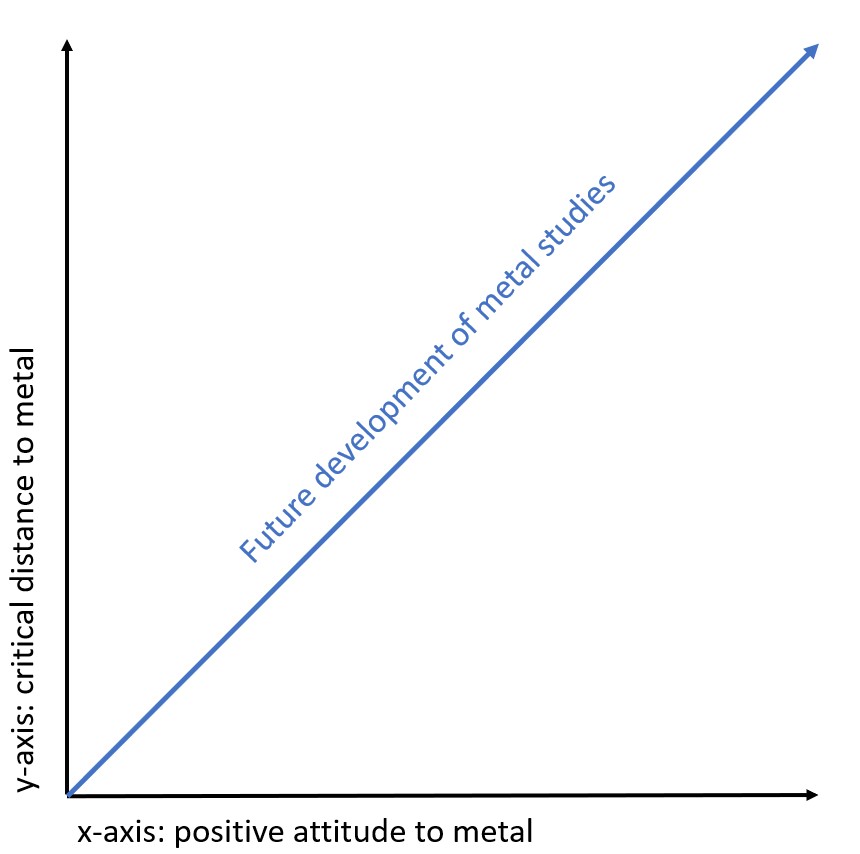
    Logically, this is a classic paradox. The point here is, cultural-historical experience teaches us that usually paradoxes cannot be solved. ((For instance, for the paradoxical structure of the identity of the European Union between nation-state and ‘super-state’, see Peter Pichler, ‘European Union cultural history: introducing the theory of ‘paradoxical coherence’ to start mapping a field of research’, Journal of European Integration 1 (2018), pp. 1-16.)) In the long term, the identitary tensions that arise from such conflicts are solved only contigently by creating new spaces of knowledge, in that scholarship goes as far as possible in both directions: in the direction of critique and the direction of keeping a positive attitude to the culture. In a perfect metal studies world, which never will become reality, this could look a bit like this figure:

    Thus, metal studies should not aim at defining a methodology or theory of metal that resolves the paradox. It should aim at constituting a new sphere of knowledge, in that we can go as far as possible into both directions. What Kahn-Harris called ‘engaged scholarship’ comes pretty close to this. With Hill, we should keep asking difficult questions. In this, history with its focus on longue durée developments over decades since 1970 could become an exciting enrichment. ((Peter Pichler, Metal Music and Sonic Knowledge in Europe: A Cultural History Since 1970, Bingley: Emerald, forthcoming.))


  • On interdisciplinary and transdisciplinary cooperations in metal music studies

    Currently, I am putting final touches on the manuscript of my book on European metal cultural history. ((P. Pichler, Metal Music and Sonic Knowledge in Europe: A Cultural History, Bingley: Emerald, Forthcoming.)) In this stage of revision, I have been thinking a lot about the forms interdisciplinary and transdisciplinary cooperations take in metal studies. In the following, I elaborate upon my view of these in our field crucial processes and invite my peers to discussion.

    In each of the currently existing introductory books to our field (and also in more specialized studies), the character of metal research is described as interdisciplinary and transdisciplinary. It is a discourse, in that since its inception around 1990 scholars from musicology, sociology, philosophy, linguistics, the study of religion etc. cooperate and discuss a shared subject: metal.

    However, often we approach the shared subject from very different angles and speak different disciplinary languages. For each of us, the epistemic and theoretical vocabularies we use are informed by our various disciplinary trainings. In my case, I live in the world of an Austrian historian, educated in this small country in central Europe. Thus metal studies, beneath the surface, is not only an interdisciplinary and transdisciplinary enterprise but also an ‘inter-identitary’ and ‘trans-identitary’ one, transgressing the boundaries between our sociological, musicological, historiographical, philosophical etc. identities.

    This has serious consequences. In metal studies, at conferences, in book projects, in collaborations and cooperations, we regularly face situations of conflict, of nonunderstanding and of misunderstanding caused by our various disciplinary traditions. From my point of view, there can be only one solution to this crucial issue: more theoretical self-reflection and and a clearly and explicitly defined theoretical language.

    In the sense of Savigny and Schaap’s recent essay on ‘putting the studies back into metal music studies’, ((H. Savigny and J. Schaap, ‘Putting the ‘studies’ back into metal music studies’, Metal Music Studies 4, 3 pp. 549-557)) we should lead an open discussion on key terms like ‘metal’ itself, but also on ‘scene’, ‘time’, ‘space’, ‘sound,’ ‘history’, ‘identity’, ‘culture’…obviously, the list ist opend-ended. The point here is to put more emphasis on explicit work on terminologies – in order to perhaps give birth to an independent language of metal studies.

  • Breaking the law!? A research agenda for a gap in scholarschip

    A gap in research

    In 1980, Judas Priest released their classic heavy metal anthem ‘Breaking the Law’ on the British Steel album. In the song’s lyrics, the protagonist thematizes law-breaking as his way of empowerment. This topos of ‘breaking the law’ is relevant in metal until present days. It is connected to metal’s idea of ‘metalness’ and scene-internal norms. Metalheads all around the world know the lyrics, at least the chorus.

    In a video clip of a live performance of the song, Rob Halford introduces the classic by saying that it would have become ‘synonymous’ to his band and metal at large:


    A second well-known example is Metallica’s album …And Justice for All (1988). Its cover and title-track work with narratives and semiotics of the allegedly corrupted laws of the American legal system. Here, law is represented as a field of oppressive norms.

    The cover takes up the ancient imagination of the Roman goddess of Justitia and reworks it in a metalness version. It was ‘translated’ to the semiotic aesthetics of 1980s thrash metal:

    Even more telling, since decades, metal’s scene language knows idioms like ‘heavy metal rules’ or even ‘Heavy Metal (is the Law)’, which is a song title by early Helloween. Here, literally metal-as-law is synonymous to scene-internal norms and rules. Metal makes the law. Despite this evident empirical relevance of law-related phenomena in metal, there currently is practically no research on this.

    Addressing the gap: a research agenda

    Addressing this substantial gap in scholarship, the author has applied for funds from the Austrian Science Funds (FWF) for a three-years research project. It is planned to research the role of law-related phenomena in the scene-building process in Graz and Styria since the 1980s.

    The proposal is affiliated with the Institute of the Foundations of Law at the University Graz. The project team consists of the author as a cultural historian, of a musicologist, and a of board of legal scholars. Also scholars from other disciplines are involved.

    In the project, which centres empirically on Styria, Graz and Austria, we want to answer three questions, that also have relevance when addressing the gap on a fuller scale:

    1.  How did ‘law’ function cultural-historically as a category in sense-making processes?
    2. Did that (those) mode(s) of sense-making change over the period from the early 1970s to the present?
    3. What role did ‘law’ play in the construction of a scene community in the long run?

    On balance, we hope this could be a fruitful addition to metal music studies.