Over the last two days, I had the wonderful opportunity of taking part in the inspiring Hardwired VII conference at the University of Salzburg. Already the seventh conference in this series, it was an event of intense discussions on topics of transdisciplinarity and transgression in metal studies. As such a stimulating event, it was an oportunity of further developing the scientific community in the field.
In this post, I want to reflect upon what – probably – can be called the ‘heart of metal studies’. Intentionally, I use this notion of the ‘heart’, because as a metaphor it evokes associations of vitality, life, energy and of the identity of the metal studies community. Worth remembering, German metal veterans Accept released a classic album called Metal Heart in 1985. ((Accept, Metal Heart, Portrait Records, 1985.))
Now what is at the heart of our field? From my point of view, taken together the two keynote lectures of the conference, by Rosemary Lucy Hill and Keith Kahn-Harris, summed up the crucial challenges scholars have to master in the coming years. Of course, I cannot deliver a full solution to the central problems of metal research in this blog post. From the perspective of a cultural historian, I want to comment upon the paradox at the heart of metal research.
In her lecture ‘”You’re asking the Wrong Question!” Methodology, Standpoint and Fandon in Metal Research’, Hill delivered an excellent analysis of the main problem of the field in its ‘teenage years’. Metal research is dominantly conducted by scholars, who also take part in the culture as metalheads. With this comes an obvious, structural conflict between the obligation of the scholars in us to keep a distant and critical view on metal and the metal fans in us, who love the music. Hill encouraged scholars to keep asking hard questions on the difficult aspects of metal, e.g. sexual violence, fascim, racism and misogyny.
In his keynote ‘Too much Transgression – Metal in an Age of Explicit Knowledge’, Kahn-Harris took up his work on metal culture and the concept of ‘reflexive anti-reflexivety’. For Kahn-Harris, today’s metal culture is to be seen as a culture in an age of abundant knowledge. Transgression takes new forms. He called these forms ‘transgressive literalism’, ‘transgressive unintellegibility’ and ‘transgressive inversion’. Also in his view, conflicts between stances to problematic aspects of metal have to be reconsidered.
For a cultural historian, both lectures thematize a paradox, which seems to form something like the heart, perhaps the dark heart of the field. This heart pumps into the field (and its community) its vitality and is its key problem at the same time. The core issue seems to be to develop theories, strategies and a communal habitus or ‘thought style’, which enable us of coping with the tensions between our identities as scholars and identites as fans in a productive way.
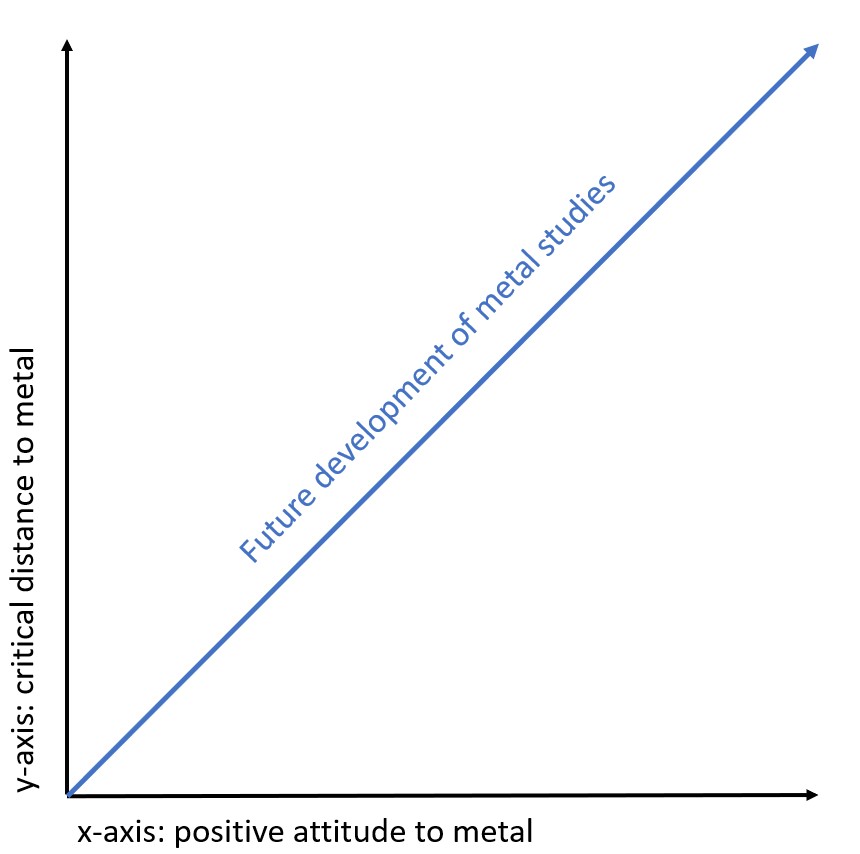
Logically, this is a classic paradox. The point here is, cultural-historical experience teaches us that usually paradoxes cannot be solved. ((For instance, for the paradoxical structure of the identity of the European Union between nation-state and ‘super-state’, see Peter Pichler, ‘European Union cultural history: introducing the theory of ‘paradoxical coherence’ to start mapping a field of research’, Journal of European Integration 1 (2018), pp. 1-16.)) In the long term, the identitary tensions that arise from such conflicts are solved only contigently by creating new spaces of knowledge, in that scholarship goes as far as possible in both directions: in the direction of critique and the direction of keeping a positive attitude to the culture. In a perfect metal studies world, which never will become reality, this could look a bit like this figure:
Thus, metal studies should not aim at defining a methodology or theory of metal that resolves the paradox. It should aim at constituting a new sphere of knowledge, in that we can go as far as possible into both directions. What Kahn-Harris called ‘engaged scholarship’ comes pretty close to this. With Hill, we should keep asking difficult questions. In this, history with its focus on longue durée developments over decades since 1970 could become an exciting enrichment. ((Peter Pichler, Metal Music and Sonic Knowledge in Europe: A Cultural History Since 1970, Bingley: Emerald, forthcoming.))
In this post, ((It is based on my conference talk at the conference “‘Music and Gender in Balance 2018”, Arctic University of Tromsö, Tromsö, Norway, 6 April 2018.)) I want to examine recent Scandinavian Extreme Metal music as a discourse, where gender balancing acts became a crucial field of negotiating the sub-genres’ structures. On the one hand, there is a growing number of female artists who perform harsh, “guttural” style vocals, which was a strictly male-connoted style of singing until about a decade ago.
This means there are transgressive gender constructions, which allow women aggressive, powerful and empowering enculturations of their gender identities. However, on the other hand, still hypermasculinity is prevailing in the field, being a major part of the genres’ codes of stylistic definition since the 1980s. I want to examine how this immensely conflictual contemporary history is kept in balance by artists, mediators, and their audience.
I start by giving a sketchy introduction to the field of Metal Studies and how contemporary history has an important position within its debates. I proceed by giving two examples of artists in the field: one of a female artist who represents the transgressive pole of the spectrum; and a second example of male gender constructions standing for the persisting and defining hypermasculine keycode. Third and finally, I will give a cultural-historical reading of this history, explaining how both can historically “work” and occur synchronically and meaningfully in a single regional discourse – with European and global implications.
Metal Music Studies and contemporary history
“Metal Music Studies” is a label for a global network of scholars who work on Heavy Metal music and culture, their interconnections, publications, conferences, and workshops. Roughly, research on Metal can be divided into three phases. ((Important works in the field are: D. Gaines, Teenage Wasteland: Suburbia’s Dead End Kids, New York, NY: Harper Collins, 1990; D. Weinstein, Heavy Metal: A Cultural Sociology, New York, NY: Lexington Books, 1991; R. Walser, Running with the Devil: Power, Gender and Madness in Heavy Metal Music, Hanover, NH: Wesleyan University Press, 1993: K. Kahn-Harris, Extreme Metal: Music and Culture on the Edge, New York, NY: Berg, 2007; H.M. Berger, Metal, Rock, and Jazz: Perception and the Phenomenology of Musical Experience, Hanover, NH: Wesleyan University Press 1999.)) A first phase between the early to mid-1990s saw pioneering monographic books by sociologists, anthropologists and musicologists. This was followed by a second phase of more intensified research and publications after 2000, but there was no such thing as Metal Studies yet.
This has changed since 2008. This year saw a conference called “Heavy Fundametalisms” in Salzburg, Austria. It catalysed the official launch of a learned society called the “International Society for Metal Music Studies” in 2013. ((www.metalstudies.org, accessed 31/03/2018.)) Since 2015, there also is an own peer-reviewed journal entitled “Metal Music Studies”. ((https://www.intellectbooks.co.uk/journals/view-Journal,id=236/, accessed 31/03/2018.)) In 2016, British sociologist Keith Kahn-Harris gave a description of the emergent field of Metal Studies:
What is the aim of metal studies? (…) At the one level the answer to this question is obvious. The aim of metal studies is to engage with metal in a scholarly fashion. This project needs no justification. (…) Yet there can also be a greater purpose for metal studies than simply the worthy creation of scholarship. The position of metal studies in relation to metal itself offers the opportunity for engaged scholarship. Most metal studies scholars are also engaged with metal as fans and metal scene members – but critically so. ((K. Kahn-Harris, ‘Introduction: The Next Steps in the Evolution of Metal Studies’, in B. Gardenour Walter e.a. (eds), Heavy Metal Studies and Popular Culture, Houndmills: Palgrave Macmillan, 2016, pp. 1-2; for introductory texts to the field see besides this anthology also A. R. Brown e.a. (eds), Global Metal Music and Culture: Current Directions in Metal Studies, Milton Park: Routledge, 2016; F. Heesch and A.K. Höpflinger (eds), Methoden der Heavy Metal-Forschung: Interdisziplinäre Zugänge, Münster and New York: Waxmann 2014; and the special issue of the Journal for Cultural Research 15, 3 (2011), devoted to ‘Metal Studies? Cultural Research in the Heavy Metal Scene’.))
This is a thoughtful commentary on the current state of Metal scholarship. It is a discourse on the brink of – probably – becoming an own specialized discipline or, at least, a highly specialized subfield. According to Kahn-Harris, ((Kahn-Harris, Introduction, pp. 3-7.)) Metal Music Studies should promote reflexivity by (1) nurturing resilience, (2) nurturing memory, (3) nurturing critique and (4) looking to the future.
All four of those goals can take several different forms. However, the second one, nurturing memory, is deeply connected to the engagement of historians. There exist many historical reflections on Metal and Metal Studies yet these histories have been written by sociologists, philosophers, anthropologists, linguists, musicologists or other disciplinary scholars. As in any other specialized discipline, historians ask their own questions, different from the ones in those disciplines. Thus, the nurturing of memory in the field needs reliable scientific narratives of Metal history by historians, too.
This is the background of my own research, which tries to help introducing the “historian’s gaze” to the field. ((https://www.peter-pichler-stahl.at/artikel/homo-ludens-metallicus-on-huizinga-cultural-history-and-sonic-knowledge-in-metal-music-studies/, accessed 31/03/2018.)) In our context, we can suppose a fundamental importance of two key research questions to be formulated by historians: (1) What have been the major historical developments of gender constructions in Heavy Metal music in recent years? (2) How has this particular history interfered, contrasted, or come together with a broader view on global and European gender history?
Two examples of Scandinavian Extreme Metal
In this respect, I choose Scandinavian Extreme Metal as an empirical example because it is a sub-discourse, where gender balancing happens in a dense, crystallized and symptomatic manner. This has at least three major reasons: (1) a first one being that specifically genres such as Thrash, Death Metal or Black Metal feature a pronounced gesture of hypermasculinity as one of their genre codes since the 1980s; (2) a second, regional reason being that several of the most influential forms of both Black and Death Metal music emerged in Scandinavia in the 1990s.
Finally, (3) a third can be found in the fact that, despite its hypermasculinity, Extreme Metal codified permanent transgression of the status quo, also concerning gender roles, as one of its other keycodes. Hence, in Scandinavia, the origin myths of Extreme Metal, its defining code of hypermasculinity as well as its permanent striving for transgression of boundaries form three highly conflictual strands interacting in a single regional discourse.
I want to give two examples of artists who represent both poles – one of empowering and transgressive female gender representation and one of persisting fundamentalist hypermasculinity; the latter should rather be called a “toxic” form of masculinity. ((A. Anderlin-Mahr, Vielfalt und Diversität anstatt toxischer Männlichkeit, in Blog W. Schmale, Mein Europa, https://wolfgangschmale.eu/andreas-enderlin-mahr_ueber_vielfalt-und-diversitaet-anstatt-toxischer-maennlichkeit/, accessed 02/04/2018.))
Representing Myrkur‘s identity after receiving death threats, the clip features differentiated strategies of female gender performance. At a first level, Bruun is shown as the conservative stereotype of a “soft woman” in a bright dress; on another, there also are sequences of female aggression, where blood is dripping from the artist’s mouth and she is screaming furiously. Both modes of female gender construction are shown alternating throughout the clip.
Here, the usual stereotype of male, Northern gutturally screaming Black Metal artists is transgressed, played with; in some ways, it even is dealt with and discussed in a parodistic and ironic manner. Myrkur can be both: “tender” woman and aggressive Black Metal frontwoman. The death threats sent to the artist give this cultural history of gender a very bitter taste; they show that this trend of transgressive and empowering female gender performance was partially perceived of as a “threat” to Extreme Metal’s definitional code of hypermasculinity.
Amon Amarth
Now, I go to my second example, representing the traditional gender codes of Extreme Metal, especially of the subgenres of Melodic Death Metal and Viking Metal. In these subgenres, Swedish band Amon Amarth is one of the most successful ones. Being founded in 1992, the group, so far, released ten albums. Their music fantastically constructs a vision of a pre-Christian, Viking Northern world.
Amon Amarth tell a history of the Vikings, in which brave and “real” men, weak women, violence, wars, and authenticity appear as the defining ingredients. In 2016, as a forerunner to their album “Jomsviking”, the band released a videoclip to the track “First Kill”:
The clip tells a very simple plot: a Viking man commits his first act of killing another man when this other man attempted to “steal his woman”. This form of hypermasculinity implies a representation of gender roles, in which women are men’s property; they can be “stolen” and a “real man” is forced to prevent other men from “stealing his women”. “he story gets even more extreme. After telling their audience of this “first kill”, the group continues the song with these lines:
(…) The first blood I spilled was the blood of a bard
I had to wipe the smile away
I was not yet a man, nor was I a boy
But still, I made that bastard pay (…) ((Lyrics to Amon Amarth, “First Kill”, released on the album “Jomsviking”. Metal Blade Records, 2016.))
In this quote, the “first kill” is told as a story of male initiation. A man’s first act of killing another man is narrated as a prerequisite of becoming a man. And the cause of committing this murder is that another man acted as a “threat” to his maleness.
Of course, Amon Amarth produce music as entertainment and fiction. However, in a frighteningly coherent way, this representation of toxic hypermasculinity, where a threat to one man’s maleness is perceived of as a matter of life and death, even of killing the supposed rival, also is a symptom of the logics of the death threats towards Myrkur. In her case, the artist was threatened to be killed because she invaded “male territory”.
In “First Kill”, the fictional story goes that one man must kill another man to defend or even in the first place achieve his full masculinity. Both cases follow the same logics of discourse: a threat to hypermasculinity requires such drastic reaction – but, shamefully and dangerously, the death threats towards Myrkur happened in the real world and today.
“Enter history”: making sense of the paradoxes
At this point, we know that the recent history of performances of gender in Scandinavian Extreme Metal music is one of the co-existence of seemingly binarily opposed poles: there is the transgressive pole represented by female artists like Myrkur; moreover, the toxic hypermasculinity which re-surfaces in “First Kill”. How can we make sense of this? How are those sharply divisive and contra-dictional gender performances balanced in a single discourse? My thesis is that we need deconstructive European cultural and gender history to start answering such questions.
In 2016, German historian Wolfgang Schmale published a thought-provoking book called “Gender and Eurocentrism: A Conceptual Approach to European History”. ((W. Schmale, Gender and Eurocentrism: A Conceptual Approach to European History, Stuttgart: Franz Steiner 2016.)) He put forward the hypothesis that, since Ancient times, a deep structural connection was established between performative discourses and gender discourses of masculinity. His theory of “collective performative speech acts” states that, since Antiquity, performative discourses were constructed to intrinsically, almost “logically” need such gender images to work at all.
This seems to be true for the Ancient performative speech act, which Schmale coins “homocentrism”, implying a dominance of the male. Most of all, this holds true for European cultural history since the 18th century and Enlightenment: since then, until very recently, history knows a collective performative speech act to be called “Eurocentrism”: performative discourses haveneeded visions of white, European and male hegemony to work at all.
This is a provocative claim because it states a deep and strong, almost “logical” discursive connection between male gender and performance at large. But this is not Schmale’s final conclusion. He comes to the argumentation that, today, history moves towards a new discursive structure of “post-performativity”, in which the almost “logical” connection between male gender and performance gets, step by step, discourse by discourse, deconstruction by deconstruction loosened – because of the disappearance of working speech collectives.
This thought-provoking result needs further research. However, this mode of explanation proves to be illuminating for our case study: it states that, since over 250 years, performative discourses were strategically constructed toneed logics of white, male and European hegemony to be able to balance their sense-making. This is no legitimization of any form of violence or discrimination arising from this; on the contrary, it emphasizes the constructivity of any gender constructions.
This can be applied straight-forwardly to our case: since its inception in the 1980s, Scandinavian Extreme Metal has continued the performative logics of hypermasculinity s to be able of performing performative speech acts at all. Nevertheless, today, we witness an emerging history of “post-performativity”, in which the strict coherence in sense-making between male gender and performance becomes loosened.
Exactly this is the way how artists like Myrkur and Amon Amarth can perform meaningfully in a single discourse. This, the slow trajectory towards a loosening between gender and performance is the way how the paradoxes are balanced. To conclude, this leads me to two main points as my result, perhaps furthermore significant for other discourses:
First, to balance gender and music in Scandinavian Extreme Metal, we need to establish a discourse in which the long-standing connection between hypermasculinity and performance since the 18th century can be discussed critically and historically. So to speak, Scandinavian Extreme Metal is a discourse in which, still today in 2018, the 18th century and the 21st century happen in the same place at the same time – however puzzling that is.
Second, even more puzzling, we need to examine exactly which inventory of strategies makes possible successful transgressions, which could even more loosen the shameful and dangerous connection between Eurocentrism and gender. In Myrkur’s case, it seems to be the trope of courageous irony, strategically juxtaposing hypermasculinity and female aggression.
Doubtless, metal music studies with its accelerating sequence of scholarly events, also its intensification of publication streams, is an emerging discourse in academia. Within these debates, an upcoming conference in London on 20th and 21st September 2018 will be devoted to the topic of ‘Multilingual Metal’. ((https://www.facebook.com/events/166129170755040/?active_tab=about, accessed 01/05/2018.)) The information on the event states:
(…) the purpose of our multi-disciplinary conference is to explore further the textual analysis of heavy metal lyrics written in languages other than English. In cases where the primary language of the lyrics is English, loans or elements from other languages can be the topic of investigation. ((Ibid.))
From a cultural-historical perspective, this is a very interesting approach to metal history. Seeing metal as a a multilingual discourse, at least in its lyrical and textual qualities, logically implies that this is a multilingual history. And, seeing metal as a multilingual history forces us to think of metal history as a transnational and transcultural history, whose defining character also is to be found in processes of translation. That said, historical research on metal has to apply a genuinely transnational approach, taking inspiration from discourses such as world history, entangled history, and – probably most important – postcolonial history. ((J. H. Bentley (ed.), The Oxford Handbook of World History, Oxford: Oxford University Press, 2011; D. Sachsenmaier, Global Perspectives on Global History, Cambridge: Cambridge University Press, 2011; P. Manning, Navigating World History: Historians Create a Global Past, New York: Palgrave Macmillan, 2003; K. Hock and G. Mackenthun (eds.), Entangled Knowledge. Scientific Discourses and Cultural Difference, Münster: Waxmann, 2012; J. McLeod, Beginning Postcolonialism, Manchester: Manchester University Press, 2010.))
This need of thinking of metal history in a postcolonial perspective is urgent and reflected in current research. ((J. Wallach e.a. (eds.), Metal Rules the Globe. Heavy Metal Around the World, Durham: Duke University Press, 2011; A.R. Brown e.a (eds.), Global Metal Music and Culture: Current Directions in Metal Studies, New York and London: Routledge, 2016.)) It leads to new, maybe fundamental questions on the history of metal. Conceptually, having to theorize metal as a discourse which hybridizes myriads of different, multilingual histories, narratives in their own languages, can we historically make sense of it in a single discourse in academia? Does metal have an own cultural-historical language? Something like a global cultural code which enables it to work in Birmingham and New York as well as in Borneo and Malaysia? ((Ibid.))
I guess, at this point of research we cannot seriously answer these questions definitely. But we have some serious hints in current research where we could go to better answer them. Already in 1991, Deena Weinstein identified metal as a cultural ‘bricolage’ having a more or less conservative ideology at its core. ((D. Weinstein, Heavy Metal: A Cultural Sociology, New York: Lexington Books, 1991.)) More recent research also stresses the transgressive traits of metal history. ((B. Gardenour Walter e.a. (eds.), Heavy Metal Studies and Popular Culture, Houndmills, Basingstoke: Palgrave Macmillan, 2016.)) In 2010, Dietmar Elflein published his important book ‘Schwermetallanalysen. Zur musikalischen Sprache des Heavy Metal.‘, which already in its title hypothesizes that metal does have an own musical language. ((D. Elflein, Schwermetallanalysen. Zur musikalischen Sprache des Heavy Metal, Bielefeld: Transcript, 2010.)) However, ironically the book was published in German language which does not work globally.
Concluding, asking for multilingual metal leads to a very important historical research perspective. It forces us to ask whether metal is a cultural phenomenon which developed its own historical language of a gobally working ‘bricolage’ of texts, riffs, music, sounds, practices, institutions, clothes, places, sites etc. To ask for the lyrical aspects can be just the beginning. Future research should strategically employ this conception of multilingual metal to get a better historical understanding of its subject.