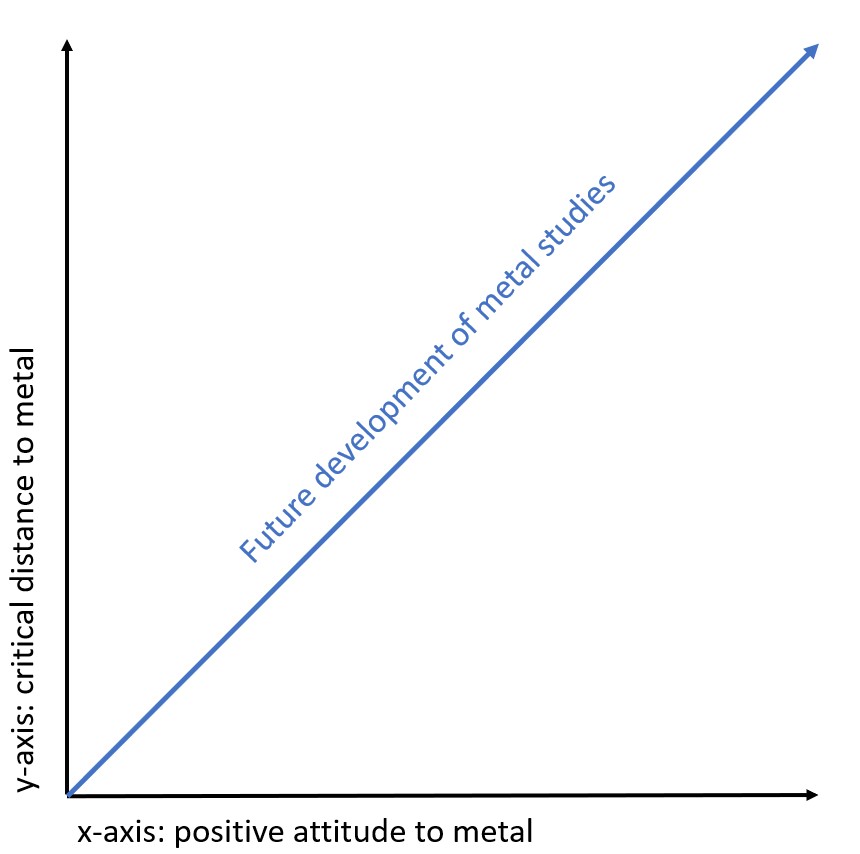
I ended my last post on the paradox at the heart of metal studies with the suggestion that cultural history, as one individual discipline in the transdisciplinary field of metal studies, could become an exciting enrichment. It gives us the promise of a structurally exploration of the the intertwined histories of fandom, scholarship and ‘fan scholarship’ in the field. In this (admittedly rather short) blog post, I take up this thought and attempt a first comparative analysis of ‘fandom’ and ‘scholarship’ as historically constructed cultural institutions. Once more, I take and stress the point of view of a historian.
There seems to be a consensus in metal research that the nexus between metal fandom and metal scholarship is a crucial one. In Salzburg, Keith Kahn-Harris and Rosemary Lucy Hill encouraged us to proactively embrace the arising tension between both by self-reflexively asking diffictult questions on racism, sexism, bigotry, misogyny, nazism and other critical phenomena in the scenes. In this, history with its focus on developments over periods of decades (for metal studies this means to study the whole period since the inception of metal culture around 1970) can provide a helpfully orientating narrative. ((Peter Pichler, Metal Music and Sonic Knowledge in Europe: A Cultural History Since 1970, Bingley: Emerald, forthcoming.))
Seen historically, both fandom and scholarship are not essentialist roles or identities but social formations, that both have long histories. The habitus, rituals and practices of that structure them can be traced back deep in history. If we view them as such complexes of historically constituted roles, the hybrid zone formed by them together in metal studies receives sharper contours. I start with fandom.
Fandom
Usually, metalheads are stereotyped as male, long-haired (semi-)adults wearing band t-shirts and battle vests. ((Once more, refer to Weinstein’s classic work: Deena Weinstein, Heavy Metal: The Music and its Culture, Boulder, CO: Da Capo Press, 2000; also, see Bettina Roccor, Heavy Metal. Die Bands, die Fans, die Gegner, Munich: Beck: 1998.)) Practices such as the formation of moshpits or showing the ‘metal horns’ at concerts complete the stereotypical imagery. They are expressions of scene members’ feelings of belonging to their communities, performed in public and addressing audiences within the scence as well as outside the scene.
If we take the point of view of cultural history things appear in another light. Popular culture – and fandom as a crucial functional position of people in it – have a history that in some of its forms can be traced back to early modern periods; at least to the 19th century, when mass media established new forms of public spheres for mass audiences. The masses became literate. ((For introductory texts, see LeRoy Ashby, With Amusement for All: A History of American Popular Culture since 1830, Lexington, KY: University Press of Kentucky, 2009; John Storey, Cultural Theory and Popular Culture: An Introduction, Harlow: Person, 2009; Kaspar Maase, Populärkulturforschung: Eine Einführung, Bielefeld, 2019.)) Thus, fandom is a cultural construction that, today, takes varying forms in different pop cultures (e.g. literature, music, film, gaming, sports etc.) but all of them stem from one root of comparable processes over decades, sometimes even centuries (as in the case of soccer culture or the passion for classical music).
Taking this view very much relativizes the allegedly absolute newness of metal fan culture since the 1970s. Yes, the practices installed over almost five decades in the global metal scene produced some innovative patterns; however, only being constructed after 1970, the new rituals, practices and scene rules built there heavily relied on what has been learnt, experienced and practiced in other fan cultures before Black Sabbath took the stage. So, metal fandom is a cultural institution that can best be studied in comparison to other forms of fandom in history. And even more crucial, it has to be compared to other cultural institutions.
Scholarship
Let us come to scholarship. At first glance, scholarship seems to be something completely different. Scholars usually are seen as rational, well-educated and distinguished personalities. Once more, the stereotype is a male one. Scholars wear glasses, speak of almost non-understandable things and live in the ivory towers of their universities. Yet, also scholarship – and the modern intellectual as a role in it – are historically constructed phenomena. The role of both cannot be separated from the history of the university in Europe and the world since the Middle Ages. ((For introductory texts, see Hilde de Ridder-Symoens et al., eds., A History of the University in Europe, 3 vols., Cambridge: Cambridge University Press, 1992-2004; Thomas Sowell, Intellectuals and Society, New York, NY: Basic Books, 2010; Dietz Bering, Die Epoche der Intellektuellen 1898–2001. Geburt – Begriff – Grabmal, Berlin: Berlin University Press.)) Since the Middle Ages, philosophers, scientists, theologians and intellectuals – scholars in a most broad sense – tell us how to make sense of the world.
As said before, this role appears to be very different from fandom. Nonetheless its realities work – basically and structurally – in ways comparable to any other spheres of community-building. Academia knows rituals, do’s and dont’s, forms of identity-building and othering. ((See Anthony Becher and Paul R. Trowler, Academic Tribes and Territories, 2nd edn., Buckingham: Open University Press, 2001.)) The essential question here is what sets this cultural institution, grown out of the tree of a history of almost thousand years, apart from other cultural institutions such as fandom.
Seen from this angle, what separates them and what makes them comparable at once belongs to the same sphere: their historical backgrounds. How, on the one hand, scholars use the centuries-old narratives of scientific wisdom in their lives and how, on the other hand, metal fans use their decades-old narratives of metalness can be compared, but only historically so. Both have come together in the history of the field of metal studies.
Metal studies as a transgressive laboratory of cultural institutions
What can we learn from this? If we take the point of view of history, metal music studies is they structural point where both histories come together. Seen this way, metal studies is nothing else than a cultural discourse, in which the insitutions of metal fandom and scholarship – with all their heritage – build a ‘match’. Thus, we should see the field as a transgressive laboratory, in which we work on these cultural institutions in the long term and, arguably, shape the new ‘sub-institution’ of the ‘metal scholar’. It is not about playing off one against each other but much more about thinking this new institution in visionary yet critical ways.