Category: Uncategorized

  • Das Ausblenden rechtsextremer Anklänge am Kaltenbach Open Air

    Im August geht in Spital am Semmering Österreichs größtes Extreme-Metal-Festival über die Bühne – samt Bands mit Nähe zum rechten Rand.

    (Der Text stellt die ungekürzte Fassung meines Artikels im “Standard” vom 13.9.2025 dar: https://www.derstandard.at/story/3000000287205/wie-ein-metal-festival-in-oesterreich-rechtsextreme-anklaenge-ausblendet)

    „Was ist das?“, fragt der Ordner, als er mich am Eingang zum Konzertbereich am Kaltenbach Open Air abtastet. Er trägt ein rotes T-Shirt mit dem Namen des Events. Ich ziehe meinen Schlüsselbund aus der Hosentasche, was er mit einem milde tadelnden „Verlier ihn nicht!“ quittiert.

    Am frühen Nachmittag des ersten Tags ist die Schlange kurz. Ich werde rasch in den eigentlichen Konzertbereich bugsiert. Man hat den Eindruck, die Schwelle zu einer Erlebniswelt zu passieren, in der alltägliche Benimm- und Geschmacksregeln außer Kraft treten.

    Im geschotterten Publikumsareal sind Band-T-Shirts und Jacken mit Band-Aufnähern („Kutten“) omnipräsent. Vereinzelt tragen Fans leichenblasse Schminke („Corpsepaint“). Kaum zu übersehen: schwere Schnürstiefel, Camouflage-Muster und nietenbewehrte Accessoires. Eine Frau mit pinken Haaren schultert einen Teddybär in Skelettoptik. Bei näherem Hinsehen entpuppt er sich als Rucksack. Alles in allem eine karnevaleske Atmosphäre.

    Publikum und Band während des Auftritts der dänischen Baest (Foto: Peter Pichler)

    In diesem Metal-Sanktuarium zwischen Sicherheitszäunen und Nadelbaumreihen verwandelt man sich nicht unbedingt in jemand anders. Man ist aber so weit aus dem Alltag gerissen, dass gewohnte Konventionen den Regeln dieses Mikrokosmos weichen.

    Der gute Ton ist laut

    Das Kaltenbach Open Air ist das größte Extreme-Metal-Festival Österreichs. Es findet immer im August, 2025 von 21. bis 23., im steirischen Spital am Semmering statt. Das Schigebiet Stuhleck wird von einer lauten Melange aus volkstümlicher Partystimmung und extremer Ästhetik überzogen.

    Die Klangflut von der Bühne ist auf Überwältigung angelegt. Im Verbund mit überall hörbarer Metal-Beschallung – aus Bluetooth-Boxen vor Zelten und allerlei sonstigen musikalischen Labestationen – ist das der Basisklang des Wochenendes. Von Donnerstagmittag, wenn die Konzerte starten, bis Samstagnacht, wenn das Licht ausgeht, vergisst man nie, wo man ist.

    Death und Black Metal bilden – neben anderen Subgenres – die wichtigsten Strömungen. Ästhetik und Klang sind seit ihrem Entstehen in den 1980ern auf das Sprengen von Grenzen getrimmt. Es geht um die Radikalisierung des Heavy Metal – Gitarrenriffs sind noch wuchtiger, Drums steigern sich zu maschinengewehrartigen „Blastbeats“. Gesang wird „guttural“ röchelnd bis hoch kreischend vorgetragen. Oft so, dass Texte unverständlich bleiben.

    Die Death-Metal-Gruppe Baest (Foto: Peter Pichler)

    Empowerment durch Stimmgewalt

    Das Grundkonzept bewegt sich an der Grenze des Akzeptierten – und weit darüber hinaus. Die permanente Grenzverschiebung kann emanzipativ wirken. Seit Jahren kultivieren ebenso Frauen im Death Metal das aggressive „Growling“ und überformen traditionelle Geschlechterbilder: Empowerment durch Stimmgewalt.

    Auch das Festival am Stuhleck bietet dem zuweilen einen Raum. 2024 trat die Grazer Band Reek of Death mit Vokalistin „Carry Størm“ in diesem Stil vor der Bergkulisse auf. Sie wünscht sich, junge Frauen zum eigenen Weg zu inspirieren.

    Absage und Kontroverse

    Die Liberalität hat aber Kipppunkte. Im letzten Winter entwickelte sich eine Debatte, in der dies deutlich wurde. Die Grazer Band Nekrodeus sagte ihren heuer geplanten Auftritt am „K.O.A“ ab. Sie nannte „politische und moralische Gründe“.

    Nekrodeus (Foto: Kuro Simon)

    Hintergrund war, dass zugleich Bands eingeladen worden waren, denen rechtsextremes bis neonazistisches Gedankengut vorgeworfen wird. Im Zentrum der Kontroverse standen zwei Black-Metal-Gruppen: Horna aus Finnland und Inquisition mit kolumbianisch-amerikanischen Wurzeln.

    In weiterer Folge wurde das Dokumentationsarchiv des österreichischen Widerstands (DÖW) auf dies aufmerksam. Im August schreibt das DÖW: „Horna veröffentlichte Alben bei einschlägigen Labels (…) zuletzt bei World Terror Commitee (W.T.C.), das von einem ehemaligen Mitglied der deutschen Band Absurd, einer Vertreterin des National Socialist Black Metal (NSBM), betrieben wird.“ Ein anderes ihrer Labels trägt den Namen „Zyklon B-Productions“. Ferner wird festgehalten, dass Mitglieder von Horna in Interviews die NS-Ideologie verharmlost oder positiv bewertet hätten.

    Auch bezüglich Inquisition fällt der Bericht höchst kritisch aus. Mitglieder von Inquisition seien „mit NS-verharmlosenden und antisemitischen Äußerungen“ aufgefallen und in der Labelwahl ähnliche Wege wie Horna gegangen.

    Das Zutreffen ist rasch festzustellen – eine kurze Online-Suche fördert die Veröffentlichungen auf den genannten Labels zutage und macht die strittigen Interviewpassagen zugänglich. Man kann von deutlich geäußerten rechtsextremen Statements und einer gut ersichtlichen Vernetzung zum rechten Rand sprechen.

    „So tun, als ob man es nicht besser wüsste“

    Dennoch hielt das Kaltenbach Open Air an seiner Einladungspolitik fest. Horna treten am Freitag auf, Inquisition am Samstag.

    Als Plattform des Festivals dient der „Kulturverein Oberes Mürztal“. Eine fast ironisch bürgerliche Etikettierung für das wenige Köpfe zählende Organisationsteam, das Bewahrung des „Underground“-Geistes der Szene als Mission sieht. Schon im Winter lancierte dieses Team bloß eine wenig aussagekräftige Stellungnahme, in der „Vielseitigkeit“ betont wird. Man solle „über den eigenen Tellerrand“ blicken, um „andere Meinungen zu respektieren, auch wenn man diese nicht immer gutheißen muss“. Festival und Horna antworteten auf aktuelle Anfragen nicht, Inquisition war nicht erreichbar.

    Abseits des Nicht-Diskurses stellt sich als zentrale Frage, warum eine freiheitszentrierte Subkultur so eklatante Verbindungen nach rechts außen bildet.

    Noch paradoxer erscheint, dass keineswegs nur Bands solchen Zuschnitts in den Kaltenbachgraben kommen. Entschieden linke Gruppen treten genauso auf – 2024 die englischen Napalm Death.

    Clemens „Cle“ Pecher, Podcaster, Musiker und Betreiber des Labels „grazil Records“ meint, dass das Open Air keinesfalls ein „Nazi-Festival“ sei. Als tief in die Szene eingewobener Akteur gibt er jedoch zu bedenken, dass gleichsam immer Bands anzutreffen seien, „die sich im Graubereich zum Rechtsextremismus bewegen“.

    Im Publikum sind keine Fans wahrzunehmen, die Rechtsextremes offensiv zur Schau tragen. Es geht um Subtileres: Ausblenden und Nicht-Abgrenzung. Die Erklärung findet sich in der Forschung des britischen Soziologen Keith Kahn-Harris. Für Ausblendungsmechanismen im Extreme Metal prägte er den Begriff der „reflexiven Antireflexivität“.

    Kein Metal ohne Metal Horns (Foto: Peter Pichler)

    Für den STANDARD erläutert Kahn-Harris, was er damit meint: „Kurz gesagt bedeutet es, so zu tun, als wüsste man es nicht besser, obwohl man es eigentlich doch weiß.“ Handeln und Selbstwahrnehmung werden zum Versuch, „bestimmte Themen aus der Betrachtung auszuklammern“. Dies hat zur Folge, dass in Musik und Ästhetik rechtsextreme Bilder Verwendung finden, zugleich aber behauptet wird, dass dies keine weiteren Auswirkungen habe.

    Bianca Kämpf, Rechtsextremismusforscherin am DÖW, ergänzt: „Fehlende Abgrenzungen werden häufig mit einer Selbstbeschreibung als ‚unpolitisch‘ erklärt.“ So wird es Festivalteams und Publikum möglich, „sich als vermeintlich neutral zu positionieren, sich nicht damit auseinandersetzen und keine Konsequenzen ziehen zu müssen.“

    Dröhnendes Ausblenden

    Gegen Ende meines Besuchs kann ich freitagabends mit allen Sinnen nachvollziehen, wie das funktioniert.

    Kurz vor 22 Uhr betreten Horna die Bühne. Der Publikumsraum ist ausgelastet. Sänger „Spellgoth“ übernimmt die Führung. Während des sechzig Minuten langen Auftritts inszeniert er sich ohne jede Ironie als satanistischer Ritualmeister. In theatralischen Ansagen erinnert er daran, dass der Leibhaftige das Maß aller Dinge sei. So weit, so genretreu.

    Etwas links vor mir in Richtung der Bühne ist eine Frau damit beschäftigt, ihr Bier Schluck für Schluck zu leeren und nichts zu verschütten. Noch weiter vorne rechts, in direkter Nähe der Bühne, verfällt ein junger Mann in schwarzmetallische Trance. Er headbangt ekstatisch.

    Beide verschwenden wohl gerade keine Gedanken an die rechtsextremen Ausritte von Musikern nur wenige Schritte vor ihnen – und wollen das zumindest im Moment auch gar nicht. Das Ausblenden des rechten Elefanten im Raum ist dröhnend laut.

    Mit den Füßen abstimmen

    Im Zuge der Recherche treffe ich eine Auskunftsperson, die aufgrund der Befürchtung negativer Konsequenzen auf Anonymität besteht. Mein Gegenüber kennt das Festival gut.

    Unser Gespräch fokussiert sich darauf, wie Abgrenzung besser gelingen kann. Es gibt konkrete Ratschläge: Man müsse sich die Mühe gründlicher Recherche machen. Einschlägige Labelwahl, Interviews und personelle Verknüpfungen können als handfeste Kriterien herangezogen werden.

    Das trifft sich mit dem, was Kahn-Harris „Abstimmen mit den Füßen“ nennt. Das Publikum hat in der Hand, welche Konzerte „sold out“ proklamieren können. Ebenso, wessen T-Shirts und Tonträger sich verkaufen. Man kann es noch differenzierter handhaben: Cle Pecher boykottierte am Kaltenbach-Festival bewusst einzelne Bands, die jenseits seiner Grenze liegen.

    Positiverweise gibt es immer mehr Gruppen, die die extreme Rechte ablehnen und das Wegsehen hinterfragen. Die mitunter zum Running Gag gewordene Floskel vom „unpolitisch sein“ als Ausflucht bekommt Risse.

    Etwa Nekrodeus sehen ihre Songs als Stellungnahme zu Rechtsruck und Rechtsextremismus: „Wir wollen uns als Personen klar von diesen reaktionären Menschen- und Gesellschaftsbildern abgrenzen und nutzen als Künstler dazu die Plattform, die wir uns mit unserer Musik geschaffen haben.“

    Campen, Black-Metal-Style (Foto: Peter Pichler)

    Headbangen ist Kopfsache

    Als ich das Gelände verlasse, komme ich an jenem Campinganhänger vorbei, der sich mir eingeprägt hat. Als launiger Sinnspruch wurde „Headbangen ist Kopfsache“ auf die Außenwand gesprayt. Man kann den Spruch auch so deuten, dass die volle Realisierung der Freiheit, die Extreme Metal beschwört, noch viel mehr Nachdenken und Hinsehen erfordern würde. Gerade, wenn das Lineup des „K.O.A“ 2026 bekanntgegeben wird.
  • Why we need metal (studies) to survive our present

    We live in uncertain times. Not a day goes by without us being inundated with bad news via news tickers and other digital channels. Ever since Steve Bannon’s dubious success, it has become clear that, in today’s digitally driven and AI-fuelled landscape of polarisation, ‘flood the zone with shit’ can be a recipe for success. Even liberal and high-quality media outlets are now under constant pressure to be visible and to be the loudest and most strident voice.

    From the war in Ukraine and climate change to the decline of democracy and the rise of authoritarianism, we live in a time when bad news is the norm. It’s only common sense that this oppressive atmosphere leaves us feeling affected. The constant feeling of latent danger and the vague sense that the world is hurtling towards disaster can thoroughly ruin our day. Needless to say, this doesn’t exactly put metalheads in a good mood. The world seems to have turned into a death metal song. Every day, it feels as though you could watch Putin, Trump and others pushing the world into the abyss at blast-beat speed. The next generation of extreme metal musicians will regard our era as the finest source of lyrical inspiration.

    Metal as healthy brainwashing

    How can you keep your brain healthy during times like these? I believe that subcultures such as metal, with their scenes and communities, can help us to cope. While metal may not fully prepare us for survival in a Thiel and Musk-esque apocalypse, it can offer some assistance. It provides a shared practice and soundscape for engaging playfully yet reflectively with the less pleasant aspects of this world. This is particularly pertinent when one consciously and reflexively engages with metal as a means of processing the crisis-ridden present and thinking critically about the world. This is precisely what good research in the field of metal studies achieves.

    But what exactly do I mean by that? Metal emerged in the late 1960s and early 1970s. It was a time of crisis and cultural reorientation, often referred to today as ‘1968’ and its aftermath. When I say that metal has developed into an impressive global music scene over more than five decades, I am not drawing up a comprehensive family tree of metal history. Nor is it an evergreen family tree, but a black one. Put simply, metal can be interpreted as an attempt to drown out times of crisis and fundamental change with loud riffs. Since ‘1968’, fans of hard rock music have been climbing on top of metre-high Marshall amplifiers to rise above the problems of their time.

    From Reaganomics to ‘Ride the Lightning’

    Back in the 1980s, the sound of thrash metal captured the sense of a world on the brink of change, as the Cold War was drawing to a close. ‘Ride the Lightning’ and ‘Reign in Blood’ were ultimately louder than Reaganomics. After all, Margaret Thatcher was the Iron Lady, and thus somewhat akin to metal, at least semantically. The extreme metal styles that became popular around the epochal year of 1989, particularly black and death metal, can be seen as reflecting the abrupt end of the era from 1914 to 1991. It is no coincidence that historian Eric Hobsbawm described this period as the ‘age of extremes’. A very rough historical rule of thumb might be that the history of metal reflects the history of the world (and vice versa).

    Why we need metal (studies) to survive our present

    I had the great pleasure of working with the following wonderful colleagues in metal studies: Anna-Katharina Höpflinger, Jörg Scheller, Laina Dawes, and Camille F. Béra. Together, we published the anthology ‘Meta/Metal: Open Questions in Metal Studies’, which was released as open access last week and can be read for free here.

    Drawing on metal and subculture, the excellent contributions in this volume address major issues of our time, such as the search for peace, better coexistence between people of different identities and backgrounds, despair over climate change and the general gloominess of the world, as reflected in black metal music. I believe that we need metal studies like this. They help us survive our present. They enable critical reflection on what is going wrong in the world.

  • Warum die John Otti Band keinen Death Metal spielt

    Aufwachen in einer neuen Welt

    Es sind nun über zwei Jahre vergangen, seitdem auf diesem Blog mein Beitrag zur Erfahrung von Metal und Metal Studies in Mexiko erschien. Seit damals ist im Bereich der Metal Studies, vor allem aber auch in der Welt überhaupt viel geschehen. Man könnte meinen, wenn man damals im Juli 2022 schlafen gegangen wäre und heute, im Januar 2025, wieder aufgewacht, es sei eine andere Welt.

    In den USA wird am 20. Januar 2025 Donald Trump seine zweite Amtszeit antreten. Eine Mehrheit der amerikanischen Wähler*innen hat sich für einen Politiker entschieden, der nicht nur bewusst lügt, sondern überhaupt keinerlei Grenzen im Regieren und seiner Machtausübung zu akzeptieren scheint.

    In Österreich hat sich nach den letzten Nationalratswahlen, bei denen die FPÖ stärkste Kraft wurde, eine mögliche Koalition von ÖVP, SPÖ und NEOS zerschlagen. Man kann dabei nur von einem Totalversagen aller Beteiligter sprechen. Sie ebnen einem Politiker einer Partei den Weg ins Bundeskanzleramt, die unter allen rechtsextremen und rechtspopulistischen Europas eine der radikalsten ist – und auch diejenige, die schon am tiefsten im medialen und politischen Betrieb angekommen ist. Und am schlimmsten daran: genau die hier gezeigten Verhaltensmuster der sich nicht einigenden anderen Parteien scheinen nur die Ressentimentfront im FPÖ-Handwerk zu bestätigen. Kurz, 2025 ist eine Welt, die wesentlich unsicherer erscheint.

    Popmusik und Heavy Metal in dieser anderen Welt

    Die Frage, ob Heavy Metal als einer der prägenden Popmusiken seit den 1980ern politisch oder unpolitisch ist, ist so alt wie Metal selbst. Die Antwort darauf hängt auch davon ab, wie man auf den Zusammenhang blickt. Unbezweifelbar ist, dass Popmusik, überhaupt jegliche kulturelle und künstlerische Betätigung und damit auch Metal im politischen Kontext entsteht; mit diesem verflochten ist und im Gehört- und Gespieltwerden auf diesen zurückwirkt.

    Heavy Metal, dem zwar oft ein konservativer Zug nachgesagt wird, welchen man in der Musiksprache und Ästhetik oft nicht lange zu suchen braucht, tritt trotzdem in der Regel freiheitsbetonend und freiheitseinfordernd auf. Eines der zentralen Kennzeichen von Metal in Ethos, Ästhetik und Klang ist Transgression, das bewusste Sprengen von zu engen Konventionen. Und noch mehr: die Geschichte der Entstehung und des Erfolgs des Metal setzte voraus, dass es künstlerische, soziale und politische Freiheit gab, die ihn ermöglichte.

    Man kann den Zusammenhang so pointieren, dass die Beziehung von Metal und politischer Freiheit jene ist, dass Metal nur dann blühen kann, wenn er frei existieren und sich entfalten kann; wenn Kreativität, Spiel und Fortentwicklung angstfrei für Künstler*innen und Hörer*innen gesichert sind; wenn ein gesellschatliches Klima herrscht, das nicht auf Bedrohung und Demütigung der “Anderen” (man darf dafür einsetzen, was man für passend hält) basiert. 2025 hat viel Potential für eine Welt, in der dies nicht mehr wie bisher sein könnte.

    Wider die John Otti Band als Rolemodel

    Man kann sich dazu auf ein Gedankenexperiment einlassen und die 1980er, als Metal in der Steiermark und Österreich voll ankam, verändert vorstellen; sich vorstellen, dass eine Partei geherrscht hätte, die Kultur so versteht, dass alles jenseits von Aufsteirern und Musikantenstadl bedroht und beschimpft worden wäre; die jegliche Kunst, die etwas wehtut, ob Museum, Literatur oder Theater als “Nestbeschmutzung” und schlimmer tituliert. Unter der Ägide dieser Partei ist es schwer vorzustellen, dass genug Freiheit geherrscht hätte, eine bis heute prosperierende Metal-Szene zu etablieren.

    Sieht man sich Live-Streams von FPÖ-Parteiveranstaltungen an, wird der Zusammenhang noch klarer. Im Bierzelt gestaltet die John Otti Band den Soundtrack zur “Festung Österreich”. Stilistisch dumpf, gedanklich einfach, die Menschen klanglich in ihrer Festung einsperrend. In einer Welt, in welcher Kultur, Musik, Politik und Gesellschaft nach diesem Maßstab funktionieren, ist Feuer am Dach. Und genau aus diesem Grund spielt die John Otti Band keinen Death Metal. Wenn die Welt schon vor vierzig oder fünfzig Jahren so freiheitsfrei getickt hätte, würde es weder Metal noch Metal Studies geben.

    Genau aus diesem Grund sollten auch wir in den kommenden Wochen und Monaten sehr gut darauf achten, dass dieses Rolemodel, seine Vetreter*innen und Politiker*innen nicht unsere Freiheit gefährden. Lasst das Modell John Otti Band dort, wo es hingehört.

  • Writing about writing about heavy metal, part four: how do you explain (Styrian) heavy metal?

    Since my last blog post on the “Mexican experience” of writing about metal, quite some time has passed. Also in writing my book about the history of the Styrian heavy metal scene. At the moment, the focus of the writing is on the phase of the 1990s with its pluralisation tendencies and the 2000s with the beginning digitalisation of the scene.

    What is formative for this phase and therefore now also characterises the reflection on writing are both continuities and processes of change in the Styrian metalness identity in those years compared to the 1980s as the founding period. The scene consolidated and pluralised in the 1990s, finally becoming digital around 2000.

    In writing, this touches on a theoretical core question of metal studies, namely how heavy metal (in Styria) can be theoretically explained. For these decades, the history of the Styrian metal scene is about determining the interplay of law, morality and sound for the construction of the local metalness identity. There is the “pure” historiographical, the “pure” musicological and the “pure” legal view – or the possibility, which seems wiser to me, of thinking all three integrally and together.

    It therefore seems most appropriate to me at this stage of writing to see the history of metal in Styria since 1990 as a “hybrid” of musical, moral and legal aspects. All together make up the specific “soundness” of this scene. Metal can therefore perhaps be explained as the “trinity” of law, morality and sound – at least in this specific scene at this specific time.

  • Tau Cross’ second album ‘Pillar Of Fire’: contemporary history of the world in 2017 as hybrid Metal music

    In June 2015, I published a reflection on multinational ‘supergroup’ Tau Cross’ (with members of Voivod and Amebix) eponymous first album. To me, it appeared to be a reflection of the world in 2015, which already knew developments of crisis in economies, politics, migration scenarios and many other areas of culture and their discourses. I coined their music a brand of ‘new music for a new age’ – but, this phrase and description was followed by a question mark. I was not effectively sure, from a cultural historian’s point of view, whether and how their postulate of ‘newness’ in music, meaning most of all cultural innovation, was really producing innovative patterns of culture.

    My uncertainty stemmed from my analysis of the band’s music and discourse. Actually, I came to the conclusion that Tau Cross created a new form of music, and celebrated an innovative cultural-historical discourse. Yet, they used known and well-known elements from different subgenres of Rock and Metal music to create their own hybrid sound. This comprised artistical elements, in both music and lyrics, from Thrash Metal, Punk and Hardcore Punk, Crust, and Folk Music.The most distinctive and hence element that ‘bracketed together’ their music and discourse together were Rob ‘The Baron’ Smith’s unique, monotonous rough vocals.

    This cultural mode of production in Metal music, hybridizing elements from Thrash Metal, Punk and Hardcore Punk, Crust, and Folk Music, writing apocalyptic and doomy, most dark lyrics, gave birth to Tau Cross’ own message in discourse. Their singer’s rasp voice was the perfect medium to perform and tell this picture and allegory of the world in 2015: basically, this message was one of hybridity and mélange – to cope with the difficulties of 2015, meant to perform an eclectic set of mind in the construction of identities.

    According to Tau Cross’ discourse of cultural history of the world in 2015, to live positively, or to at least be able to survive, one needed to construct an identity which accepted and tolerated facets of belief, behavior, rules, ethics and politics from very different sources. It was a message of existential postmodernism, of relativism, liquidity and an ever-changing flux of identities in which their discourse saw a fitting modus vivendi for 2015. ((Cf. Zygmunt Bauman, Liquid Modernity, Cambridge: Polity Press, 2000.))

    However, this was their discourse  of Metal music in 2015. In 2017, Tau Cross released their second album ‘Pillar Of Fire’. ((Cf. Tau Cross, Pillar Of Fire, Relapse Records, released 21/07/2017.)) Again this is a very allegoric and metaphorical title which can be intepreted in many different, positive and/or negative ways. Taken that their debut from 2015 was a statement to cope with the then world by promoting hybrid identities, what is their current discourse about, analyzed from a cultural-historical point of view? The years since then have changed the world – we face Donald Trump as the president of the United States, the ongoing negotiations on the ‘Brexit’ in Europe, globally the rise of right-wing populism and the spread of terrorism.

    Is hybridity, or maybe an even greater relativsm and hybridity, in the shape of irony or nihilism, today’s message in ‘Pillar Of Fire’s discourse? At the moment, because of the record’s very mythological and metaphorically open lyrics ((Cf. ibid.)), and its very recent release, having only gotten a part of its expectable reception, we do not know exactly. But we can assume that the album’s title track, for it is the song that performs the album’s title-message, contains its discourse’s main narrative:

    Oh no, they’re burning their Gods again, the sacred and the profane
    A pillar of fire

    My my, its crawling beneath my skin. The visions are crowding in
    My Heaven and Hell
    From the garden of the dawn, to the ocean night

    All is said and all is done
    And nothing new beneath our sun
    All we built and all we knew
    Is turned to dust, just me and you
    Falling through the universe

    Hey hey, the Gods have all gone away
    The people have learned to pray
    To a pillar of fire
    And these dark cathedral spires, point like fingers to the skies
    Accusingly accusingly, accusingly, the question always why

    I’m looking down, at a body on a table looking up
    I’m looking down at the body on the table…looking up
    And all we are is held by silver thread
    Sewn into the earth, sent back to the dead. ((Source: ‘Pillar Of Fire’, released on ibid.))

    The lyrics open with the phrase ‘Oh no, they’re burning their Gods again, the sacred and the profane. A pillar of fire (…)’. So, a pillar of fire, is a fire which burns the world’s gods. Gods can be conservative and overcome policies, morals, religions, in a nutshell: worn-out identities. Supposed, in 2017 our culture seems to burn its old identites, it afterwards has to generate new ones. How to find or construct these new ones, in 2017’s world of terrorisms, fear, populism and crisis? Maybe we just have to read on to find the answer, according to Tau Cross:

    All is said and all is done
    And nothing new beneath our sun
    All we built and all we knew
    Is turned to dust, just me and you
    Falling through the universe. ((Source: Ibid.))

    If there is nothing new beneath our sun, there are only old and used things of culture – like Thrash Metal which has been there since the early 1980s; like Punk, Hardcore and Crust which stem from even the decade before; like Folk Rock which became succesful in the 1960s. Yet, again Tau Cross hybridize their elements of identities very conservatively – again Rob Miller’s vocals shape their discursive leitmotiv. What does that mean? In 2017, still and even more radical, Tau Cross emphasize postmodernist ‘hybridism’ to be the way of cultural choice. We have to build a ‘pillar of fire’ in which to burn our old identities – just to build new ones from new ways of combinations.

  • Metal Music Studies go global: academic boundaries, ties and identities

    From June 6th to June 16th 2017, I had a rather long travel: from Graz, Austria, to Victoria, British Columbia, Canada; then heading over to Norwich, Great Britain, and finally going back to Graz. In Victoria, at the University of Victoria (UVIC), I had the immense pleasure to be a part of the International Society for Metal Music Studies’ (ISMMS) 2017 conference, devoted to the topic of ‘Boundaries and Ties: the Place of Metal Music in Communities’. Over three exciting days, scholars, musicians and practitioners from all over the world, had intriguing talks on different facets and aspects of the liaison dangereuse between the local and the global in Metal culture.

    Many talks focussed on Extreme Metal culture. My own talk took up the topic of one of my blogposts from 2016. I tried to conceptually come to the terms with the relationship between globalization and localization in Metal culture, taking the Metal on the Hill 2016 Extreme Metal festival as an empirical example. After the conference on Metal in Canada,  I flew straight to London, passing on to Norwich where I had a talk at the annual conference of the Research Network on the History of the Idea of Europe, devoted to the subject of ‘Europe and the East: Self and Other in the History of the European Idea‘.

    (Re-)Reflecting on this ten days, flying almost over 20.000 kilometers and having scientific talks on two very different topics, on two continents, in front of two very different academic communities, I do not want to analyze or present my talks themselves. Much more, to me, the interesting aspect of this (rather exhausting) trip is how it happened: a cultural historian from Graz, Austria, who normally teaches und publishes on European Union Cultural History, left his European (home-)continent to fly to another continent, Northern America, where he gave a talk on his local Metal scene.

    After this ‘breaching’ of my used geographical, thus spatial and temporal, even topical boundaries in academic discourse, I went back to my home-continent (after the ‘Brexit’, I still consider Britain to be a part of Europe) to have a talk on my home-topic of EU studies. I feel, this is a very interesting combination of spatial and temporal structures of discourse in itself. What happened?

    As a scholar of the rather ‘conservative’ and ‘established’ field of EU studies, I left behind my used academic  territory of the ‘EU scholar’, also leaving the continent linked to this discourse (Europe). By flying to Canada, I spatially and temporally ‘stripped’ myself of my ‘EU scholar’- videntity and literally dressed up in the clothes of a ‘Metal Music Studies scholar’: when speaking in Victoria, I wore a Metal t-shirt of German band ‘Tranquillizer’.

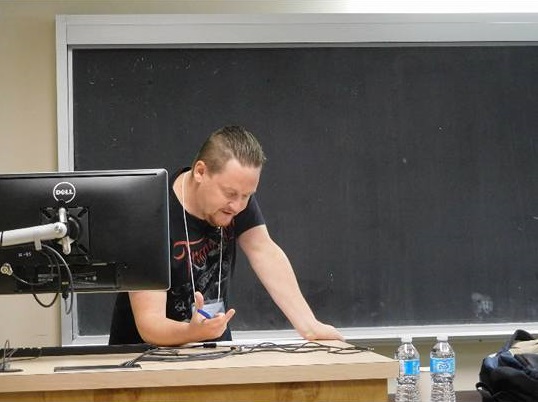
    ((The author giving his talk at UVIC’s conference on ‘Boundaries and Ties: the Place of Metal Music in Communities, 11th June 2017, potograph by Anna Chilewska.))

    In a nutshell, this on a first glance rather mundane process of breaching temporal, spatial and identitary boundaries can tell us something important about scientific discourses in general, and Metal Music Studies as a discourse of its own. (1) First, it shows very clearly that scientific discourses (like EU studies) are closely linked to spatial and temporal contexts. Most of all, EU studies as a discourse, takes place in Europe itself, and the identity of the ‘EU scholar’ is tied to his subject-continent.

    (2) Second, Metal Music Studies as an  emerging scientific discourse had the power to make me break my usual boundaries in academia. It made me go to North America, leaving Europe behind, and somehow even forced me to strip off my used scholar’s identity. This is a very symbolical hint at the often subtle transgressive power of Metal: it pushes forward to transgress existing boundaries, something Keith Kahn-Harris tried to capture in his concept of ‘Metal beyond Metal’.

    This leads to a simple yet exciting thought and argument which needs much more further reflection and work on it: Metal Music Studies implements the globalizing and identity-shaping potential  of Metal (‘Metal beyond Metal’) into academia. It is not only mere scientific reflection and writing but the construction of a new global research identity, having practices of its distinct own.

    However, this means this new field is not very conscious of itself yet – it needs a lot more of theoretical self-reflection. For example, it would form an exciting project to edit a volume on different theoretical approaches in Metal Music Studies, shaping its subject from the various involved disciplines’ (musicology, cultural studies, sociology, anthropology, history, communication studies, business studies, gender studies) perspectives.

  • ‘Metal On The Hill 2016’: A ‘Thick Description’ of a Cultural Historian’s Imagination at an Extreme Metal Festival

    The context

    One week ago, on 13. August 2016, being a Metal music fan, I attended the ‘Metal On The Hill 2016’ ((Cf. http://www.metal-on-the-hill.com/, retrieved 20.08.2016.)) festival, a festival of Extreme Metal, organized by a Styrian Heavy Metal label, which took place on the ‘Schlossberg’ and its ‘Kasemattenbühne’ in the city centre of Graz. The location is an old vault with brick walls, which used to be the storage of the town’s castle since Renaissance days. ((Cf.  www.graz.at., retrieved 20.08.2016.)) It was re-functioned as a ‘Freilichtbühne’, an open-air arena under historical auspices, in recent time. There, at the historical centre of the regional area of Styria, for the first time, an Extreme Metal festival took place.

    This is not only another indication that Metal reaches the cultural mainstream but it means that, spatially and metaphorically, the performance of Extreme Metal music reached the heart of an old – historical – Austrian and European city. Graz, being the second largest urban area of Austria, having about 250.000 inhabitants, ((Cf. ibid.)) is, thus, a kind of a cultural ‘avantgardian’ of Austria and Europe: it integrates Extreme Metal into its cultural narrative. For sure, that Napalm Records, ((Cf. https://shop.napalmrecords.com/, retrieved 20.08.2016.)) the label which organized the festival, originates from Eisenerz, Styria, favoured this process.

    What I want to reflect on in this article, is the imagination and experience of a cultural historian, at the same time a Metal music fan, attending this festival. I want to employ the theory of ‘thick description’, developed by anthropologist Clifford Geertz in the 1970s, ((Cf. Clifford Geertz: Thick Description: Toward an Interpretive Theory of Culture”. In The Interpretation of Cultures: Selected Essays. New York 1973, 3-30.)) on this imagination and experience. I want to do a thick description of a cultural historian’s imagination in Extreme Metal music, at a certain place, at a certain time of contemporary history.

    Coming to the arena: a conservative experience

    On the day of the festival, 13. August 2016, I arrived at the Kasemattenbühne at about 2 p.m. There was already a rather big crowd. My first impression was that it was going to be well received and well attended. The location was situated beneath a modern roof, but, actually, it was a place of history, of ‘old Graz’ which I grew up in:

    IMG_2060 (( The Kasemattenbühne; photo: Peter Pichler. ))

    Like this, coming to the arena of Kasemattenbühne, I felt to be a part of Graz’ and Styria’s history and the imagined community of Metal music, at once . This is a rather peculiar and new, almost innovative finding of research: so far, Metal music and its cultural discourse has claimed to be emancipative; a transformative force of culture. ((Cf. Jeremy Wallach e.a. (eds.): Metal Rules the Globe. Heavy Metal Music around the World. Durham & London 2012. )) Being at the Metal On The Hill festival, for me, was a conservative experience: it was an experience of Heavy Metal music happening within the ‘old’ framedwork of my regional belonging and history. It was a conservative experience – but still there was the imaginary and culture of rebellion, anarchy and ‘being against the establishment’ that forms the cultural core narrative of Metal music.

    Experiencing conservative anarchism

    The billing of the festival featured many long-standing successful bands  and ‘newcomers’ in Extreme Metal: Moonspell, Mantar, Satyricon and Arch Enemy were some of the main acts. ((Cf. ibid.)) Too, there were some bands which one could call Alternative Metal or Rock: And Then She Came  from Germany and Italian group Lacuna Coil were this side of the festival. The festival lasted from about 2 p.m. to 10:30 pm. Hence, it was  about eight hours of dense music and images of Metal culture, most of all Extreme Metal discourse:

    IMG_2064 ((And Then She Came; photo: Peter Pichler.))

    IMG_2096 ((Mantar; photo: Peter Pichler.))

    IMG_2175 ((Moonspell; photo: Peter Pichler.))

    IMG_2215 ((Lacuna Coil; photo: Peter Pichler.))

    IMG_2233 ((Satyricon; photo: Peter Pichler.))

    Taking a look at these pictures, makes very clear that the festival, as experienced by myself as a ‘metalhead’ and cultural historian at once, but by many other people in the ‘crowd’, too, was a a classical Heavy Metal experience; in terms of sound, sphere and imaginary. It was loud, it was crowded, and it was full of symbolism of riot, of revolution, of satanism and anti-christianism (Satyricon), as well as mysticism (Moonspell). It was a mixture of brutality and mythology.

    That was the feeling of the metalhead in me. But, the cultural historian in my head acknowleged something else. At Metal On The Hill 2016 festival, Extreme Metal (noise, brutality, satanism, mysticism, crowdedness, Extreme Metal identity) took place within the space of common Styrian history. Its discourse progressed to the heart of Styrian regional and local history, spatially embodied by the Kasemattenbühne on the Schlossberg, in the city centre of Graz. So, for me as a cultural historian, I imagine the festival to be a discourse of conservative anarchism.

    A thick description of conservative anarchism

    So, looking back at my personal and professional experience at this festival, it is a form of memorial and cultural imagination of the past which can be called a ‘thick description’ of conservative anarchism. We have to be aware of the very fact, also in the case of this festival, that Heavy Metal is marching into cultural mainstream. This process changes its identity and discourse. It makes its discourse become attached to conservatism but at the same time Heavy Metal and Extreme Metal stick to their imaginary of anarchism and other ‘blackisms’. Thus, when trying to give a cultural-historical description of the 2016 Graz  Metal On The Hill festival as a cultural event, it has to be seen as a play of conservative anarchism. It was an event where old and new, regional history and Heavy Metal culture met: what we do have to expect from that rendez-vous, I do not know. But, it is very likely that it will change both – conservatism and Metal culture.

  • Die derzeitige Situation der Welt und Europas im Kontext der harten Musik: “Rust In Peace”?

    Wenn man sich derzeitig in Europa und der Welt bewegt, noch dazu als Historiker, der es sich zur Aufgabe gesetzt hat, die Welt im Werden zu sehen, kann es einem schaudern: In Österreich wird ein Poltitiker der Freiheitlichen Partei Österreichs klarer Favorit zur Stichwahl zum Bundespräsidenten, der sich nicht verübelt, als solcher Kandidat mit Symbolen des Deutschnationalismus aufzutreten; sowie überhaupt die Rolle des Bundespräsidenten im Verfassungsrang zu verschieben. Sein linksliberaler Gegenkandidat hat wohl daher schlechte Karten, da sein Portfolio “grün” assoziiert ist, und das ist im Jahr nach der “Flüchtlingskrise”, mit umgehender Angst vor dem Fremden (wieso auch immer), ein höchst schlechter Kredit.

    Der Wiener Historiker Wolfgang Schmale hat die momentane Situation, in der wir uns leider befinden, als “Massaker an der Sprache der Freiheit” charakterisiert. Und er hat Recht: In ganz Europa, nein, eigentlich gobal, werden all die Diskurse, die sich auf Toleranz, Miteinander, Überbrückung der Grenzen, Transkulturalität, Emanzipation, ja, ich wage es zu sagen, Europa, beziehen, mit Füßen getreten. Wir erleben eine Gegenwart der Diskurse, die Authentizität in einer Zeit sucht, die Horror hervorbrachte: die 1930er-Jahre. In den 1930er-Jahren, Österreich bis 1934 und 1938, in Deutschland nur bis 1933, gab es ein Schwanken zwischen Pluralismus und monolithisch-nationaler Auserwähltheit, aber – wie wir alle bestens wissen – scheiterte  es am nationalen Denken.

    Natürlich, der Mai des Jahres 2016 ist nicht der Januar des Jahres 1933 – aber wir haben in Europa folgenden “Schatz” der Gegenwart: Nationalisierung, Viktimisierung, Zerstörung des Transnationalen, Zerstörung des Respekts und Zerstörung der Würde unser aller; die “driving force” des allen ist die Angst vor dem Diffusen der Globalisierung und den Krisen unserer Zeit, in der die Nation die “Antwort” und “Rettung” zu sein scheint. Sie kann es nicht sein, weil die Nation im Globalen eben nur die Nation ist – sie ist nicht EUropa, sie ist nicht die Welt. Kurz, wir brauchen einen Weg nach EUropa, einen Weg in die Welt. Um den drohenden Horizont mit Megadeth zu beschreiben:

    Tremble you weaklings, cower in fear
    I am your ruler, land, sea and air
    Immense in my girth, erect I stand tall
    I am a nuclear murderer I am Polaris
    Ready to pounce at the touch of a button
    My system locked in on military gluttons

    I rule on land, air and sea
    Pass judgment on humanity
    Winds blow from the bowels of hell
    Will we give warning, only time will tell
    Satan rears his ugly head, to spit into the wind

    I spread disease like a dog
    Discharge my payload a mile high
    Rotten egg air of death wrestles your nostrils
    Launch the Polaris, the end doesn’t scare us

    When will this cease
    The warheads will all rust in peace
    Bomb shelters filled to the brim
    Survival such a silly whim
    World leaders sell missiles cheap
    Your stomach turns, your flesh creeps

    High priest of holocaust, fire from the sea
    Nuclear winter spreading disease
    The day of final conflict
    All pay the price
    The third world war
    Rapes peace, takes life
    Back to the start, talk of the part
    When the earth was cold as ice
    Total dismay as the sun passed away
    And the days where black as night

    Eradication of earth’s
    Population loves Polaris. ((Quelle: Lyrics zum Song “Rust In Peace…Polaris” vom Album “Rust In Peace”, 1990.))